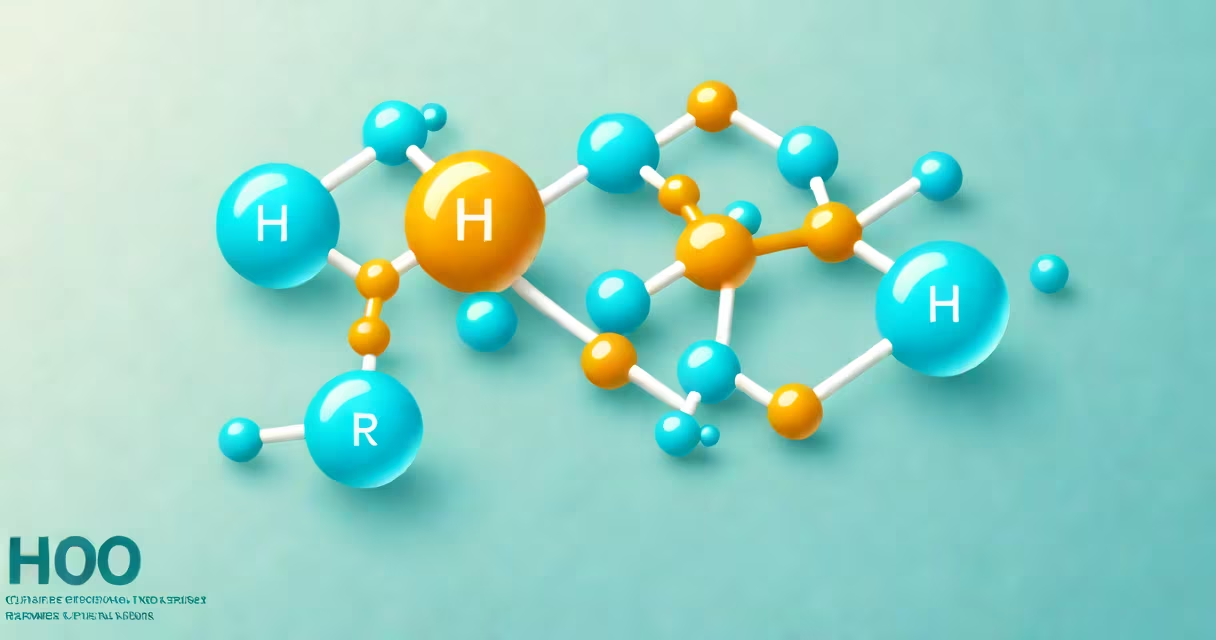
Water's chemical name is dihydrogen monoxide, and its chemical formula is H₂O. This means each molecule consists of two hydrogen atoms covalently bonded to one oxygen atom.
Water forms when two hydrogen atoms share electrons with one oxygen atom through polar covalent bonds. The oxygen atom attracts electrons more strongly than hydrogen, creating a partial negative charge on the oxygen and partial positive charges on the hydrogens. This polarity enables water to dissolve many substances and form hydrogen bonds with other molecules.
Despite its simplicity, H₂O exhibits unique physical properties. It expands when freezing, floats as ice, and has high surface tension. These traits stem from hydrogen bonding between adjacent water molecules, which creates a stable network in solid and liquid states.
Each water molecule results from a reaction between hydrogen gas (H₂) and oxygen gas (O₂), typically initiated by heat or electrical energy. The balanced equation is:
2H₂ + O₂ → 2H₂OThis reaction releases significant energy - about 286 kJ per mole of water formed - making it highly exothermic. Natural processes like combustion and cellular respiration produce water as a byproduct.
Individual water molecules do not exist in isolation. In liquid water, they constantly form and break hydrogen bonds. A single water molecule can bond to four others at once, creating a changing, tetrahedral network. This network accounts for water's high boiling point (100°C at sea level) compared to similar-sized molecules like methane (CH₄), which boils at -161°C.
Water exists in three primary states: solid (ice), liquid (water), and gas (steam or water vapor). The state depends on temperature and pressure. At standard atmospheric pressure, water freezes at 0°C and boils at 100°C.
| State | Molecular Arrangement | Physical Properties |
|---|---|---|
| Solid (ice) | Hexagonal lattice with fixed hydrogen bonds | Less dense than liquid water; floats |
| Liquid | Transient hydrogen bonds; constant reformation | High heat capacity; excellent solvent |
| Gaseous (vapor) | Isolated molecules; minimal interaction | Expands to fill container; invisible |
Water can also exist in supercooled or superheated states under controlled conditions. For example, researchers have observed liquid water at temperatures below 0°C in micro-droplets, though such states are unstable and rare in nature.
Water is often mislabeled as "H₂O" in casual speech, but this term refers specifically to pure water. Natural water contains dissolved ions, gases, and organic compounds. Tap water may contain calcium, magnesium, chlorine, and fluoride - all altering its chemical makeup beyond pure H₂O.
Some confuse water with hydrogen peroxide (H₂O₂), which has an extra oxygen atom. Hydrogen peroxide is toxic and used as a disinfectant. Its formula differs by one oxygen, yet the similarity in naming leads to dangerous mix-ups. According to the CDC, accidental ingestion of H₂O₂ causes gastrointestinal bleeding and tissue damage.
A lesser-known fact: water molecules rotate rapidly in liquid form. Each molecule reorients itself approximately 10¹² times per second. This motion contributes to water's ability to transfer heat efficiently and supports life processes like nutrient transport in cells.
In human cells, water makes up about 60% of body mass. It serves as a medium for biochemical reactions, regulates temperature, and transports nutrients and waste. For instance, blood plasma is 90% water, enabling red blood cells to move freely through capillaries.
Consider a 70 kg adult. Their body contains roughly 42 liters of water. If this were distilled H₂O, it would weigh 42 kilograms. But due to dissolved salts and proteins, actual blood volume is slightly denser. The difference illustrates how biological systems modify pure water chemistry.
During dehydration, even a 2% loss of body water impairs cognitive function. Studies show reduced concentration and memory performance at this threshold (National Center for Biotechnology Information). This underscores that water's role extends beyond its chemical formula - it's essential for maintaining physiological balance.
While water is H₂O, related compounds differ in structure and behavior. For example, heavy water (D₂O) replaces hydrogen with deuterium, a heavier isotope. D₂O has a higher density and boiling point (101.4°C) and is used in nuclear reactors as a neutron moderator.
Another comparison: carbon tetrachloride (CCl₄) has a central carbon bonded to four chlorines. Unlike water, it is nonpolar and immiscible with water. This contrast highlights how molecular geometry affects solubility and reactivity. CCl₄ was once used in dry cleaning but is now restricted due to toxicity (EPA).
Understanding water chemical name and formula helps explain why water behaves uniquely among small molecules. Its polarity, hydrogen bonding, and phase transitions make it indispensable in nature and industry.
Water chemical name and formula is H₂O - a deceptively simple combination that shapes Earth's climate, biology, and chemistry.