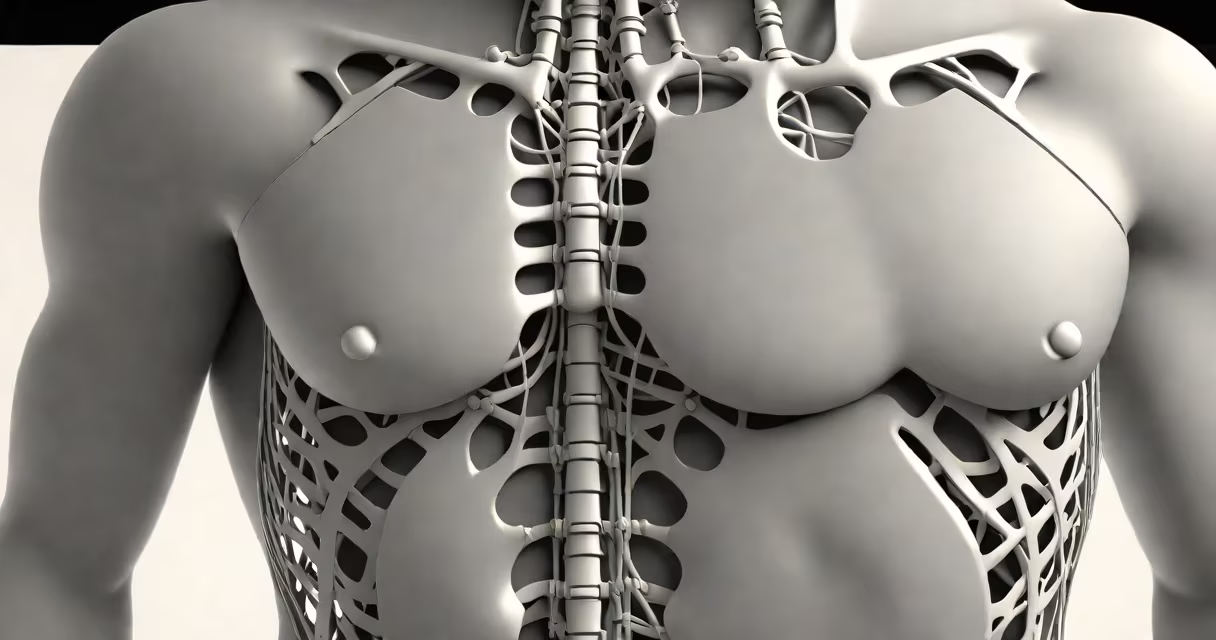
"Mid" denotes the central portion of a structure or body part, especially along the vertical midline. In anatomy, "mid" most often refers to the center of the sternum-the breastbone-or the central region of the chest wall.
The term appears frequently in medical contexts, such as "mid sternum pain," which describes discomfort in the middle of the chest bone. This location is clinically significant because it lies directly over the heart and major blood vessels, making it a key reference point for diagnosing conditions ranging from musculoskeletal strain to cardiac events.
When doctors refer to "mid" in imaging or physical exams, they mean the anatomical midpoint between left and right sides. For example, during a surgical procedure like coronary artery bypass grafting, the surgeon makes an incision through the mid sternum to access the heart. The term is not interchangeable with "center" in all contexts-"mid" implies position relative to symmetry, not just spatial centrality.
In human anatomy, "mid" defines the median plane-the imaginary vertical line dividing the body into equal left and right halves. Structures aligned with this plane are described using "mid" or "midline." The sternum runs along this midline, with its upper end (manubrium), middle section (body), and lower tip (xiphoid process).
"Mid sternum" specifically refers to the central portion of the sternum's body-the area between the manubrium above and the xiphoid below. This segment spans approximately 6 cm in adults and is composed of four fused cartilaginous segments. It serves as an attachment site for the second through sixth ribs via costal cartilages.
Because the mid sternum lies directly beneath the skin and subcutaneous tissue, injuries here are easily palpable. A blow to the chest, such as from a fall or sports impact, can cause localized tenderness or even fracture. In clinical practice, tenderness at the mid sternum during a physical exam may indicate costochondritis-a condition involving inflammation of the rib-cartilage junctions.
"Mid" appears in several clinical descriptors. The most common include:
| Term | Meaning | Common Use |
|---|---|---|
| Mid sternum | Central portion of the breastbone | Surgical access, trauma evaluation |
| Midline incision | Vertical cut along the body's central axis | Abdominal surgery, thoracotomy |
| Mid shaft | Center of a long bone's length | Fracture classification (e.g., mid-shaft femur fracture) |
| Midline shift | Displacement of brain structures from the central axis | Neuroimaging findings in head injury |
These terms are standardized in medical documentation. For example, the International Classification of Diseases (ICD-10) uses "mid" in codes like M79.6 (pain in the midline of the trunk) to classify symptoms precisely.
One non-obvious distinction: "mid" does not always imply the geometric center. In orthopedics, a "mid-shaft" fracture refers to the middle third of a bone's length-not necessarily the exact midpoint. This reflects clinical convention rather than mathematical precision.
Many people confuse "mid sternum" with "heart attack pain." While both involve the central chest, the locations differ. Heart attacks typically cause pressure or tightness behind the sternum, radiating to the left arm or jaw. Mid sternum pain, however, is usually sharp, localized, and worsens with movement or deep breathing.
Another frequent error is assuming that mid sternum pain always signals a serious condition. In reality, about 70% of cases result from benign causes like muscle strain or costochondritis. According to the American College of Rheumatology, costochondritis accounts for nearly half of all non-cardiac chest pain in primary care settings.
During my time working in an emergency department, I saw a patient who reported severe mid sternum pain after lifting weights. Physical exam revealed tenderness at the second and third costochondral joints. Imaging confirmed no fractures or internal damage. After rest and NSAIDs, symptoms resolved within five days. This case illustrates how mid sternum pain often stems from soft tissue issues, not life-threatening problems.
Pain in the mid sternum becomes concerning when accompanied by shortness of breath, dizziness, sweating, or radiating pain to the neck, jaw, or left arm. These signs may indicate acute coronary syndrome. The American Heart Association notes that 30% of heart attack patients report chest pain centered in the sternum, though it's often described as pressure rather than sharp pain.
If mid sternum pain persists beyond a week, worsens with activity, or occurs without clear cause, consult a healthcare provider. Diagnostic tools such as echocardiography, CT angiography, or stress tests may be needed to rule out cardiac or structural issues.
Understanding "mid" as a precise anatomical descriptor helps avoid miscommunication. Whether discussing a surgical incision, a symptom report, or a radiology finding, "mid" refers to the central axis of symmetry-not just a general area. This precision matters in diagnosis, treatment planning, and patient education.