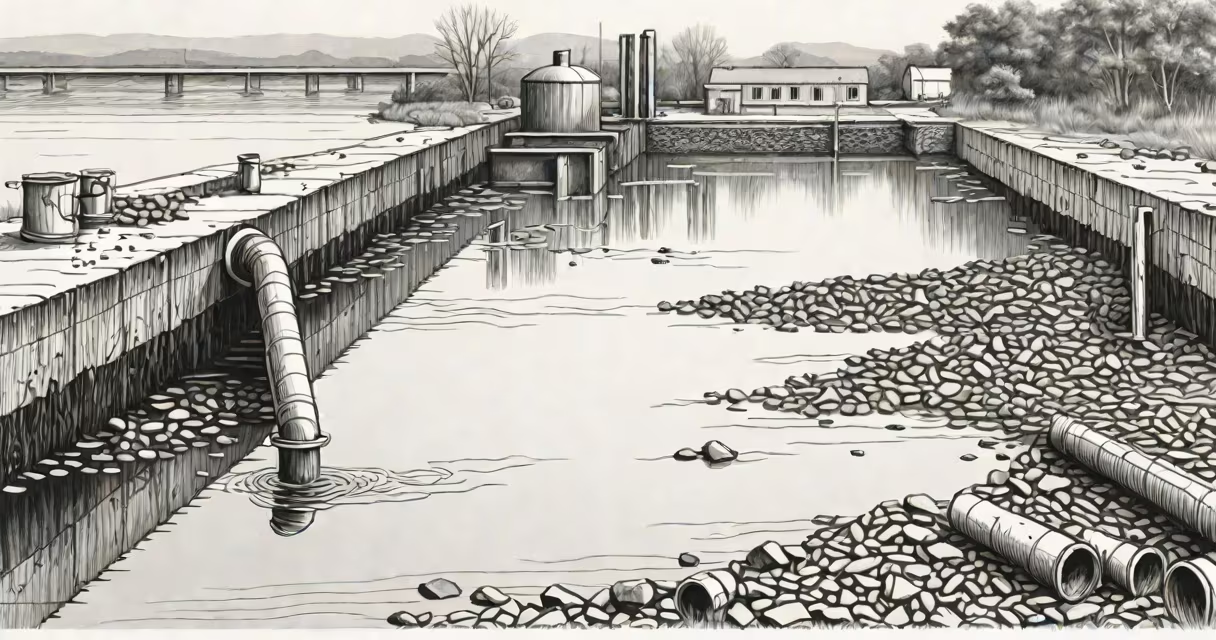
Point source water pollution originates from a single, identifiable location such as a pipe, ditch, or sewer outfall that discharges pollutants directly into water bodies. These sources are regulated under environmental laws because their origin is traceable and measurable.
Unlike pollution that spreads across landscapes-like runoff from farms or streets-point source pollution comes from a specific, fixed location. The U.S. Environmental Protection Agency (EPA) defines it as any discernible, confined, and discrete conveyance, including pipes, ditches, and containers, from which pollutants are discharged.
Examples include effluent from factories, treated wastewater from municipal sewage plants, and stormwater runoff from urban areas collected through storm drains. Because these sources are detectable and often monitored, they are subject to strict permitting requirements under the Clean Water Act.
When a facility releases liquid waste into a waterway through a pipe or channel, it introduces contaminants such as heavy metals, nutrients, pathogens, and organic compounds. These substances enter the aquatic environment directly, bypassing natural filtration processes like soil absorption or wetland buffering.
The flow rate and concentration of pollutants depend on the type of facility. A paper mill may discharge high levels of suspended solids and chlorine compounds, while a city's wastewater treatment plant may release nitrogen and phosphorus even after processing. In both cases, the discharge point is fixed and documented.
Regulatory agencies require facilities to obtain permits specifying allowable pollutant levels. Violations trigger enforcement actions, including fines or operational shutdowns. Monitoring stations near discharge points collect data to verify compliance.
Point source pollution falls into several categories based on the source and type of discharge:
| Type | Source Example | Common Pollutants | Regulation Authority |
|---|---|---|---|
| Industrial | Chemical manufacturing plant | Heavy metals, solvents, acids | EPA National Pollutant Discharge Elimination System (NPDES) |
| Municipal | Wastewater treatment plant | Nitrogen, phosphorus, fecal coliform | State environmental agencies + EPA |
| Thermal | Power plant cooling system | Heated water only | Section 316(a) of Clean Water Act |
| Marine | Ship bilge water discharge | Oil, grease, detergents | U.S. Coast Guard + EPA |
Each category operates under different permit conditions. For instance, thermal discharges are regulated not for chemical content but for temperature increase, which can disrupt aquatic ecosystems by reducing dissolved oxygen levels.
In 2019, the EPA reported that over 40% of assessed river miles in the U.S. failed to meet water quality standards due to point source discharges. In the case of the Cuyahoga River in Ohio, decades of industrial waste dumping led to a fire in 1969-fueling national attention and contributing to the passage of the Clean Water Act in 1972.
Even after treatment, municipal sewage systems can exceed limits during heavy rainfall. In 2021, New York City experienced over 100 combined sewer overflow events, releasing untreated sewage into the Hudson River. These events are tracked via real-time monitoring and reported annually.
A key distinction often missed: not all discharges from pipes are point sources. Stormwater runoff collected through storm drains is technically a point source if it flows through a pipe, but it's classified separately under NPDES stormwater permits because it's linked to diffuse land-based pollution.
Many assume that all pollution in rivers comes from factories. But most water contamination actually stems from non-point sources-like agricultural runoff or urban stormwater. Point source pollution accounts for about 15% of total water pollution in the U.S., according to the EPA's 2022 National Water Quality Inventory.
Another misconception is that treated wastewater is safe. While treatment reduces many pollutants, it doesn't eliminate all contaminants. Pharmaceuticals, microplastics, and certain pesticides persist in effluent. A 2020 study published in Environmental Science & Technology detected 17 pharmaceutical compounds in treated wastewater discharged into the Colorado River.
Also, point source pollution is not always human-made. Natural geothermal vents can discharge heated, mineral-rich water into streams. However, these are not regulated under the Clean Water Act unless they alter water quality or harm ecosystems.
While the Flint water crisis was primarily caused by corrosion from uncoated pipes and failure to apply anti-corrosion treatments, it involved point source elements. The city's water supply came from a centralized intake and distribution system-making it a point source system. When the water source changed from Lake Huron to the Flint River, the new water chemistry accelerated lead leaching from aging infrastructure.
This shows that even when the initial contaminant enters through a fixed source, secondary pollution can occur downstream due to system failures. The EPA later cited violations of the Safe Drinking Water Act related to inadequate monitoring and reporting-highlighting that point source regulation includes ongoing oversight, not just discharge control.
The Clean Water Act requires facilities discharging pollutants into U.S. waters to obtain a National Pollutant Discharge Elimination System (NPDES) permit. These permits set limits on what can be released, how much, and how often. They also mandate regular sampling and reporting.
Permits are renewed every five years. Facilities must submit annual reports showing compliance. Non-compliance results in penalties. In 2023, a textile factory in North Carolina was fined $1.2 million for exceeding arsenic limits in its discharge-violating its NPDES permit.
Understanding what is point source water pollution helps clarify where regulation applies and where enforcement is most effective. Because these sources are traceable, they're easier to monitor and control than non-point sources like farm runoff or atmospheric deposition.
However, ignoring non-point sources leads to incomplete solutions. The EPA estimates that 60% of impaired waterways are affected by non-point pollution. Addressing both types requires coordinated policy, investment in infrastructure, and public awareness.
Point source water pollution remains a critical focus in environmental protection. Its identifiable nature allows for targeted regulation, making it one of the most effectively managed forms of water contamination in the United States.