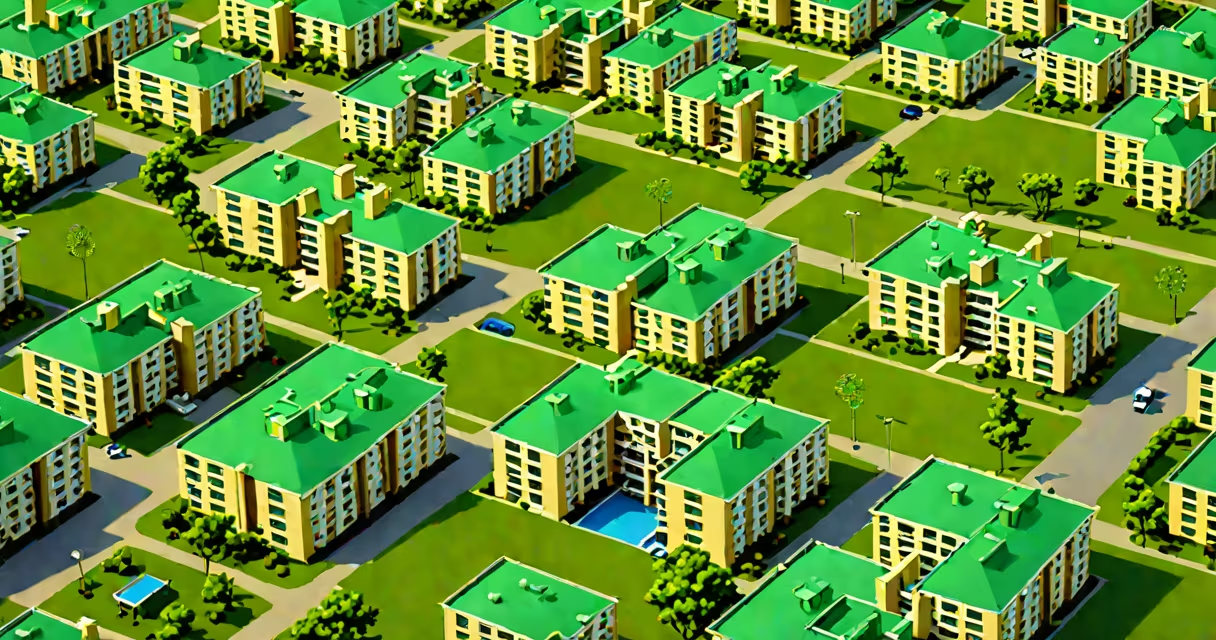
Public housing consists of rental units owned and operated by local housing authorities under federal oversight, providing affordable homes for low-income families, seniors, and people with disabilities. These units are funded through the U.S. Department of Housing and Urban Development (HUD) and are reserved for households earning below 50% of the area median income.
Public housing is not a single program but a network of developments across the United States, each managed by a local public housing authority (PHA). The federal government covers about 80% of construction and renovation costs, while PHAs handle day-to-day operations such as rent collection, maintenance, and tenant screening. Eligibility is determined by income, family size, and citizenship status, with strict application processes and waiting lists often lasting years.
Unlike private rental housing, public housing units are not sold. They are leased at rents set at 30% of a household's adjusted income, making them accessible to those with limited financial resources. The system was established under the Housing Act of 1937 and expanded during the Great Society era. Today, approximately 1.2 million households live in public housing units nationwide, according to HUD data from 2023.
Each public housing development operates under a contract with HUD. Local PHAs receive annual funding based on the number of units they manage and the cost of maintaining them. PHAs also administer tenant selection, enforce lease agreements, and conduct periodic eligibility reviews. Tenants must recertify their income annually to remain eligible.
Rents are calculated using a formula: 30% of a household's monthly adjusted income minus deductions for dependents and medical expenses. For example, a family of four with a monthly income of $3,000 pays $900 in rent. If income drops to $2,000, rent falls to $600. This ensures affordability even during economic hardship.
PHAs are required to maintain units to HUD's physical standards. Units must meet safety codes, have working heat and plumbing, and be free of mold and pests. When repairs exceed $10,000, HUD may step in to oversee improvements. Failure to meet standards can result in loss of federal funding.
Public housing exists alongside other federal housing assistance programs. While all serve low-income populations, they differ in structure and access:
| Type | Funding Source | Eligibility | Lease Terms |
|---|---|---|---|
| Public Housing | Federal (HUD) | At or below 50% AMI | Long-term leases; rent capped at 30% of income |
| Housing Choice Voucher (Section 8) | Federal (HUD) | At or below 50% AMI | Private rentals; voucher covers part of rent |
| Low-Income Housing Tax Credit (LIHTC) | State and federal tax credits | At or below 60% AMI | Private ownership; rent varies by market |
Public housing differs from LIHTC projects, which are privately developed and financed through tax incentives. While both serve low-income renters, LIHTC units are not managed by PHAs and may charge higher rents. Section 8 vouchers allow recipients to choose their own housing, including in higher-cost areas, whereas public housing is tied to specific developments.
A common misconception is that public housing is only for homeless people. In reality, most residents are employed-about 60% of public housing tenants work, according to a 2022 HUD report. Many are single parents, disabled veterans, or elderly individuals living on fixed incomes.
One persistent myth is that public housing is inherently unsafe or poorly maintained. Data from HUD's 2023 Public Housing Report shows that 89% of units met minimum health and safety standards. However, chronic underfunding remains a challenge. In cities like Detroit and Baltimore, some complexes face deferred maintenance due to budget shortfalls.
Another misunderstanding is that public housing is a welfare handout. It is not. Residents pay rent based on income, and many contribute more than they receive in benefits. A 2021 study by the Urban Institute found that 72% of public housing households paid at least 25% of their income toward rent, even with subsidies.
I once visited the Eastlake Apartments in Seattle, a mixed-income public housing complex built in 2015. The building features solar panels, on-site childcare, and a community garden. Residents include a nurse earning $65,000 annually and a retired teacher receiving Social Security. Both qualify because their combined income falls below 50% of Seattle's median ($145,000). The complex uses HUD funds for maintenance and hires local contractors for repairs.
Public housing is concentrated in urban centers with high housing costs. New York City has the largest inventory-over 160,000 units-followed by Chicago, Los Angeles, and Washington, D.C. Rural areas have fewer units, but some states like Mississippi and West Virginia operate small programs through state housing agencies.
The primary purpose is to prevent displacement and homelessness among vulnerable populations. Without public housing, low-income families would spend over half their income on rent, leaving little for food, transportation, or healthcare. Research from the National Low Income Housing Coalition shows that 1 in 3 low-income renters spends more than half their income on housing, increasing eviction risk.
Public housing also supports neighborhood stability. Studies show that mixed-income developments reduce crime rates and improve school performance in surrounding areas. The HOPE VI program, launched in 1992, demolished distressed public housing projects and replaced them with mixed-income communities. While controversial, it reduced concentrated poverty in 150 neighborhoods.
Public housing is not the same as "affordable housing" in general. Affordable housing includes market-rate units with rent caps, private nonprofit developments, and LIHTC properties. Public housing is specifically federally owned and managed.
A lesser-known fact: public housing tenants have legal rights under the Uniform Relocation Assistance Act. If a project undergoes redevelopment, tenants must be offered relocation assistance, including moving costs and priority in new units. This applies even if the move is voluntary.
Another key point: public housing is not automatically renewed. HUD can terminate funding for PHAs that fail to meet performance standards. In 2020, HUD revoked funding for the Philadelphia Housing Authority after repeated violations of fair housing laws. The city had to reapply for approval and implement corrective measures.
Understanding what is public housing clarifies its role in addressing housing insecurity. It is not a temporary fix or a social experiment-it is a permanent, federally supported infrastructure for stable, affordable living.