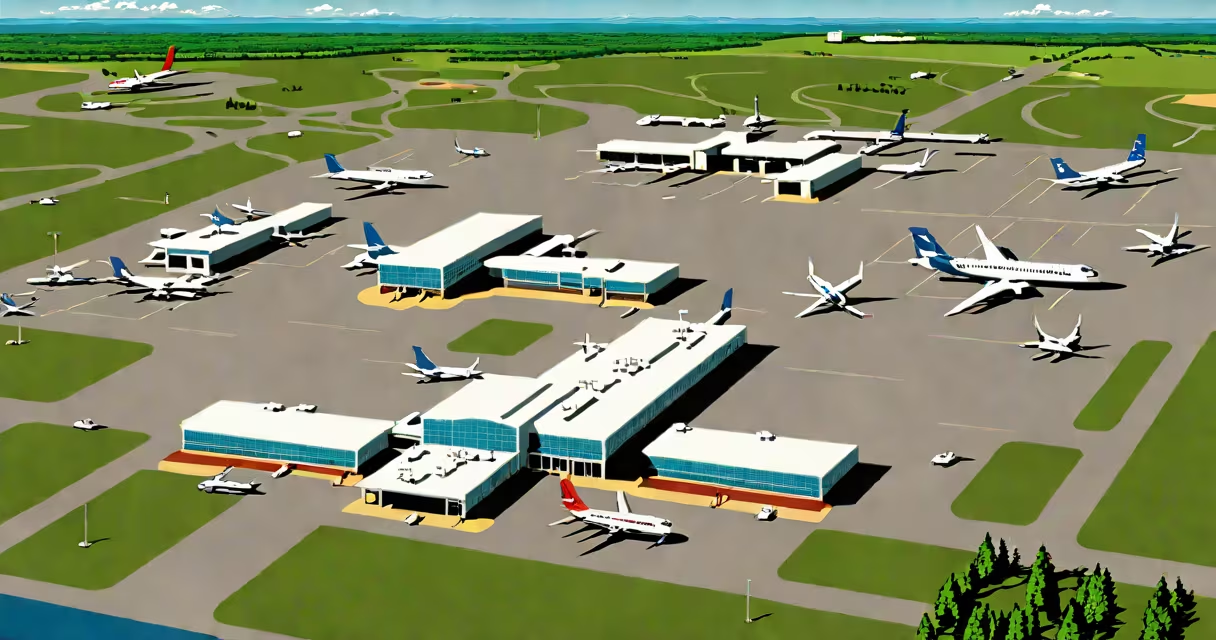
Duluth International Airport (DLH) is a public airport serving Duluth, Minnesota, and parts of northeastern Wisconsin. It operates under federal aviation authority and handles commercial passenger flights, cargo transport, and general aviation. The airport lies along the shore of Lake Superior, 16 miles west of downtown Duluth.
Operated by the City of Duluth under contract with the Federal Aviation Administration (FAA), DLH maintains a single runway (12/30) measuring 7,500 feet long and 150 feet wide. It supports aircraft up to the size of a Boeing 737-800 and accommodates seasonal regional jet service. The terminal building includes check-in counters, security screening, baggage claim, and a small food court.
The airport is designated as a primary commercial service airport by the FAA's National Plan of Integrated Airport Systems (NPIAS). It receives federal funding through the Airport Improvement Program (AIP) for infrastructure upgrades and safety enhancements. In 2023, DLH served 214,000 enplaned passengers, ranking among the top 100 busiest airports in the United States by passenger volume.
DLH functions as a hub for regional air connectivity. Airlines schedule daily departures to major hubs such as Minneapolis-Saint Paul International Airport (MSP), Chicago O'Hare (ORD), and Detroit Metropolitan (DTW). These routes are often operated via code-sharing agreements, meaning a flight may be marketed by one airline but flown by another.
Passenger traffic peaks during winter months due to tourism related to skiing, snowmobiling, and lakefront events. The airport also supports emergency medical evacuations and search-and-rescue coordination through its proximity to remote wilderness areas in the Boundary Waters Canoe Area Wilderness (BWCAW).
Airline operations are coordinated through the Air Traffic Control Tower (ATCT), which manages takeoffs, landings, and ground movements. The tower operates 24 hours a day during peak seasons and reduces staffing during off-peak periods. All aircraft must file flight plans and receive clearance before entering controlled airspace within 10 nautical miles of the airport.
Duluth International Airport serves four main user groups: commercial travelers, cargo operators, private pilots, and emergency services.
| Service Type | Users | Examples |
|---|---|---|
| Commercial Passenger | Travelers on scheduled flights | Delta Air Lines, American Airlines, United Express |
| Cargo | Freight carriers, supply chain logistics | UPS, FedEx, regional freight brokers |
| General Aviation | Pilots flying personal or business aircraft | Private jets, single-engine planes, helicopters |
| Emergency Response | Search and rescue, medical evacuation teams | National Weather Service, local EMS, state patrol |
General aviation accounts for approximately 60% of total aircraft operations at DLH. This includes training flights, sightseeing tours, and charter services. The airport hosts a Fixed Base Operator (FBO) offering fuel, hangar space, maintenance, and pilot briefings.
During the 2022 winter storm season, DLH handled 12 emergency medical flights transporting patients from remote communities in the North Shore region. These flights were coordinated with the Minnesota Department of Health and the U.S. Coast Guard's inland response network.
Many visitors assume Duluth International Airport is closed during winter due to weather. This is incorrect. While snowstorms can delay or cancel flights, the airport remains operational year-round. Snow removal crews begin clearing runways within 30 minutes of a storm's start, using deicing fluid and plows equipped with GPS-guided systems.
Another misconception is that DLH offers direct international service. The airport does not have scheduled international flights. However, it does allow customs inspections for private aircraft arriving from Canada under the U.S.-Canada Air Transport Agreement. These flights require prior notification and documentation submitted through the U.S. Customs and Border Protection (CBP) portal.
A lesser-known fact: DLH was originally established in 1920 as a military airfield. It became a civilian airport in 1946 after World War II. The current terminal structure opened in 1975 and underwent a $12 million renovation in 2018 to improve accessibility and energy efficiency.
On January 14, 2023, a Delta Connection flight (operated by SkyWest Airlines) arrived at DLH from MSP at 8:45 a.m. The flight carried 52 passengers, including a family traveling to Duluth for a winter wedding. Upon arrival, they cleared U.S. Customs and Immigration at the domestic checkpoint-no international documents were required.
After collecting luggage, the family took a shuttle bus to the rental car facility. They rented a four-wheel-drive SUV for the 45-minute drive to their hotel in the city center. The airport's parking garage charged $12 per day, with free Wi-Fi and electric vehicle charging stations available.
Later that afternoon, a cargo plane from FedEx Express landed from Memphis, carrying 12 pallets of medical supplies bound for clinics in northern Minnesota. The shipment was processed through the cargo terminal and delivered to a distribution center within three hours.
This example illustrates how DLH integrates commercial, private, and freight operations into a single functional system. The airport's ability to handle diverse traffic types reflects its role as a critical node in the regional transportation network.
Duluth International Airport remains a important link between northern Minnesota's communities and national air networks. Its consistent performance, even during extreme weather, underscores its reliability and operational maturity.