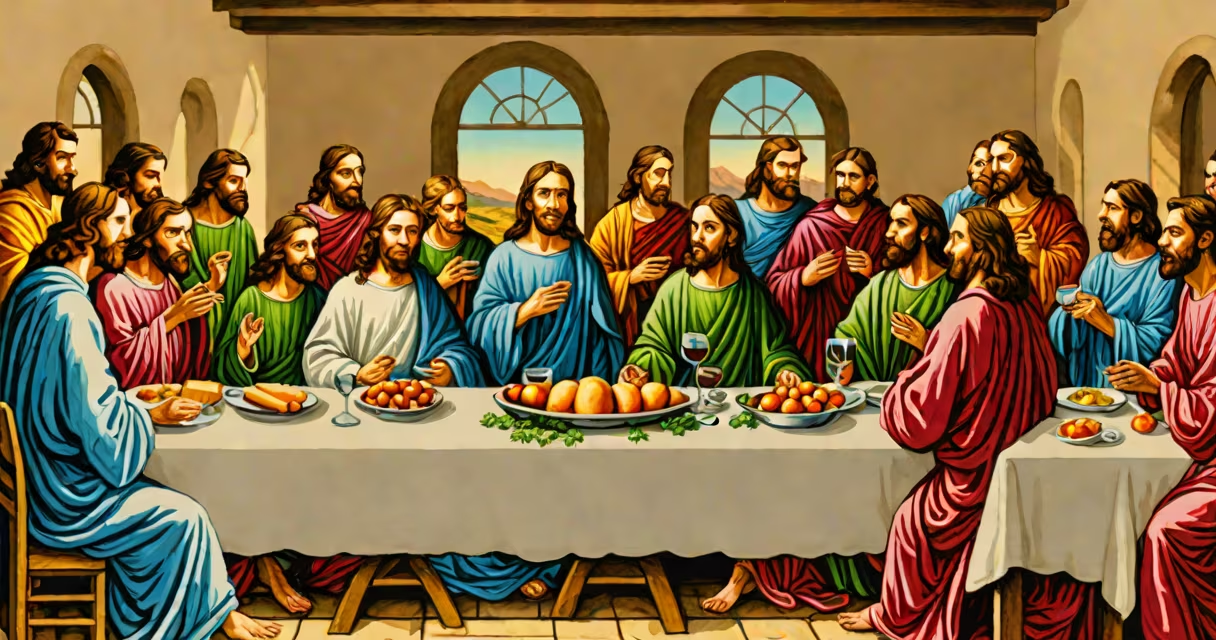
The Last Supper was Jesus Christ's final meal with his twelve disciples before his crucifixion, serving as the foundation for the Christian sacrament of Holy Communion. It marks the institution of the Eucharist, where bread and wine represent Christ's body and blood, symbolizing sacrifice and spiritual unity.
According to the Gospels of Matthew (26:17-30), Mark (14:12-25), and Luke (22:7-38), Jesus shared a Passover meal with his disciples in Jerusalem. During the meal, he broke bread and said, "This is my body," then passed wine, saying, "This is my blood." These actions established a ritual central to Christian worship. The event occurred during the Jewish festival of Passover, which commemorates liberation from slavery in Egypt, adding layers of symbolic resonance.
Christian theology interprets the Last Supper as both a memorial and a prophetic act. The bread signifies Christ's sacrificial death; the wine, the new covenant in his blood. This moment is not merely historical-it is reenacted weekly in churches worldwide through the Eucharist, affirming ongoing spiritual connection with Christ's sacrifice.
In Catholic, Orthodox, and many Protestant traditions, the Eucharist is celebrated using consecrated bread and wine. The belief varies: Catholics hold to transubstantiation-the idea that the bread and wine literally become Christ's body and blood-while most Protestants view the elements as symbolic representations. Despite doctrinal differences, the core practice remains consistent: remembering Christ's sacrifice through shared ritual.
Communion services typically follow a liturgical structure. The bread is broken and distributed; the wine is poured and shared. This physical act reinforces communal identity and spiritual renewal. In some denominations, such as Anglicans and Lutherans, the rite is performed weekly; in others, monthly or quarterly.
A key distinction lies in the timing of the meal. The Synoptic Gospels (Matthew, Mark, Luke) place the Last Supper on the evening of Nisan 14, the day before Passover. John's Gospel places it earlier, on Nisan 13. This discrepancy has led to scholarly debate about whether Jesus ate the Passover meal or a preparatory meal. The difference affects interpretations of the timing of Christ's crucifixion relative to Passover.
The Last Supper features four essential components: bread, wine, the setting, and the participants. Bread-typically unleavened, as required by Passover tradition-symbolizes Christ's body, broken for humanity. Wine represents his blood shed for forgiveness. Both elements are consumed in ritual form during communion.
The setting is equally significant. The meal took place in an upper room in Jerusalem, likely a private house or guest chamber. Historical evidence suggests such rooms were common in first-century Judea. The location underscores intimacy and secrecy-Jesus prepared the disciples for betrayal, arrest, and execution in a confined space, away from public scrutiny.
The twelve disciples present represent the twelve tribes of Israel. Judas Iscariot, who would betray Jesus, is included in the group. His presence highlights the tension between divine purpose and human failure. Jesus foretold his betrayal during the meal, saying, "One of you will betray me." This moment adds psychological depth to the scene, emphasizing that the sacred act occurred amid impending doom.
Different Christian traditions interpret the Last Supper differently. Below is a comparison of major views:
| Denomination | View on the Eucharist | Key Belief |
|---|---|---|
| Catholic | Transubstantiation | Bread and wine become Christ's actual body and blood |
| Eastern Orthodox | Mystical Real Presence | Divine reality transforms the elements; not literal change |
| Lutheran | Sacramental Union | Christ's body and blood are truly present "in, with, and under" the bread and wine |
| Reformed (Calvinist) | Spiritual Presence | Christ is spiritually present; believers receive grace through faith |
| Methodist | Real Presence | Christ is spiritually present; the sacrament strengthens faith |
These interpretations reflect theological priorities. Catholics emphasize ontological transformation; Reformed traditions focus on faith and spiritual nourishment. The diversity shows that while the event is universally recognized, its meaning is interpreted through distinct doctrinal lenses.
Many assume the Last Supper was a formal banquet. In reality, it was a modest meal typical of poor households in first-century Galilee. The table was low, guests reclined on cushions, and food was simple-bread, wine, olives, fish. There is no historical evidence of a large feast or elaborate dishes.
Another misconception is that the painting by Leonardo da Vinci depicts the actual Last Supper. The artwork, created around 1495-1498, is a Renaissance interpretation, not a historical record. Da Vinci's version shows Jesus and disciples seated at a long table, but archaeological and textual evidence suggests they likely reclined on three sides of a U-shaped table. The painting's composition is artistic, not archaeological.
A lesser-known but critical point: the Last Supper was not a "farewell speech" or final sermon. While Jesus did speak extensively-predicting Peter's denial, Judas's betrayal, and the coming of the Holy Spirit-his primary action was ritualistic. The breaking of bread and passing of wine were the central acts, not the words. The meal's meaning lies in the gesture, not the lecture.
Consider a Sunday morning service at St. Mary's Episcopal Church in Portland, Oregon. The priest begins by reading Luke 22:14-20: "While they were eating, he took bread, gave thanks, broke it, and gave it to them." The congregation then receives the elements. The bread is wheat-based, baked fresh that morning. The wine is red, non-alcoholic for accessibility. Each person takes a small piece of bread and sips from a shared cup.
Afterward, a child asks, "Why do we do this?" The priest replies, "Because Jesus said, 'Do this in remembrance of me.' We eat and drink to remember his love and sacrifice." This moment illustrates how the Last Supper's meaning is preserved not through doctrine alone, but through lived ritual.
I once attended a communion service in a rural church in northern Italy. The priest used homemade bread from local flour and wine from a nearby vineyard. The atmosphere was quiet, intimate. When I received the bread, I felt a weight-not of ritual, but of presence. That moment clarified something I'd read in textbooks: the Last Supper is not just memory. It is encounter.
The Last Supper is central to Christian worship worldwide. It is observed in churches, homes, prisons, hospitals, and refugee shelters. The frequency varies: daily in monasteries, weekly in most congregations, occasionally in others. Its purpose is not to repeat history but to renew spiritual commitment.
Historically, the meal was tied to Passover. Today, it is often linked to Easter, the celebration of Christ's resurrection. The Last Supper is not a standalone event-it is part of a larger narrative: betrayal, crucifixion, resurrection. Understanding it requires seeing it within that arc.
For many, the Last Supper is a moment of personal reflection. It prompts questions: Who am I in this story? Am I Peter, denying Christ? Am I Judas, acting out of greed? Or am I one of the faithful, receiving grace?
The Last Supper is closely tied to the concept of the Eucharist, a term derived from the Greek word for "thanksgiving." The early Church practiced the Eucharist regularly, as described in Acts 2:42: "They devoted themselves to the apostles' teaching and to fellowship, to the breaking of bread and to prayer." This passage confirms that the meal was central to early Christian life.
The meaning of the Last Supper transcends time. It is not a relic of the past but a living practice. Through bread and wine, Christians continue to participate in a sacred moment-one that defines their faith, shapes their community, and connects them to a sacrifice that changed history.