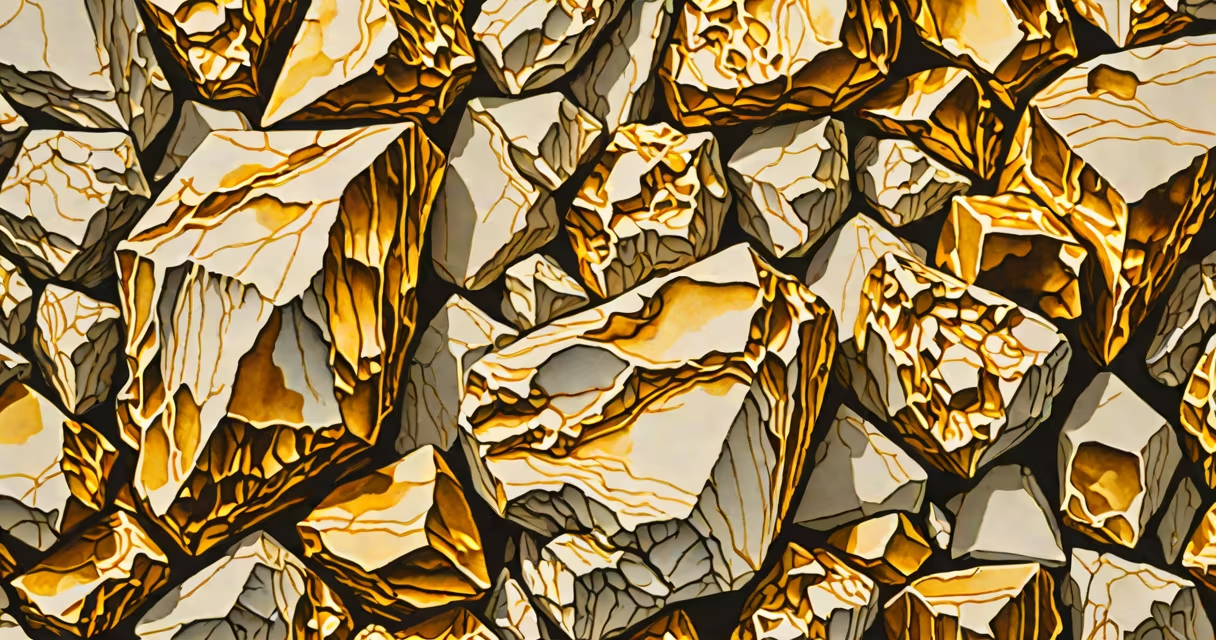
Gold ore is rock that contains sufficient concentrations of gold to justify mining and processing. It typically consists of gold embedded in quartz, sulfide minerals, or alluvial sediments. The term refers to the natural material from which gold is extracted, not pure gold itself.
Gold occurs in nature primarily as native metal-uncombined with other elements-but it is rarely found in high enough purity to be economically viable. Instead, it must be extracted from ore through methods like crushing, grinding, leaching, and smelting. The concentration of gold in ore is measured in grams per tonne (g/t); ores with more than 1 g/t are generally considered economically recoverable.
According to the U.S. Geological Survey, global gold production relies heavily on hard-rock (lode) and placer deposits. Hard-rock ores form deep underground through hydrothermal activity, while placer deposits result from weathering and erosion that concentrate gold in riverbeds and gravel beds. Both types require different mining techniques and processing steps.
Gold ore forms when hot, mineral-rich fluids circulate through cracks in Earth's crust. As these fluids cool, they deposit gold along with quartz, pyrite, and other minerals. This process often occurs near volcanic zones or tectonic plate boundaries. The Carlin Trend in Nevada, for example, hosts gold deposits formed by low-temperature hydrothermal fluids interacting with carbonate rocks.
Placer deposits arise when weathered gold particles wash downstream and settle in stream beds or ancient river channels. These deposits are often found in sedimentary environments and were historically exploited during gold rushes. The Klondike region in Canada and parts of California's Sierra Nevada were major sites for placer mining in the 19th century.
A key distinction is that not all gold-containing rock qualifies as ore. For instance, a rock with 0.2 g/t gold may contain gold but lacks economic viability. The cutoff varies by location, technology, and market price. At $1,800 per ounce, a mine might profitably process ore with 0.5 g/t gold; at $1,200, only ore above 1 g/t would be viable.
Gold ore falls into two broad categories: hard-rock (lode) and placer. Hard-rock ore is mined from veins or disseminated deposits within bedrock. Placer ore is found in loose sediments, usually in rivers or glacial deposits.
| Type | Formation Process | Typical Gold Concentration | Common Locations |
|---|---|---|---|
| Hard-rock (lode) | Hydrothermal fluid deposition in fractures | 0.5-10 g/t | Nevada (USA), Witwatersrand (South Africa), Yukon (Canada) |
| Placer | Weathering and transport by water or ice | 0.1-5 g/t (highly variable) | Alaska (USA), Sierra Nevada (California), Australia's Goldfields |
Hard-rock ores often contain refractory gold-gold locked inside sulfide minerals like pyrite-that resists direct cyanide leaching. These require roasting or pressure oxidation before extraction. In contrast, placer ores usually have free gold particles that can be recovered using gravity separation methods like panning or sluicing.
One non-obvious fact: most gold ore is not visible to the naked eye. A sample with 3 g/t gold contains only about 0.0003% gold by weight. You'd need to process 1,000 kilograms of such ore to yield just 3 grams of gold-roughly the weight of a small coin.
People often assume that gold ore looks like chunks of shiny yellow rock. In reality, most gold-bearing rock appears dull gray or black, especially when mixed with quartz or sulfides. The gold itself is microscopic and only becomes visible after processing.
Another confusion arises between "ore" and "mineral." Gold is a mineral, but not all gold-bearing minerals are ore. For example, electrum-a natural alloy of gold and silver-is a mineral, but only when concentrated sufficiently does it qualify as ore. Similarly, pyrite ("fool's gold") resembles gold but contains no economic value unless it hosts trace gold.
Some believe gold is always found in veins. While vein deposits are common, gold also occurs in disseminated form-spread throughout rock matrix rather than concentrated in fissures. The Porgera mine in Papua New Guinea, for instance, extracts gold from fine-grained disseminated ore, requiring large-scale milling operations.
Consider a hypothetical scenario: a mine processes 100 tonnes of hard-rock gold ore with an average grade of 3 g/t. First, the ore is crushed and ground into fine powder. Then, it undergoes cyanidation-exposure to a weak sodium cyanide solution-which dissolves the gold into a soluble complex.
After leaching, the gold-laden solution is filtered and treated with zinc dust in a process called the Merrill-Crowe method. Zinc displaces gold from solution, forming a precipitate. This sludge is then smelted to produce a doré bar-about 90% gold and 10% silver-ready for refining.
From 100 tonnes of ore at 3 g/t, the mine yields 300 grams of gold (100,000 kg × 0.000003 = 0.3 kg). That's roughly 10 ounces-worth about $2,000 at current prices. The remaining 99.7 tonnes become tailings, stored in containment ponds. Environmental regulations require monitoring for cyanide residues and heavy metals.
I once visited a small-scale artisanal mine in Ghana where miners used mercury amalgamation to extract gold from placer sediments. The process was effective but environmentally damaging. Mercury vapor released during heating contaminated soil and water. This highlights why modern mining uses regulated chemical processes and strict waste management protocols.
Knowing what constitutes gold ore informs investment decisions, environmental impact assessments, and technological innovation in mining. High-grade ores allow smaller, less invasive operations. Low-grade ores demand larger infrastructure and greater energy input.
The World Bank estimates that global gold production reached 3,600 metric tons in 2023, with over 70% coming from hard-rock mines. The rest came from placer and recycled sources. This shows that while placer mining still matters, the majority of supply relies on deep underground ore bodies.
Understanding gold ore isn't just academic-it shapes economies, drives exploration, and influences sustainability debates. simply curious about where gold comes from, recognizing the difference between raw ore and refined metal is essential.