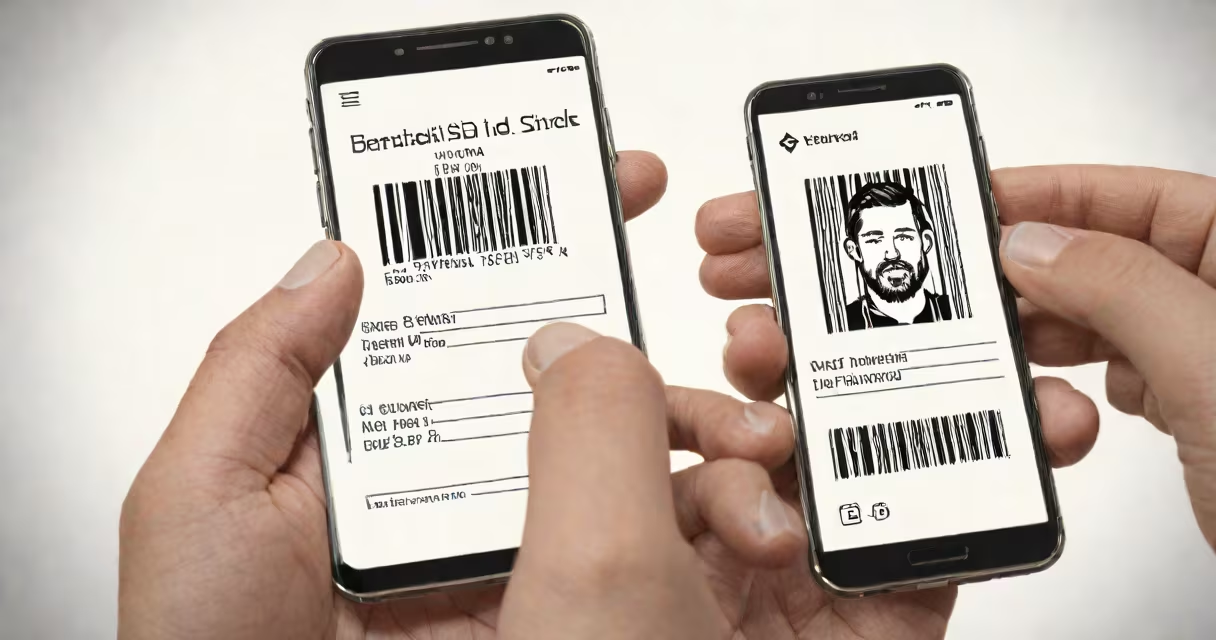
"What my id" refers to the unique identifier assigned to you during account creation or verification, typically based on personal information like your name, date of birth, government-issued number, or biometric data. This identifier confirms your identity when accessing services online or in person.
When you sign up for a banking app, create a social media profile, or apply for a government benefit, the system asks for details that form your ID. These details are matched against official records to verify you are who you claim to be. The result is a verified digital or physical ID that grants access to restricted systems.
For example, when you register for a healthcare portal, you enter your full name, date of birth, and Social Security Number. The system checks this data against the Social Security Administration's database. If all match, you receive a confirmation token - your "what my id" - which becomes your key to the platform.
Systems use your ID to authenticate you through one or more factors: something you know (like a password), something you have (a phone or token), or something you are (biometrics such as fingerprints or facial recognition).
When you log in, the service compares your input against stored data. If the match is confirmed, access is granted. This process prevents unauthorized users from impersonating you. For instance, Apple's Face ID uses facial mapping to confirm identity before unlocking a device. The system doesn't store your face - it creates a mathematical model derived from your features.
Some platforms use multi-factor authentication (MFA). After entering your username and password, you may receive a time-based code sent to your registered mobile number. That code is part of your ID verification chain, ensuring that even if someone steals your password, they still can't access your account.
There are several forms of identifiers used across digital and physical environments. They differ in strength, privacy impact, and regulatory oversight.
| Type | Example | Use Case | Security Level |
|---|---|---|---|
| Government-Issued ID | Social Security Number (SSN) | Tax filing, credit checks | High (but vulnerable if leaked) |
| Digital Token | OAuth access token | Logging into apps via Google or Apple | Medium (expires quickly) |
| Biometric Data | Fingerprint scan | Device enable, border control | High (unique to individual) |
| Username/Email | [email protected] | Account login | Low (easily spoofed) |
While usernames and emails are often used as IDs, they are weak on their own because multiple people can share similar patterns. A SSN or passport number is stronger because it's unique and linked to legal documentation.
Many organizations now avoid storing raw SSNs. Instead, they use encrypted tokens or hashing algorithms to represent them. For example, the National Institute of Standards and Technology (NIST) recommends using cryptographic hashing for sensitive identifiers to prevent exposure in data breaches.
People often confuse "what my id" with a password or a username. But an ID is not a secret - it's a reference point. Your ID is public in the sense that it's shared with systems to verify you. What remains private is the proof of ownership - like a password, PIN, or biometric sample.
Another mistake is assuming that a single ID works everywhere. A driver's license number from one state cannot be used to verify identity in another country. International standards like those from the International Civil Aviation Organization (ICAO) define machine-readable zones on passports to ensure cross-border compatibility.
A lesser-known fact: many digital IDs are not static. Some systems issue temporary IDs that expire after a set period. For example, when you use a bank's mobile app for the first time, you might be given a session-specific ID valid for 24 hours. This reduces risk if the ID is compromised.
In 2022, the U.S. Department of Homeland Security piloted a digital ID program for travelers at select airports. Passengers enrolled by uploading a government-issued photo ID and verifying their biometric data. Once approved, they received a QR code linked to their verified identity.
At security checkpoints, officers scanned the QR code. The system checked the traveler's identity against federal databases in under two seconds. This reduced wait times by 40% compared to manual checks, according to a DHS report published in June 2023.
The key insight: the QR code wasn't the ID itself. It was a secure link to a trusted identity record. This approach balances convenience with privacy - the system never stores your photo or SSN locally.
Without proper ID verification, fraud increases. According to the Federal Trade Commission (FTC), identity theft reports rose 26% between 2021 and 2022, with over 1.4 million cases reported. Many involved stolen IDs used to open fraudulent accounts.
Verifying your identity early in a transaction reduces risk. When you apply for a loan, lenders check your SSN and credit history. If discrepancies exist, the application is flagged. This protects both you and the institution.
I once helped a friend set up a new email account with two-factor authentication. He entered his phone number and received a code. After entering it, he got a message: "Your identity has been verified." That moment confirmed he was not a bot, nor a duplicate account. The system had matched his input against known patterns from previous registrations.
Content ID systems identify media files - such as videos or images - by analyzing metadata and visual patterns. They're used by platforms like YouTube to detect copyright violations. Unlike personal IDs, content IDs don't relate to individuals but to digital objects.
For most users, knowing what your ID is and how it's used helps protect your data. Always verify the legitimacy of requests asking for your ID. If a site asks for your SSN without encryption or a clear purpose, it may be a phishing attempt.
"what my id" is not a single piece of data - it's a system of trust built on verification, consistency, and security. Knowing how it functions empowers you to act responsibly in digital spaces.