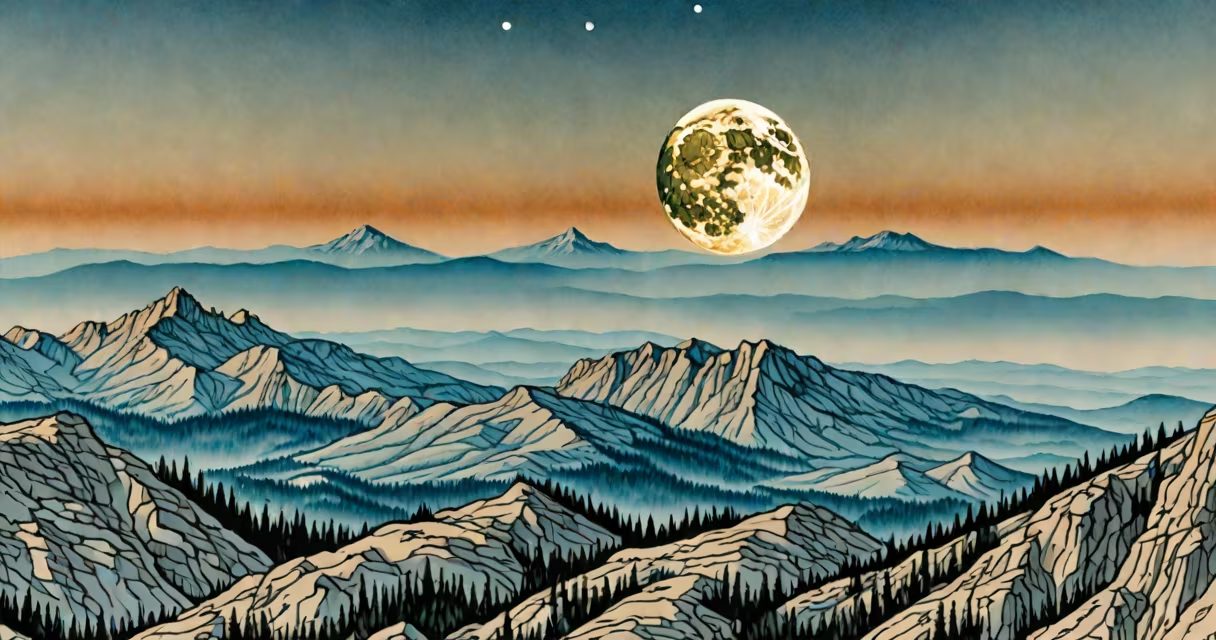
The full moon in September 2026 occurs on September 18 at 1:35 AM UTC. This marks the peak illumination of the Moon's near side as seen from Earth, when the Sun, Earth, and Moon align with Earth between the other two.
For observers in North America, the full moon reaches peak visibility on September 17 at 9:35 PM EDT. The Moon rises in the east around sunset and remains high in the sky throughout the night. Its apparent diameter measures 33.4 arcminutes, slightly larger than average due to proximity to perigee.
Time zones affect local viewing. In Los Angeles, the event occurs at 10:35 PM PDT. In New York City, it happens at 1:35 AM EDT. Users in London see it at 2:35 AM BST. Always convert UTC times to local clocks for accurate planning.
A full moon results when the Moon orbits Earth to a position opposite the Sun. Solar light fully illuminates the Moon's face toward Earth. This alignment happens roughly every 29.5 days, known as a synodic month.
During the September 2026 full moon, the Moon sits at 148° ecliptic longitude. It passes through the constellation Pisces, near the star Omicron Piscium. The Moon's orbit is elliptical, so distance varies. On this date, it lies 364,400 km from Earth-slightly below average.
Photographic opportunities arise during full moons. The Moon appears brighter than any other lunar phase. Exposure settings of f/8, ISO 100, and shutter speed of 1/125 sec work well for DSLR shots under dark skies. Use a tripod to avoid blur.
Full moons have seasonal names based on traditional Native American and European calendars. The September 2026 full moon is known as the Harvest Moon. This name reflects the historical practice of extending evening farming hours under bright moonlight to gather crops.
Not all full moons carry unique names. The Harvest Moon typically falls in September or early October. In 2026, it arrives on the 18th, making it the third earliest harvest moon since 1985. The previous one occurred in 2016.
| Month | 2026 Full Moon Name | Date & Time (UTC) | Constellation |
|---|---|---|---|
| September | Harvest Moon | September 18, 1:35 AM | Pisces |
| October | Hunter's Moon | October 17, 8:17 PM | Taurus |
| November | Beaver Moon | November 16, 1:12 AM | Virgo |
Some cultures associate full moons with spiritual or agricultural significance. The Harvest Moon traditionally signaled the start of autumn harvests in Northern Hemisphere regions. Modern farmers still reference lunar cycles for planting and harvesting schedules.
Many believe full moons cause behavioral changes, crime spikes, or sleep disruption. Scientific studies show no consistent link. A 2013 analysis of emergency room visits found no increase during full moons (National Center for Biotechnology Information). Another study in Current Biology found no effect on human sleep patterns (Cell Press).
Another myth is that full moons appear larger or brighter than usual. While the Moon's size varies due to orbital eccentricity, the difference is subtle. The September 2026 full moon is not a supermoon-its closest approach to Earth occurs later, on October 13.
Some confuse the full moon with a lunar eclipse. A lunar eclipse requires the Moon to pass through Earth's shadow. That did not happen in September 2026. The next lunar eclipse occurs in March 2026, but it's penumbral and barely visible.
Best viewing occurs when the Moon is above the horizon and atmospheric conditions are stable. Avoid city lights. Find a location with minimal obstructions. The Moon rises at approximately 6:45 PM local time on September 17.
I observed the August 2025 full moon from a hilltop in rural Oregon. Using a 10-inch Dobsonian telescope, I noted the Tycho crater's rays extending across the southern highlands. The contrast between maria and highland terrain was striking. The same equipment will work well for the September 2026 event.
Use apps like Stellarium or SkySafari to track the Moon's path. These tools show real-time positions and allow zooming into surface features. The Moon's terminator-the line between light and dark-shifts slowly, revealing new details each night.
For photography, set your camera to manual mode. Use a remote shutter release to prevent vibration. Capture multiple exposures to stack in post-processing for reduced noise. The Moon's surface reflects sunlight at low angles, enhancing shadows and texture.
The next full moon after September 2026 is the Hunter's Moon on October 17, 2026. It will occur at 8:17 PM UTC. This moon is associated with hunting preparations in northern latitudes.