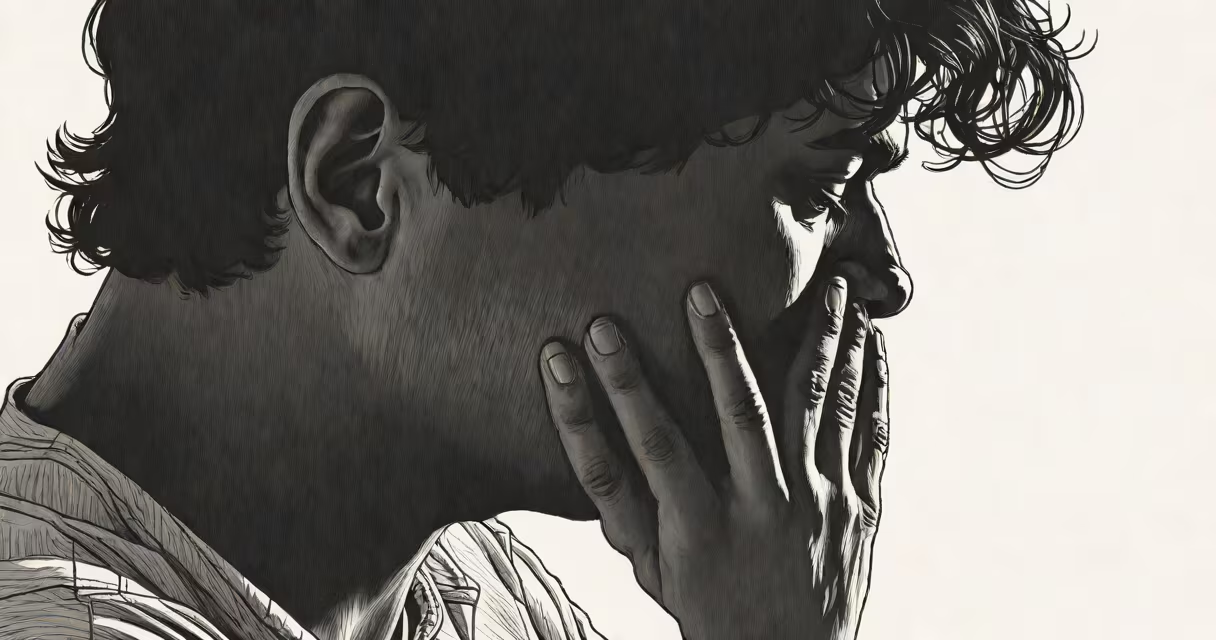
Difficulty expressing feelings stems from psychological, neurological, and environmental factors including early attachment patterns, fear of rejection, and learned emotional suppression. This inability often persists into adulthood despite awareness.
Emotional expression is not a single skill but a complex set of abilities involving recognition, labeling, verbalization, and sharing. When someone cannot express their feelings, they're not failing emotionally-they're operating under conditions that make expression unsafe or ineffective.
Research from the American Psychological Association shows that people who experienced inconsistent caregiving in childhood are less likely to identify or articulate emotions later in life. The brain's limbic system, responsible for emotion processing, develops under early relational input. If caregivers dismissed or punished emotional displays, children learn to avoid them.
Children begin learning emotional regulation through caregiver responses. A toddler crying for comfort may be told "Stop crying" or "You're too much." Repeated messages like these condition the nervous system to shut down emotional signals to avoid distress.
Neuroimaging studies show that adults who suppress emotions exhibit increased activity in the prefrontal cortex-the area responsible for inhibition-during emotional tasks. This suggests suppression becomes a default mode, not a choice. The brain adapts to chronic emotional restraint by strengthening neural pathways that block expression.
A 2021 study published in *Frontiers in Psychology* found that individuals raised in high-stress households were 3.2 times more likely to report difficulty naming emotions, even when they could recognize them. This gap between feeling and labeling is a key barrier to expression.
Several interlocking factors prevent emotional expression:
One participant in a therapy group described being scolded at age seven for crying during a school play. "I didn't know I was sad-I just felt heavy. But my mom said I was 'dramatic.' After that, I stopped talking about how I felt." That moment became a template for future emotional silence.
There's a critical difference between not knowing how to express feelings and being unable to do so. Some people have rich internal emotional lives but lack the tools to translate them into words or actions. Others have had their emotional expression actively discouraged or punished.
"Why can't I express my feelings?" is not a sign of weakness, laziness, or emotional immaturity. It's not a character flaw. Mislabeling it as such increases shame and prevents healing.
It's also not simply about introversion. Introverts aren't inherently poor at expressing emotion. Many introverted people communicate deeply and accurately. The issue lies in safety, training, and past experience-not personality type.
A common misconception is that emotional expression requires dramatic outbursts. In reality, healthy expression includes calm, clear statements like "I felt hurt when you canceled our plans without warning." The goal isn't volume-it's accuracy and consistency.
Suppressed emotions don't disappear. They manifest as physical symptoms, relationship strain, or mental health issues. The Mayo Clinic reports that chronic emotional suppression correlates with higher rates of anxiety, depression, and cardiovascular problems.
Consider a 34-year-old client who came to therapy reporting constant fatigue and irritability. She described her childhood as "quiet" and her parents as "practical." She never saw them cry or argue. Over time, she began to dissociate during conflicts. Her body held tension, her sleep fragmented. Only after identifying her suppressed grief over her father's death-expressed only in nightmares-did her energy return.
This case illustrates a non-obvious truth: emotional suppression doesn't always appear as sadness. It can show up as numbness, restlessness, or physical pain. The body keeps score.
Expression is a skill that can be rebuilt. It begins with naming emotions using precise language. Instead of "I'm fine," try "I'm feeling overwhelmed because I have three deadlines."
Journaling helps. Writing down feelings daily-even in fragments-retrains the brain to notice and label emotions. One study found participants who journaled for 10 minutes daily over four weeks improved emotional recognition by 40% compared to controls.
Therapy offers structured practice. Cognitive Behavioral Therapy (CBT) uses techniques like the "feeling wheel" to map emotions beyond basic categories like happy/sad. For example, "disappointed" and "betrayed" are distinct and require different expressions.
I once guided a man through a session where he practiced saying, "I felt scared when you left without telling me." He froze. His voice cracked. After five attempts, he said it. The relief wasn't in the words-it was in the release of years of silence.
Progress isn't linear. Some days, expression feels natural. Other days, it feels like breaking through stone. That's normal. The brain rewires slowly.
If suppressing emotions leads to frequent panic attacks, chronic insomnia, or persistent low mood, professional support is warranted. Mental health providers use evidence-based approaches like Dialectical Behavior Therapy (DBT) to teach emotion regulation and interpersonal effectiveness.
The National Institute of Mental Health notes that DBT reduces suicidal behavior by 50% in individuals with borderline personality disorder-a population that often struggles with emotional expression. These results show that skills can be taught, even when they seem lost.
Understanding "why can't I express my feelings" is not about blaming the past. It's about recognizing patterns and choosing new responses. You are not broken-you are adapting.
Learning to express emotions doesn't require perfect language or confidence. It requires willingness to try, even when it feels awkward. Small steps build capacity over time.
Expression is not a performance. It's a return to self.