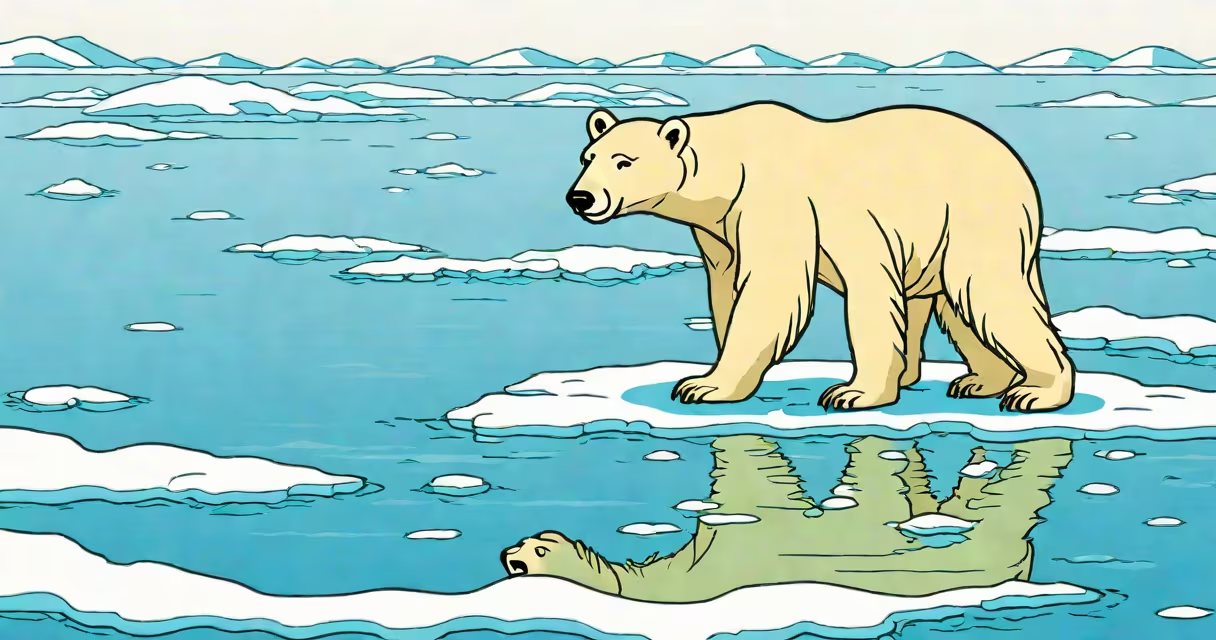
Polar bears depend on Arctic sea ice to hunt seals, their primary food source. As global warming melts this ice faster each year, their ability to survive declines-making conservation efforts critical to prevent extinction.
These apex predators live in the circumpolar Arctic, ranging across Canada, Alaska, Russia, Norway, and Greenland. Their survival hinges on sea ice, which forms each winter and breaks up in summer. Without stable ice platforms, they cannot access prey. In recent decades, the duration and extent of sea ice have shrunk dramatically due to rising greenhouse gas emissions.
The International Union for Conservation of Nature (IUCN) lists polar bears as Vulnerable, with populations declining in four of the eight subpopulations. The U.S. Fish and Wildlife Service added them to the Endangered Species List in 2008, citing climate change as the primary threat. Scientists project that two-thirds of wild polar bear populations could vanish by 2100 if current warming trends continue.
Polar bears are adapted to life on sea ice, not land. They use the frozen ocean surface as a hunting platform to ambush ringed and bearded seals. A single successful hunt may provide enough energy to sustain a bear for days or weeks. When sea ice disappears early, bears must fast longer, often walking hundreds of miles across land in search of food.
During these extended fasts, fat reserves deplete. Cubs born in dens lose weight rapidly if their mothers cannot find food. Studies show that polar bears in the southern Beaufort Sea region have lost an average of 10% of their body mass since the 1980s. Some individuals have starved to death during periods of prolonged ice-free conditions.
A 2021 study published in Nature Climate Change modeled future scenarios under different emission pathways. Under high-emission scenarios, polar bears in the Barents Sea region face local extinction by 2050. Even under moderate emissions, sea ice retreat reduces hunting windows by up to 60% compared to pre-industrial levels.
Nations with polar bear habitats have signed international agreements to reduce threats. The 1973 Agreement on the Conservation of Polar Bears, ratified by five Arctic nations, bans hunting except for subsistence purposes and requires coordinated research and monitoring.
National strategies include protected areas, reduced industrial activity near denning sites, and restrictions on oil and gas exploration. In Canada, the government has designated large portions of the Canadian Arctic as national parks and wildlife reserves. In Svalbard, Norway enforces strict limits on human presence near bear habitats.
Non-governmental organizations like World Wildlife Fund (WWF) and Polar Bears International run public education campaigns and fund field research. These groups track individual bears using satellite collars, monitor cub survival rates, and assess body condition through aerial surveys.
Many assume polar bears are simply "big grizzly bears" or that they can adapt to life on land. This is incorrect. While both species are bears, polar bears evolved specifically for marine hunting. Their black skin, thick fur, and large webbed feet are adaptations to cold water and ice. Grizzlies lack these traits and cannot survive long-term without access to terrestrial food sources.
Another misconception is that polar bears are thriving because they appear in media frequently. In reality, their visibility in documentaries and social media often reflects population decline. Increased sightings near human settlements are signs of stress-not success. As sea ice vanishes, bears wander farther inland searching for food, leading to more human-wildlife conflicts.
Crucially, protecting polar bears is not just about saving a single species-it's about preserving the entire Arctic system. They are an indicator species: their health reflects the stability of the region's food web. When polar bears struggle, so do seals, walruses, seabirds, and the indigenous communities who rely on them.
From 2004 to 2018, researchers tracked 143 female polar bears in the southern Beaufort Sea using GPS collars. Data showed that the average time bears spent on sea ice dropped from 180 days per year to fewer than 120 days. This reduction forced many to spend months on land, where food is scarce.
Body condition declined. Bears captured during spring mating season weighed 15% less than those measured in the 1980s. Cubs born in this region had lower survival rates-only 60% survived past their first year, compared to 80% in earlier decades.
By 2020, scientists concluded that the population had declined by nearly 40% since the 1980s. The U.S. Geological Survey attributed this drop directly to earlier sea ice breakup and later freeze-up. This trend continues: in 2023, sea ice extent in the Beaufort Sea reached its lowest level on record for the month of June.
Individual actions contribute to systemic change. Reducing carbon emissions by choosing low-carbon transportation, supporting renewable energy policies, and minimizing meat consumption lowers your personal contribution to climate change. Each ton of CO₂ avoided helps slow Arctic warming.
I once observed a polar bear carcass on the shore of Wrangel Island during a research expedition. The animal was emaciated, ribs visible beneath thin fur. Its last known location was 120 kilometers from the nearest sea ice. It had likely walked for weeks, unable to find food. That moment underscored the urgency: polar bears aren't just animals-they're symbols of a planet in distress.
Protecting polar bears means addressing the root cause: climate change. Efforts to reduce fossil fuel dependence, expand protected areas, and enforce international conservation treaties are essential. The fate of polar bears is intertwined with our own choices.
Climate change doesn't just affect polar bears-it reshapes entire biomes. The survival of polar bears is not a side issue. It is a litmus test for global environmental responsibility.