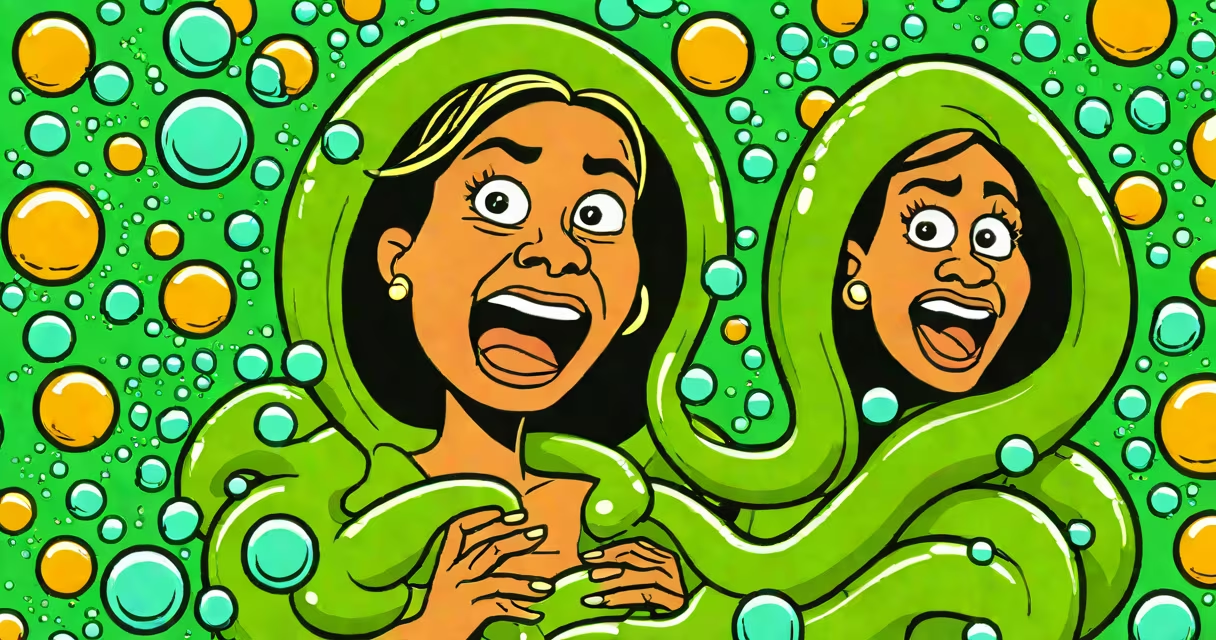
"Yo mama so slimy" is a humorous insult that exaggerates a person's mother as being excessively slippery or gooey, typically used in lighthearted teasing or competitive wordplay. The phrase thrives on absurd imagery and rhythmic delivery, common in oral traditions of joke battles.
This joke belongs to a long-standing genre of playful insults known as "yo mama" jokes-clever, often nonsensical barbs that mock someone's mother through hyperbole. The core structure involves stating a trait (like sliminess) and then stretching it into the ridiculous. For example, "Yo mama so slimy, she slides off the frying pan before the eggs even hit the surface."
These jokes are rarely meant to be taken seriously. They function as social rituals in settings like playgrounds, family gatherings, or comedy circles where wit and timing matter more than accuracy. The humor lies in the mismatch between the mundane subject (a mother) and the outlandish claim (slimy enough to slide off a pan).
"Yo mama so slimy" follows a predictable pattern: a subject ("yo mama"), a quality ("so slimy"), and an exaggerated consequence. The punchline often adds a visual or physical scenario to ground the absurdity. The rhythm matters-many versions are delivered in a cadence similar to rap or chant.
For example: "Yo mama so slimy, she makes the floor look dry." This version uses contrast-the expected wetness of a slimy surface is reversed by saying it makes the floor seem dry. That twist amplifies the humor through irony.
Performance enhances impact. A well-timed pause before the punchline, a deadpan expression, or a dramatic hand gesture increases comedic effect. These jokes are often traded in rapid succession during "insult battles," where participants try to outdo each other with increasingly absurd lines.
While "yo mama so slimy" is popular in American English-speaking contexts, similar forms exist globally. In Nigerian Pidgin, for instance, people say "Your mum so oily, she can't hold a spoon." In Spanish-speaking communities, "Tu mamá es tan resbaladiza que hasta el aceite la mira con envidia" (Your mom is so slippery, even oil looks at her with envy) appears in informal exchanges.
These variants share a structural template: exaggeration of a physical trait combined with a relatable setting. The trait varies-slimy, oily, fat, loud-but the form remains consistent. The humor stems from the gap between reality and the imagined outcome.
| Variant Type | Example | Common Setting |
|---|---|---|
| Physical Trait + Absurd Consequence | "Yo mama so slimy, she's the reason geese don't fly south." | Playground, schoolyard |
| Comparative Hyperbole | "Yo mama so slimy, she's got more layers than a wedding cake." | Family dinner, party |
| Environmental Impact | "Yo mama so slimy, she slips on a rug and causes a chain reaction." | Comedy routines, online videos |
Many people assume "yo mama so slimy" is inherently offensive. But context determines intent. When used among friends who understand the tradition, it's part of a shared language of playful mockery. The same line can feel insulting in a formal setting or between strangers.
A key misunderstanding is treating the joke as a personal attack. The target isn't the mother-it's the concept of exaggeration itself. The joke doesn't claim the mother actually exists in that state. Instead, it plays with perception and expectation.
Another error is misattributing origin. Some believe the phrase emerged from internet memes. But records show oral versions existed in African American vernacular speech as early as the 1970s. The Journal of American Folklore documents early 20th-century variants of "yo mama" jokes in Southern U.S. communities, indicating deep roots in spoken culture.
In a middle school classroom in Atlanta, two students were trading insults during recess. One said, "Yo mama so slimy, she's the reason the floor wax was invented." The other responded, "Yo mama so slimy, she's the reason they had to invent the mop."
The class laughed. No one took offense. The exchange lasted 15 seconds. The humor came from the escalation-not the content. The idea of a mother causing the invention of cleaning tools is impossible, yet the logic feels coherent within the joke's internal world.
I've seen this changing firsthand. During a youth workshop on verbal creativity, a group of 12-year-olds spent 20 minutes crafting "yo mama" lines. One kid said, "Yo mama so slimy, she's the reason fish wear hats." The room erupted. The absurdity wasn't the point-it was the shared laughter and the sense of belonging in the game.
"Yo mama so slimy" is not a meme. It's not a viral trend. It's not a modern internet invention. While it appears on platforms like TikTok and Reddit, its origins predate digital media by decades. The format predates YouTube by over 50 years.
It's also not a racial or gendered slur. The joke targets the mother figure, not the individual. The mother is a stand-in for a generalized, exaggerated archetype. Removing her from the equation changes the meaning entirely. Saying "your mom is slimy" in anger is different from saying "yo mama so slimy" in jest.
Finally, it's not about actual sliminess. The word "slimy" functions as a metaphor. It implies unpredictability, lack of control, or difficulty handling. The joke exploits the sensory discomfort associated with slime-stickiness, unpredictability, messiness-without requiring real contact.
"Yo mama so slimy" is a form of verbal play rooted in exaggeration, rhythm, and shared cultural understanding. It thrives on absurdity and timing, not malice. Used appropriately, it strengthens bonds through laughter. Misused, it can cause hurt-but that reflects intent, not the joke itself.
Understanding the context and tradition behind "yo mama so slimy" helps distinguish playful banter from genuine disrespect. The joke persists because it's flexible, adaptable, and universally recognizable in its form. It's not just a line-it's a ritual.