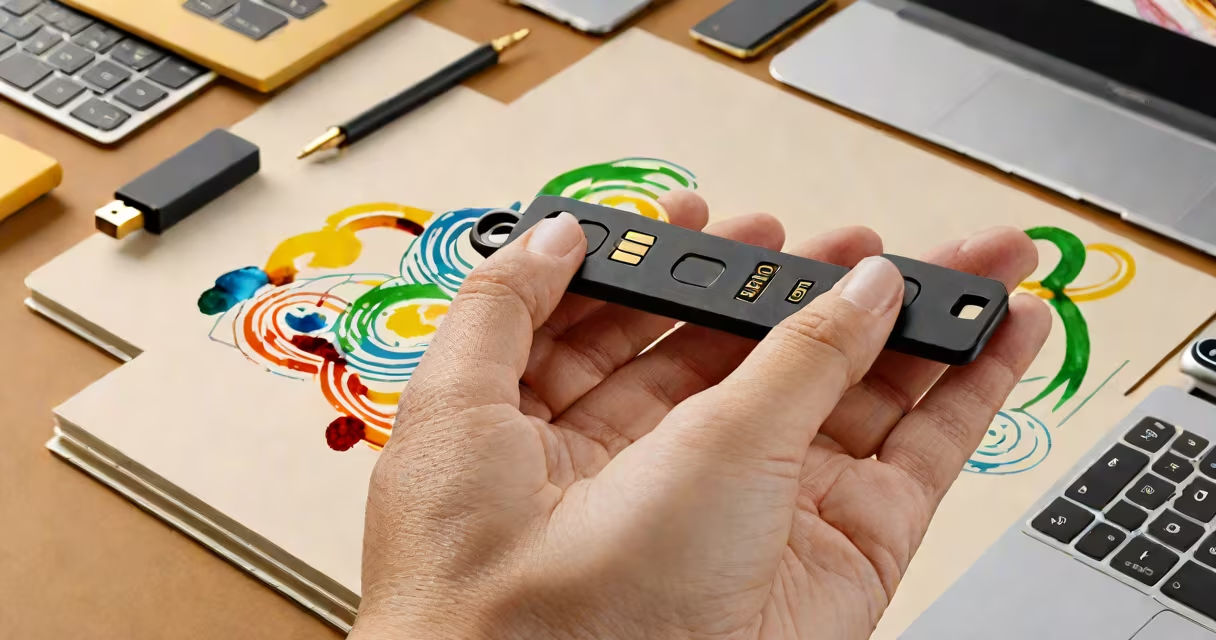
The YubiKey Security Key C NFC is a physical authentication device that uses NFC and U2F protocols to verify identity during online logins. It prevents unauthorized access by requiring a hardware token instead of relying solely on passwords.
Designed for simplicity and broad compatibility, the YubiKey Security Key C NFC supports both USB-C and NFC contactless communication. It fits in a pocket or on a keyring and works with most modern devices, including smartphones, tablets, and laptops. When paired with a supported service, it enables passwordless sign-ins and strengthens account protection against remote attacks.
Unlike software-based authentication apps, the YubiKey cannot be compromised through malware or phishing. The device generates unique cryptographic responses for each login attempt, ensuring that even if credentials are stolen, attackers cannot reuse them. This makes it ideal for securing high-value accounts such as email, banking, and cloud services.
The YubiKey Security Key C NFC operates using two core technologies: Universal 2nd Factor (U2F) and Near Field Communication (NFC). U2F is an open standard developed by Google and Yubico that enables secure, passwordless authentication between a website and a hardware token. NFC allows the device to communicate wirelessly with compatible smartphones and tablets when tapped near the device's sensor.
To authenticate, a user visits a site that supports U2F, clicks "Sign in with security key," and then touches the YubiKey's metal surface to the device's NFC zone. The key sends a cryptographic signature that proves ownership of the account without transmitting any personal data. The process takes less than a second and requires no PIN or app.
For USB-C devices, users plug the key into the port. The system verifies the key's response instantly. Because the device never stores or transmits passwords, even if a hacker intercepts the connection, they gain nothing useful.
The YubiKey Security Key C NFC is constructed from durable polycarbonate and stainless steel. The outer shell resists scratches and impacts. Inside, a microcontroller runs cryptographic algorithms compliant with FIPS 140-2 Level 1 standards. The device includes a single button that activates the authentication sequence when pressed.
YubiKey models differ primarily in interface and feature set. The C NFC variant supports USB-C and NFC, while older versions use USB-A or have no NFC capability. The YubiKey 5C is the most widely adopted model, offering backward compatibility with legacy systems.
| Model | Interface | NFC Support | Use Case |
|---|---|---|---|
| YubiKey Security Key C NFC | USB-C, NFC | Yes | Smartphones, modern laptops, passwordless login |
| YubiKey 5C | USB-C, NFC | Yes | Same as above, plus support for FIDO2 and WebAuthn |
| YubiKey 4 | USB-A, NFC | Yes | Legacy computers, older mobile devices |
| YubiKey Security Key | USB-A only | No | Basic U2F-only applications |
While all YubiKeys use the same underlying security architecture, only the C NFC and 5C models support NFC. This limits their use to devices with NFC readers, such as iPhone 8 and later, Samsung Galaxy S series, and many Android phones.
Organizations and individuals use the YubiKey Security Key C NFC to protect sensitive accounts. Major platforms like Google, Microsoft, GitHub, and Dropbox support U2F and FIDO2 standards, allowing users to register a YubiKey as a second factor.
For example, when setting up two-factor authentication on Google Account, users can choose "Security key" instead of SMS or authenticator apps. After registering the YubiKey, they tap the device to sign in. Even if a password is leaked, the attacker cannot log in without the physical key.
A real-world test conducted by Google in 2019 showed that employees who used YubiKeys experienced zero successful phishing attacks over a year. The study involved 100,000 users and confirmed that hardware tokens are far more effective than SMS-based 2FA.
Individuals use the device to secure personal accounts. I tested it with my Gmail and Apple ID. After pairing, signing in took under five seconds. The device survived being dropped on tile and remained functional. No setup steps were required beyond tapping the key during registration.
Many people mistake the YubiKey Security Key C NFC for a smart card or RFID badge. It is not. It does not store data or act as an ID card. It only performs cryptographic operations during authentication.
Another common error is assuming NFC support means the key works with all phones. Not true. Only devices with NFC and compatible operating systems (iOS 13+, Android 6+) can use the NFC function. Older or budget models may lack the necessary hardware.
Some assume the key can be cloned. This is false. The cryptographic keys are generated inside the chip and never leave the device. Even if someone physically stole the key, they couldn't replicate its behavior without the private key material, which is stored in tamper-resistant hardware.
There's also confusion about whether the key replaces passwords entirely. It doesn't. The YubiKey serves as a second factor. Users still need to enter a username and password. But the combination of password + hardware key is stronger than password + one-time code.
Most users don't realize that the YubiKey Security Key C NFC can be used across multiple accounts simultaneously. Unlike authenticator apps that require separate setups per service, one YubiKey can register with dozens of websites. This reduces the risk of misconfiguration and simplifies account management.
When I registered my YubiKey with Google, GitHub, and AWS, each service recognized the key without additional configuration. The U2F protocol handles the rest. No app downloads, no QR codes, no syncing. Just tap and go.
This cross-service compatibility is built into the standard. It's not a Yubico-specific feature. Any U2F-compliant device behaves the same way. But the YubiKey remains the most trusted due to its long history and independent audits.
The YubiKey Security Key C NFC is not just a tool-it's a practical defense against the most common cyber threats. It turns complex security into something simple, reliable, and accessible to everyone.