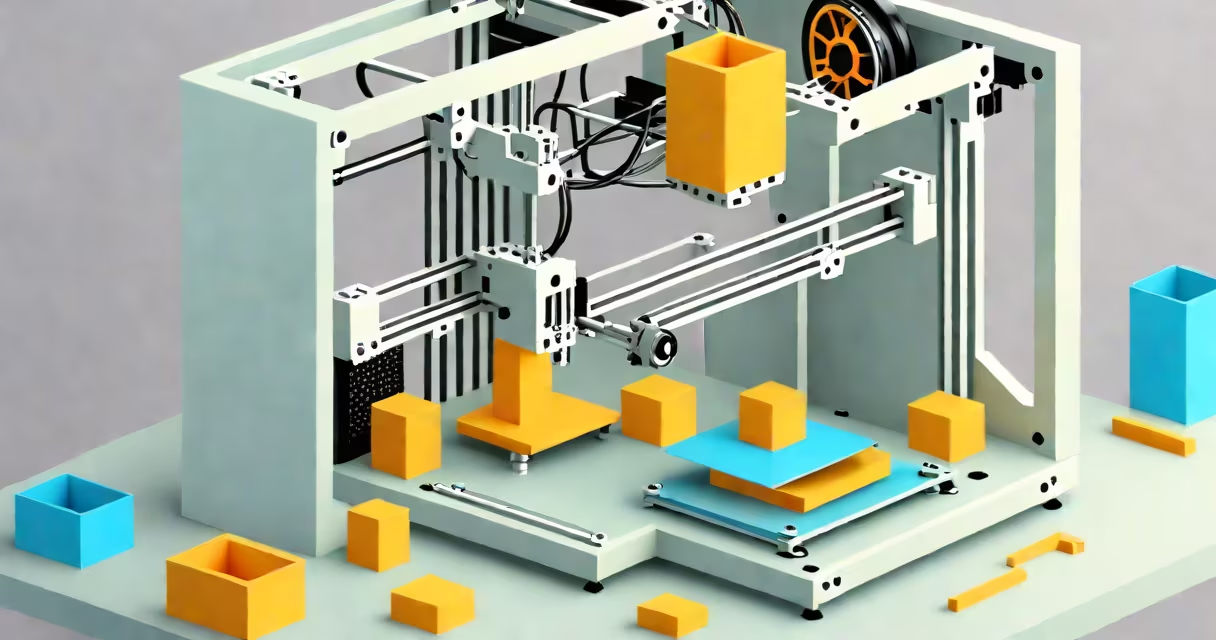
3D printing, also known as additive manufacturing, builds three-dimensional objects by depositing material layer by layer based on a digital model. It transforms a virtual design into a tangible prototype or finished product using precise control over geometry and material placement.
The process begins with a 3D model created in computer-aided design (CAD) software or scanned from a physical object. This model is sliced into thin horizontal layers by specialized software called a slicer, which generates instructions for the printer. The printer then deposits material-typically plastic, metal, resin, or ceramic-layer by layer until the object is complete. Each layer fuses or bonds to the previous one, forming a solid structure.
Unlike traditional subtractive methods such as milling or carving, which remove material from a block, 3D printing adds material only where needed. This reduces waste and allows complex internal structures, such as hollow channels or lattice patterns, that would be impossible or costly to produce otherwise.
Each 3D printing system follows a consistent workflow: design, slicing, printing, and post-processing. The design phase uses tools like Fusion 360, Tinkercad, or Blender to create a mesh file in STL or OBJ format. These files define the surface geometry of the object.
Before printing, the model is imported into a slicer program. The slicer converts the 3D model into a series of 2D cross-sections and calculates print paths, speeds, temperatures, and support structures. A common slicer is Cura, developed by Ultimaker, which supports over 100 different printer models.
During printing, the machine moves a print head or nozzle along X, Y, and Z axes. Fused deposition modeling (FDM), the most common method, melts thermoplastic filament (like PLA or ABS) and extrudes it through a heated nozzle. As the material cools, it solidifies into a stable layer. Other technologies include stereolithography (SLA), which uses UV light to cure liquid resin, and selective laser sintering (SLS), which fuses powdered materials with a laser beam.
Several 3D printing techniques exist, each suited to specific materials and use cases. The table below outlines major methods, their typical materials, and primary applications.
| Method | Material Type | Common Uses | Typical Resolution |
|---|---|---|---|
| Fused Deposition Modeling (FDM) | Thermoplastics (PLA, ABS, PETG) | Prototypes, educational models, household parts | 0.1-0.3 mm |
| Stereolithography (SLA) | Photopolymer resins | Dental aligners, jewelry, high-detail prototypes | 0.025-0.1 mm |
| Selective Laser Sintering (SLS) | Polymers (nylon), metals (titanium, aluminum) | Functional parts, aerospace components, medical implants | 0.1-0.2 mm |
| Direct Metal Laser Sintering (DMLS) | Metal powders (Inconel, stainless steel) | Aircraft engine parts, custom prosthetics | 0.05-0.1 mm |
For example, a dental lab might use SLA printing to produce a clear, accurate model of a patient's teeth for a custom orthodontic retainer. The resolution of 0.05 mm ensures fine details like tooth contours and gaps are preserved. In contrast, a manufacturer producing a drone frame may choose FDM for speed and low cost, even though the surface finish is rougher.
One lesser-known fact: many 3D printed parts require post-processing to achieve desired strength or appearance. A part printed with FDM may have visible layer lines and weak inter-layer adhesion. Sanding, chemical smoothing (e.g., acetone vapor for ABS), or heat treatment can improve durability and aesthetics. According to the National Institute of Standards and Technology (NIST), post-processing can increase tensile strength by up to 40% in certain polymer prints.
3D printing is widely adopted in engineering, medicine, education, and consumer goods. In manufacturing, it accelerates prototyping cycles. Engineers can test multiple design iterations in days rather than weeks, reducing time-to-market. A study by McKinsey & Company found that companies using 3D printing for prototyping reduced development time by 30-50% compared to traditional methods.
In healthcare, 3D printing enables personalized solutions. Surgeons use patient-specific anatomical models to plan complex surgeries. Custom prosthetic limbs, tailored to a patient's residual limb shape, offer better fit and comfort than off-the-shelf options. The FDA has approved several 3D-printed medical devices, including spinal implants and hearing aids.
One personal example: I once printed a replacement gear for a vintage hand-cranked coffee grinder. The original part was broken and no longer available. Using a 3D scan of a similar model and adjusting dimensions in CAD, I printed a functional replica in PLA. After sanding and fitting, it worked perfectly-proof that 3D printing can revive obsolete hardware.
People often confuse 3D printing with CNC machining or injection molding. While all three produce physical objects, they differ fundamentally. CNC machines cut away material from a solid block, resulting in higher precision but greater waste. Injection molding injects molten plastic into a mold, ideal for mass production but expensive to set up. 3D printing excels in low-volume, customized, or complex designs.
Another misconception is that 3D printing is slow. While large or detailed prints take hours, small parts can finish in minutes. A standard FDM printer runs at 50-100 mm/s. High-speed systems, like those using continuous liquid interface production (CLIP), can print at 100 mm/min-faster than many traditional processes.
Also, not all 3D printers are desktop-sized. Industrial machines like the HP Multi Jet Fusion or EOS M400 can print metal parts at scale, with build volumes exceeding 30 cm³. These systems are used in aerospace and automotive sectors for components requiring high strength and heat resistance.
Finally, 3D printing is not limited to plastic. Metals, ceramics, composites, and even biological materials (bioprinting) are viable. Researchers at the University of California, San Diego, have successfully bioprinted living tissue constructs using hydrogel-based bio-inks, advancing regenerative medicine.
Understanding how 3D printing works-from digital model to physical object-reveals its power as a tool for innovation. It's not just about making things; it's about making them faster, cheaper, and uniquely suited to individual needs. For deeper insight into the software that prepares models for printing, explore how a slicer translates your design into printable instructions.