Iron was not discovered by a single individual; it was gradually understood and used by multiple ancient cultures over thousands of years. Early humans encountered iron in meteorites and later learned to extract it from ore through smelting techniques developed independently across Eurasia and Africa.
The earliest known use of iron dates to around 3500 BCE in ancient Egypt and Mesopotamia, where small amounts of meteoric iron were shaped into tools and ornaments. These materials came from space, not Earth's crust. The first intentional extraction of iron from ore occurred around 1500 BCE in Anatolia (modern-day Turkey), where people began producing iron metal using bloomery furnaces. This marked the beginning of the transition from the Bronze Age to the Iron Age.
Archaeological evidence from sites like Tell Hammam et-Tirzah in Israel and Çatalhöyük in Turkey shows that ironworking spread across the Near East and Mediterranean regions by 1200 BCE. By this time, communities had developed methods to heat iron-rich ores with charcoal to produce usable metal. The process required precise control of temperature and airflow-skills passed down through generations rather than invented by one person.
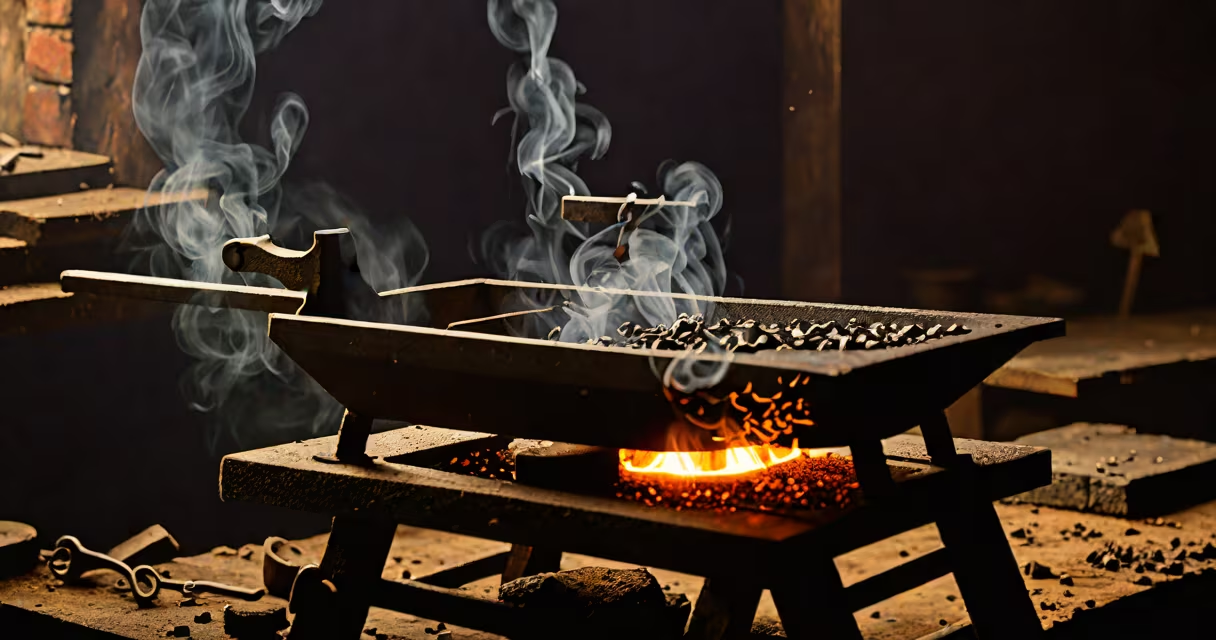
Early ironmakers used a technique called bloomery smelting. They stacked layers of iron ore and charcoal in a clay or stone furnace, then blew air into the base using bellows. Temperatures reached about 1,200°C (2,200°F), enough to reduce iron oxides into metallic iron while leaving slag behind. The result was a spongy mass called a "bloom," which needed to be hammered repeatedly to remove impurities and consolidate the metal.
This method produced low-carbon iron suitable for tools and weapons. Unlike bronze, which required tin-a rare and expensive material-iron was abundant in many regions. Once people learned to work it, iron became central to agriculture, warfare, and construction. A single iron plowshare could last decades longer than a bronze one, increasing crop yields.
For example, excavations at the site of Alalakh in modern-day Turkey revealed iron artifacts dating to 1800 BCE. These included knives and arrowheads made from smelted iron. Radiocarbon dating and metallographic analysis confirmed they were forged using bloomery techniques, proving that ironworking was already advanced in the Levant long before the term "Iron Age" was coined.
Iron was not uniform in quality or application. Different cultures adapted it based on available resources and needs. The following table outlines key forms and uses:
| Type | Source | Use Case | Example Location |
|---|---|---|---|
| Meteoric iron | Extraterrestrial | Ornamental objects, ritual items | Naqada, Egypt (c. 3500 BCE) |
| Bloomery iron | Smelted ore | Tools, weapons, agricultural implements | Alalakh, Turkey (c. 1800 BCE) |
| Wrought iron | Refined bloomery product | Structural beams, nails, armor | Assur, Assyria (c. 1000 BCE) |
| Cast iron | High-temperature smelting | Heavy tools, sculptures | China (c. 500 BCE) |
China developed cast iron independently around 500 BCE, using larger furnaces capable of reaching temperatures above 1,300°C. This allowed molten iron to be poured into molds-unlike earlier methods that relied on solid blooms. Chinese artisans created complex irrigation tools and architectural components from cast iron, demonstrating a level of mastery unmatched in Europe until the 18th century.
Many assume iron was "discovered" in a single moment, like fire or the wheel. That's incorrect. Iron is a naturally occurring element, and its presence in soil and rock has been known since prehistoric times. What changed was human ability to extract and shape it.
A common error is attributing iron's use to a specific civilization or inventor. For example, some sources claim the Hittites "invented" ironworking. While the Hittite Empire (c. 1600-1178 BCE) did dominate trade routes in Anatolia and may have been among the first to use iron widely, archaeological findings show iron tools existed in Egypt and Mesopotamia earlier. The Hittites likely refined techniques, but didn't originate them.
Another misconception is that iron replaced bronze because it was stronger. In reality, early iron was often softer and less durable than bronze. Its advantage lay in abundance and cost. Iron ore was more widely distributed than copper and tin. As populations grew, access to iron enabled mass production of tools and weapons, making it essential for expanding states and empires.
I visited a historical reenactment site in northern Germany where volunteers recreated a 12th-century bloomery furnace. Using locally sourced hematite ore and hardwood charcoal, they heated the furnace for nearly eight hours. When they opened it, the bloom was dark gray and porous, covered in slag. After hammering it over an anvil for 45 minutes, they shaped a knife blade. The metal cracked slightly under pressure-proof that early iron was brittle compared to modern steel.
This experiment showed that mastering iron wasn't a sudden breakthrough. It took trial, error, and accumulated knowledge. One participant noted, "You don't learn how to make iron in a day. You do it for years, watching the color of the flame, feeling the weight of the bloom."
Iron was never "found" like a lost artifact. It was extracted, processed, and improved upon over centuries. The term "discovery" implies a single moment of revelation. Iron's story is one of incremental progress across continents and millennia.
According to the British Museum's classification of ancient metals, iron use predates written records in many regions. The museum notes that "iron tools appear in the archaeological record before the invention of writing in several cultures, indicating that the knowledge was transmitted orally and through apprenticeship."
Similarly, the Metropolitan Museum of Art's timeline on metallurgy states: "The transition to iron was gradual. No single culture can be credited with inventing ironworking. Instead, it emerged independently in multiple centers due to similar environmental and economic pressures."
There is no single person who discovered iron. Iron was known to ancient peoples through natural occurrences and eventually mastered through experimentation. The development of ironworking marks one of humanity's most significant technological shifts-not because of a sudden invention, but because of sustained innovation across diverse societies.