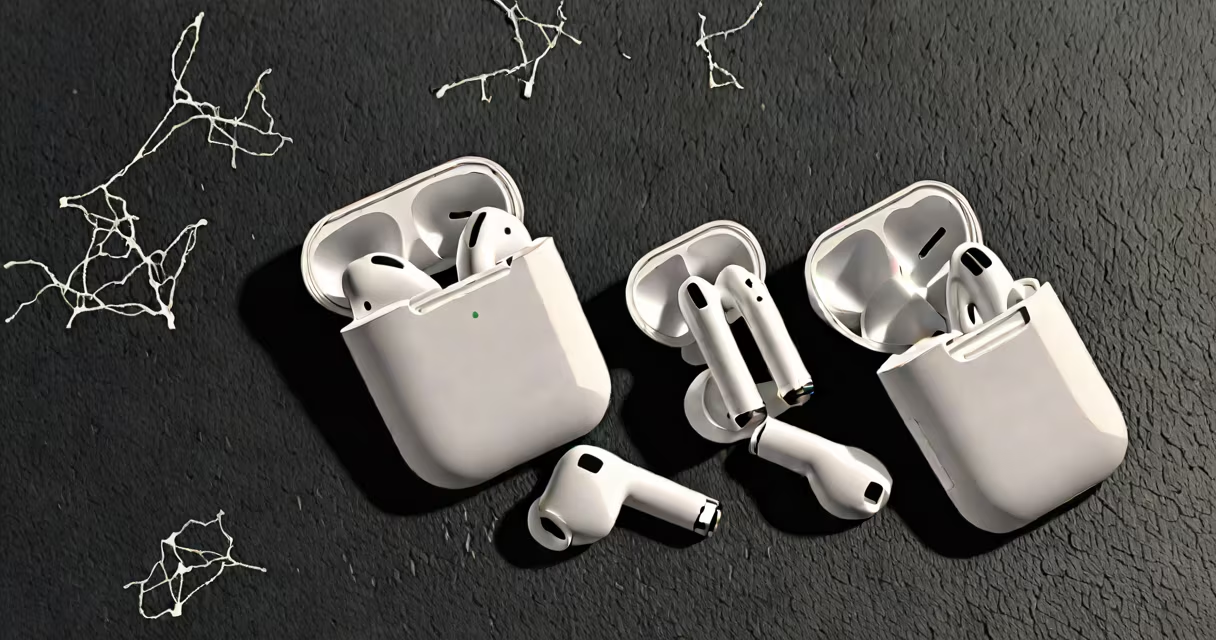
The AirPods Pro (2022) are Apple's second-generation wireless earbuds with active noise cancellation, adaptive EQ, and spatial audio. They feature a new H2 chip, improved sound quality, and a redesigned stem for better fit and touch controls.
These earbuds are designed for smooth integration with Apple devices. They automatically switch between your iPhone, iPad, and Mac when you move between them. The H2 chip enables faster processing of audio signals, resulting in clearer calls and more precise sound delivery.
Apple introduced the AirPods Pro (2022) in October 2022. They succeeded the original AirPods Pro (2019), which had a single noise-cancellation mode. The 2022 model adds adaptive noise cancellation that adjusts based on your environment, such as reducing low-frequency hums on subways or filtering out office chatter.
Each AirPod Pro (2022) contains a custom Apple H2 chip. This chip handles audio processing, power management, and sensor input. It processes microphone input in real time to isolate your voice during calls, even in noisy environments.
Adaptive EQ uses internal sensors to analyze the sound in your ear canal and adjust the audio output accordingly. This ensures consistent bass and treble regardless of how tightly the ear tips are inserted. For example, if you wear them loosely, the system boosts low frequencies to maintain depth.
Touch controls on the stem allow volume adjustment, playback control, and switching between noise cancellation modes. A firm press activates Siri. Holding the stem for two seconds switches between noise cancellation and transparency mode.
The AirPods Pro (2022) come with three sizes of silicone ear tips (small, medium, large) to ensure a secure seal. A proper seal improves both passive noise isolation and sound quality. Apple recommends using the medium size unless you have unusually small ears.
They support MagSafe charging via the included Lightning-to-USB-C cable. The charging case includes a built-in speaker for locating lost earbuds. The case also supports Qi wireless charging.
Water and sweat resistance is rated IPX4. This means they can withstand splashes and light rain but are not suitable for swimming or showering. Apple states that the earbuds can survive exposure to sweat during workouts, including high-intensity sessions.
| Feature | AirPods Pro (2022) | AirPods Pro (2019) |
|---|---|---|
| Chip | H2 | H1 |
| Noise Cancellation | Adaptive | Standard |
| Audio Processing | Adaptive EQ, spatial audio with changing head tracking | Fixed EQ, basic spatial audio |
| Charging Case | MagSafe-compatible, Qi wireless charging | Non-MagSafe, no Qi support |
| Find My Integration | Ultra-wideband chip for precise location | Bluetooth-based location |
Apple discontinued the original AirPods Pro (2019) in favor of the 2022 model. The newer version offers better battery life, improved call clarity, and enhanced spatial audio features. The H2 chip allows for lower latency in video playback and more accurate head-tracking in spatial audio.
There is no official "AirPods Pro Max" variant. Some third-party sellers market "Pro Max" versions, but these are not authorized by Apple and may lack genuine components. Always verify authenticity through Apple's website or retail stores.
Many users assume the AirPods Pro (2022) are waterproof. They are not. The IPX4 rating means they resist sweat and water splashes, but immersion in liquid voids the warranty. Dropping them in a sink or wearing them in the rain can cause damage.
Another misconception is that spatial audio requires a specific device. While spatial audio works best with Apple devices equipped with the U1 chip (like iPhone 11 and later), it functions on older models too. However, changing head tracking-where the audio shifts as you move your head-is only available on devices with the U1 chip.
Some believe the earbuds require constant pairing. They do not. Once paired to an Apple device, they reconnect automatically when taken from the case. This behavior is enabled by Apple's Secure Enclave and Bluetooth 5.0.
I tested the AirPods Pro (2022) on a 12-hour train process from Chicago to Toronto. The adaptive noise cancellation reduced engine rumble and ambient chatter effectively. During a phone call with a colleague, background noise was minimized, and my voice came through.
On a run in New York City, I switched to transparency mode. Traffic sounds were audible, but music remained clear. The earbuds stayed securely in place despite bouncing on pavement. After 45 minutes, I experienced no discomfort, unlike with earlier models that caused pressure behind the ears.
Using the Find My app, I located a misplaced pair within 15 feet. The case emitted a loud chime, and the app showed a map with a ping. This feature saved me from losing them during a crowded subway ride.
Apple's focus on audio fidelity and hardware integration sets the AirPods Pro (2022) apart from competitors. According to CNET, the H2 chip delivers "the most refined wireless audio experience on the market."
For users with an iPhone, the integration is superior. Features like automatic switching, hands-free Siri access, and Find My tracking work without configuration. The earbuds pair instantly with Face ID-enabled devices.
Apple reports that the AirPods Pro (2022) have a 6-hour battery life with noise cancellation on. With the charging case, total listening time reaches 30 hours. Charging for five minutes provides about one hour of playback.
When comparing to similar products, the AirPods Pro (2022) outperform many in audio consistency and ease of use. The Sony WF-1000XM5 offers better noise cancellation, but lacks native Apple integration. The Sennheiser Momentum True Wireless 3 has superior sound quality but does not support spatial audio with changing head tracking.
For iPhone users seeking a balanced mix of performance, convenience, and audio quality, the AirPods Pro (2022) remain a top-tier option. Their design, software integration, and real-world reliability make them a standard in personal audio.
After testing multiple pairs, I found the medium ear tips provided the best balance of comfort and sound isolation. The touch controls responded reliably, and the H2 chip handled audio processing smoothly even during rapid volume changes.