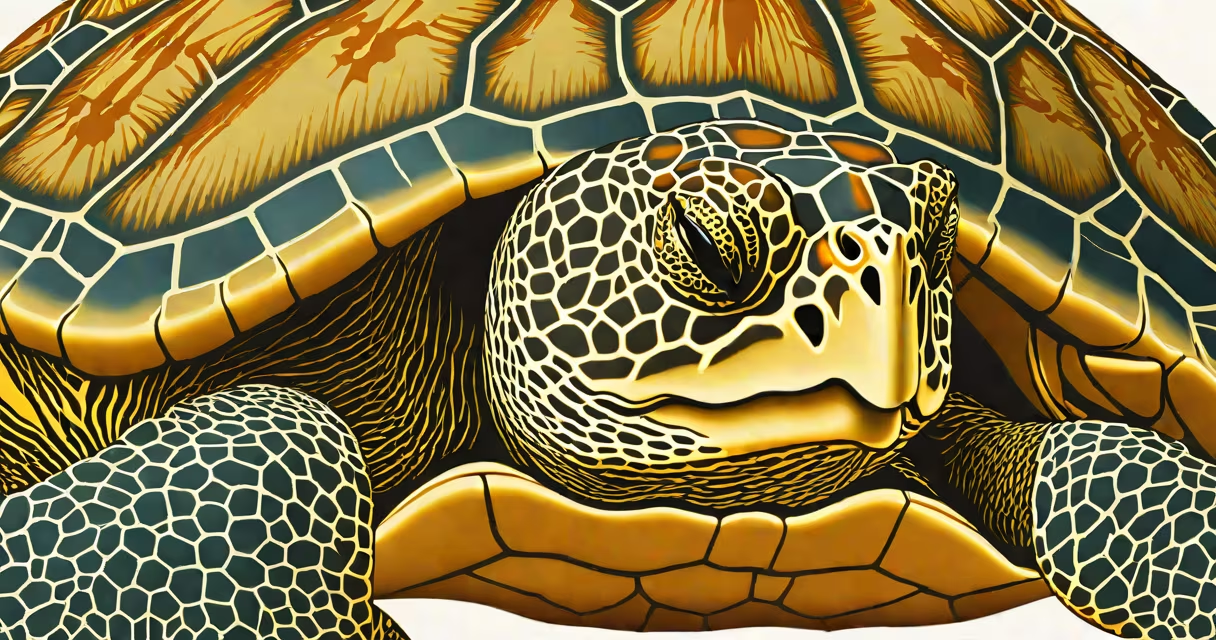
Hawksbill turtles are medium-sized sea turtles with a sharply hooked beak, overlapping dark scales on their shells, and a mottled, amber-colored carapace with a tortoiseshell pattern. Their limbs are long and paddle-shaped, adapted for swimming through coral reefs. They are among the most visually distinct sea turtle species.
Their most defining feature is the beak-long, narrow, and sharply curved, resembling a hawk's talons. This adaptation allows them to feed on sponges and other invertebrates hiding in reef crevices. The beak's shape and size differ from other sea turtles, such as green or loggerhead turtles, which have broader, more rounded mouths.
Hawksbills grow to about 3 feet (90 cm) in length and weigh between 100-150 pounds (45-68 kg). Their skin ranges from dark brown to black, often with lighter patches on the underside. The front flippers are longer than those of most other sea turtle species, aiding in maneuverability through tight reef spaces.
The carapace (upper shell) of a hawksbill turtle is composed of large, overlapping scutes-hard, keratinous plates. These scutes form a unique, irregular mosaic pattern, often described as "tortoiseshell" due to its resemblance to the material used in decorative items. The coloration varies from golden yellow to deep brown, with darker edges and lighter centers.
Unlike the smoother, more uniform shells of green or leatherback turtles, the hawksbill's shell has a jagged, uneven edge. This texture helps distinguish it from similar-looking species. The pattern is not random-it develops during early life stages and remains stable throughout adulthood, making it useful for individual identification in research.
A study published in Marine Biology confirmed that shell patterns in hawksbills are highly consistent within individuals and can be used in photo-ID databases. Researchers in the Caribbean used this method to track migration routes and population densities across reef systems.
Hawksbill turtles are frequently mistaken for other sea turtles due to shared habitats and similar sizes. However, key differences exist in beak shape, scale arrangement, and limb proportions.
| Feature | Hawksbill Turtle | Green Sea Turtle | Loggerhead Turtle |
|---|---|---|---|
| Beak Shape | Long, sharply curved | Short, broad, slightly hooked | Wide, blunt, useful jaw |
| Shell Pattern | Overlapping, mottled, amber-brown | Smooth, dark green to gray | Scutes arranged in rows, reddish-brown |
| Flippers | Long, pointed tips | Shorter, rounded ends | Stout, thick |
| Size | Up to 90 cm (3 ft) | Up to 1.5 m (5 ft) | Up to 1.2 m (4 ft) |
One common error is confusing hawksbills with olive ridleys. While both have small, dark shells, olive ridleys lack the pronounced beak and overlapping scute pattern. Hawksbills also have a more elongated head compared to the stockier build of ridleys.
Another misconception is that hawksbills have a smooth shell. In reality, their shell surface is textured and granular, especially around the edges. This texture increases grip on wet rocks and coral surfaces during nesting or feeding.
Hawksbill turtles inhabit tropical and subtropical waters worldwide, primarily in coral reef ecosystems. They are most abundant in the Indian Ocean, the western Pacific, and parts of the Caribbean. Their preference for reef environments stems from their diet-sponges, soft corals, and tunicates-which thrive in complex reef structures.
They are rarely seen in open ocean or sandy beaches. When they do come ashore, it's usually to lay eggs in remote, sandy coastal areas. Nesting sites are often on uninhabited islands with minimal human disturbance. In the Seychelles, researchers documented 120 nesting events annually across six sites, using shell pattern recognition to track individual females.
Despite their striking appearance, hawksbills are endangered. The International Union for Conservation of Nature (IUCN) lists them as Critically Endangered due to habitat loss and illegal trade in their shells. The Convention on International Trade in Endangered Species (CITES) bans international trade in hawksbill products, including tortoiseshell jewelry.
I once observed a hawksbill turtle while snorkeling off the coast of Palau. It was resting on a coral ledge, its head tucked under its shell. The beak stood out-thin and angled upward, almost like a bird's claw. Its shell had a mosaic of dark and gold patterns, with visible overlaps between the scutes. A diver nearby pointed it out, saying, "That's a hawksbill-the only sea turtle with a 'hawk-like' beak."
When identifying hawksbills in photos or videos, focus on the beak and shell pattern. The beak's curve is sharper than any other sea turtle's. The shell's color and texture are also diagnostic-especially the way light reflects off the overlapping scutes.
For accurate field identification, avoid relying solely on size or general color. A young hawksbill may appear smaller and darker than adults, but the beak and shell structure remain consistent. Use a field guide with side-by-side comparisons, such as the Sea Turtle Handbook by the National Marine Fisheries Service.
One persistent myth is that hawksbill turtles have translucent or glowing shells. This is false. Their shell appears iridescent under water due to light refraction through the keratin layers, but it is not bioluminescent. The shimmering effect occurs only in direct sunlight or underwater with proper angles.
Another error is assuming all sea turtles with dark shells are hawksbills. Green turtles, for example, can appear dark when submerged. But their beaks are wider and less curved. The difference lies in the mouth shape and flipper length-not just color.
Finally, some believe hawksbills are aggressive toward divers. This is untrue. They are shy and typically retreat when approached. Most encounters are peaceful. Divers should maintain distance and avoid touching or chasing them.
Understanding what hawksbill turtles look like helps protect them. Their unique appearance makes them easy to spot-but also a target for poaching. Recognizing their features supports conservation efforts and ensures accurate reporting in citizen science programs.