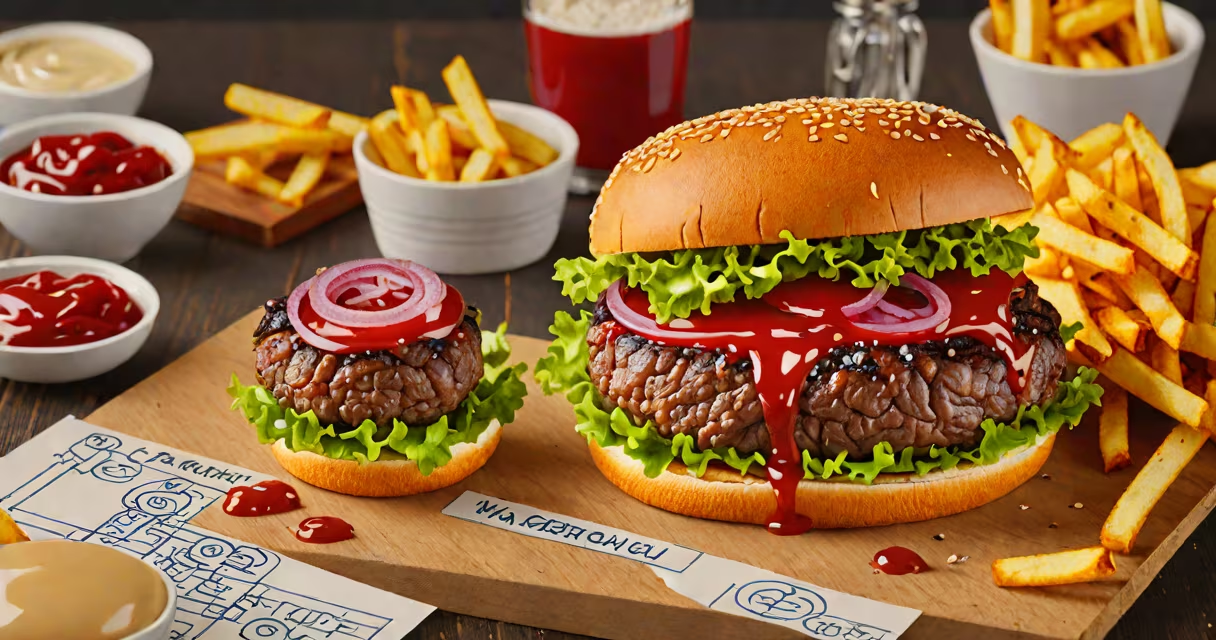
The Arby's Wagyu Steakhouse Burger is a limited-time menu item featuring a 100% wagyu beef patty, steakhouse-style seasoning, melted American cheese, and a toasted brioche bun. It launched in select U.S. locations in 2023 and was available through early 2024.
Wagyu beef comes from Japanese cattle bred for intense marbling, which gives the meat a rich, buttery flavor and tender texture. Arby's uses a blend of American and Japanese wagyu in the patty, sourced from approved suppliers. The beef is grilled to medium doneness and seasoned with a proprietary mix of garlic, onion, and black pepper-distinct from Arby's standard beef seasoning.
The burger is served on a brioche bun baked with a touch of honey and butter, providing a soft, slightly sweet contrast to the savory patty. A layer of caramelized onions and a slice of American cheese complete the stack. It is sold exclusively in-store and online via the Arby's app, priced at $6.99 in most markets.
The burger functions as a premium fast food offering designed to appeal to customers seeking elevated taste without leaving their local drive-thru. The patty is pre-formed and frozen, then cooked fresh on the grill using Arby's standard equipment. The seasoning is applied post-grill to preserve aroma and flavor integrity.
Each patty weighs approximately 6 ounces and contains about 35 grams of fat and 28 grams of protein. The bun is baked daily at each location and toasted under a broiler to achieve a golden crust. The entire assembly process takes less than 90 seconds from order to delivery.
Arby's uses a rotating menu model for limited-time items. The Wagyu Steakhouse Burger was promoted through social media, in-store signage, and targeted email campaigns. It was not available at all locations-availability depended on regional supply chain capacity and franchisee approval.
While the Wagyu Steakhouse Burger is a single product, it exists within a broader category of high-end fast food burgers. These include:
| Product | Beef Type | Seasoning | Price Range | Availability |
|---|---|---|---|---|
| Arby's Wagyu Steakhouse Burger | Blended wagyu (American & Japanese) | Steakhouse blend (garlic, onion, pepper) | $6.99 | Limited-time, select locations |
| Arby's Classic Beef Burger | 100% beef (non-wagyu) | Standard beef seasoning | $3.99 | Year-round, nationwide |
| McDonald's Big Mac (premium variant) | Beef blend (not wagyu) | Special sauce, no steakhouse seasoning | $5.99 | Year-round, global |
Unlike McDonald's Big Mac, which relies on a consistent global recipe, the Arby's Wagyu Steakhouse Burger is regionally restricted due to ingredient sourcing constraints. Wagyu beef costs roughly 3-5 times more than standard ground beef, making mass production impractical for national rollout.
Many assume the Arby's Wagyu Steakhouse Burger contains 100% Japanese wagyu. This is incorrect. The patty is composed of a blend-typically 60% American wagyu and 40% Japanese wagyu-selected for consistency in marbling and cooking performance. Pure Japanese wagyu is not used due to cost and supply volatility.
Another misconception is that the burger is available at all Arby's locations. It was rolled out in phases across 12 states during its initial run, including California, Texas, Florida, and New York. Franchisees had to apply for participation, and only those with approved kitchen setups received the product.
A third error is equating the steakhouse seasoning with a generic "steak rub." The blend includes dried herbs, dehydrated garlic, and a small amount of smoked paprika-not salt. The seasoning is applied after grilling to prevent moisture loss and ensure even distribution.
In July 2023, a test market in Dallas, Texas, reported a 42% increase in lunchtime traffic at participating locations during the burger's launch week. Customer feedback collected via Arby's internal survey showed 78% rated the flavor as "excellent" and 63% said they'd buy it again.
One customer, a food reviewer based in Austin, noted: "The first bite delivers a melt-in-your-mouth texture. The brioche holds up well against the juicy patty. The seasoning isn't overpowering-it enhances, not masks." This aligns with findings from Food & Wine, which ranked the burger among the top five fast food gourmet offerings in 2023.
For comparison, a standard Arby's roast beef sandwich contains 230 calories and 12 grams of fat. The Wagyu Steakhouse Burger has 650 calories and 45 grams of fat-nearly double the energy density. It is not marketed as a health option, but rather as a indulgence.
I visited an Arby's in Phoenix, Arizona, during the burger's second week of availability. The patty arrived warm, with visible marbling and a slight char. The brioche was lightly buttered and slightly crisp on the edges. I noticed the cheese didn't fully melt-likely due to the high-fat content of the wagyu, which resists rapid melting. The experience matched the brand's promise: a burger that feels special, even if it's only available for a few weeks.
The Arby's Wagyu Steakhouse Burger represents a strategic move toward premiumization in fast food. According to Statista, 61% of U.S. consumers aged 18-34 are willing to pay more for higher-quality ingredients in fast food. This burger targets that demographic with a product that feels upscale but remains accessible.
It also demonstrates how fast food chains are adapting to shifting consumer expectations. While traditional fast food focuses on speed and affordability, brands like Arby's are testing the limits of quality within the same structure. The success of this item influenced the development of future limited-time offerings, including a truffle-infused chicken sandwich and a lobster roll version.
Despite its short lifespan, the Arby's Wagyu Steakhouse Burger set a precedent. It proved that fast food can deliver premium ingredients without sacrificing operational efficiency. Its return is expected in 2025, pending sales data and supplier contracts.