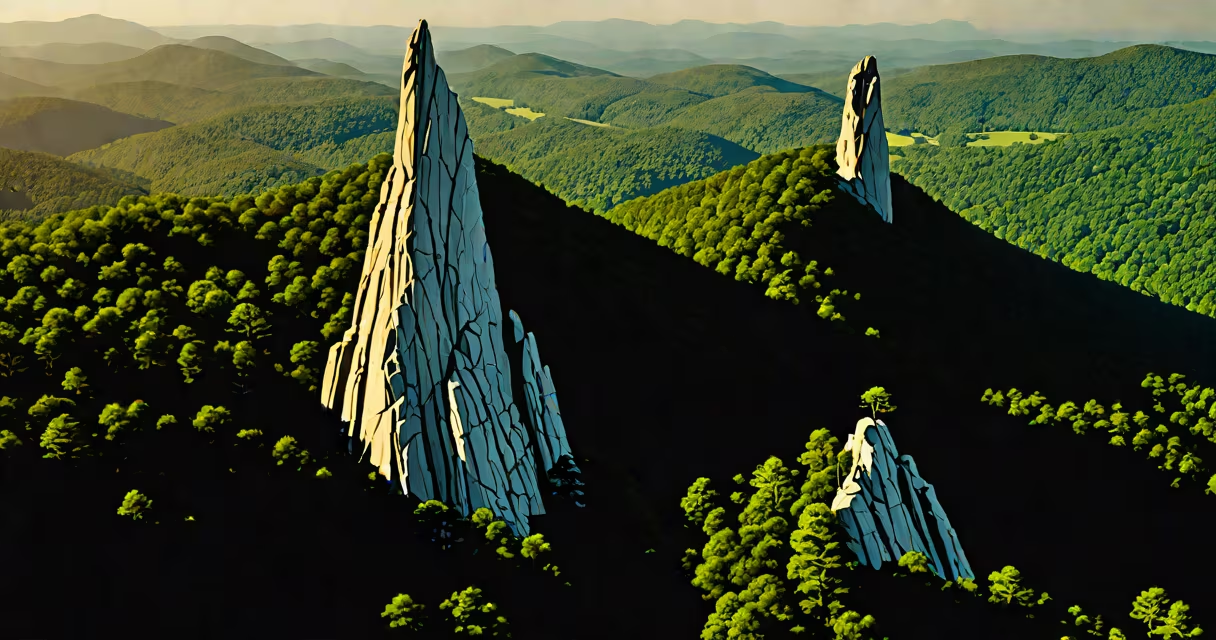
Chimney Rock North Carolina is a 360-foot-tall granite spire formed over 1 billion years ago, located within Chimney Rock State Park near Lake Lure. The formation stands as a prominent geological landmark in the Blue Ridge Mountains, accessible via a 1.5-mile trail that climbs 1,000 feet to the summit.
The rock is composed of pegmatite, a coarse-grained igneous rock rich in quartz, feldspar, and mica. This composition resisted erosion while surrounding softer rock eroded away, leaving the spire exposed. Geologists estimate the formation began during the Grenville Orogeny, a continental collision event that shaped much of eastern North America's bedrock.
Visitors reach the summit via the Chimney Rock Trail, a steep path with switchbacks and iron handrails installed in the 1930s by the Civilian Conservation Corps. The trail ends at a stone platform with a viewing deck offering 360-degree views of the Pisgah National Forest, the Blue Ridge Parkway, and the surrounding valleys. The park charges $10 per vehicle for entry, with additional fees for guided tours and the Skyline Trail.
Chimney Rock emerged through differential erosion. Over millions of years, water, ice, and wind wore down softer sedimentary layers around the harder pegmatite core. As the surrounding rock eroded, the resistant spire remained, creating a vertical column that now rises above the field.
The park's elevation ranges from 2,300 to 3,000 feet above sea level. Summer temperatures average 75°F during the day and drop to 55°F at night. Winter brings snowfall, with an average of 12 inches annually. The area receives about 50 inches of precipitation yearly, mostly in spring and fall.
Access is limited to foot traffic. Vehicles cannot drive to the base of the rock. Visitors park at the main lot, then walk 0.7 miles along the paved Park Loop Trail before joining the Chimney Rock Trail. The hike takes 45 to 75 minutes depending on pace and fitness level. Dogs are permitted on leash but not on the trail itself.
Chimney Rock is classified as a monolith-a single large rock formation isolated from surrounding terrain. It differs from other similar formations such as the Matterhorn in Switzerland or El Capitan in Yosemite, which are also granitic but formed under different tectonic conditions.
| Feature | Description | Relevance |
|---|---|---|
| Height | 360 feet (110 meters) | One of the tallest freestanding rock spires in the eastern U.S. |
| Rock Type | Pegmatite with quartz and feldspar | Resistant to weathering; explains long-term stability |
| Trail Length | 1.5 miles round-trip | Steep incline; not suitable for those with mobility issues |
| Viewing Platform | Stone deck at 3,000 ft elevation | Offers visibility to 25 miles on clear days |
Unlike artificial lookout points, Chimney Rock's view is unobstructed. On a clear day, visitors can see the Blue Ridge Parkway stretching westward toward Asheville and the Great Smoky Mountains to the south. The park also hosts seasonal events such as the annual Chimney Rock Music Festival and stargazing nights in partnership with the North Carolina Astronomical Society.
Many assume Chimney Rock is man-made due to its symmetry and verticality. It is not. The rock's near-perfect vertical alignment results from natural fracturing patterns in the pegmatite, not human intervention. No construction records exist from the 18th or 19th centuries claiming ownership or modification of the site.
Another misconception is that the trail leads to a cave or hollow interior. The rock is solid throughout. The narrow passages visible from the base are surface cracks caused by thermal expansion and contraction over time. These fissures do not penetrate deeper than 10 feet.
A lesser-known fact: the rock's name comes from early 19th-century settlers who likened its shape to a fireplace chimney. The original name was "The Chimney," later formalized as "Chimney Rock" in 1850s land surveys. The park was established in 1965 after decades of local advocacy and federal funding.
In July 2022, a group of four hikers from Charlotte attempted the trail at 7 a.m. to avoid afternoon thunderstorms. They started at the Park Loop Trailhead, where signage noted the trail's difficulty level as "moderate to strenuous." After 20 minutes, they reached the first switchback, where the incline rose to 25%. By the halfway point, heart rates averaged 150 beats per minute.
At the summit, one member reported seeing a bald eagle circling at 3,000 feet. The group spent 20 minutes taking photos before descending. They encountered a ranger at the base who confirmed that the park had recorded 12,000 visitors in June 2022, with peak days averaging 2,500 people.
After the hike, they visited the visitor center, where a display showed cross-sections of the rock revealing layering consistent with pegmatite cooling from magma. The exhibit cited research from the North Carolina Geological Survey, which confirms the rock's age at 1.1 billion years.
Chimney Rock lies 45 miles northeast of Asheville and 20 miles southwest of Hendersonville. The nearest major airport is Charlotte Douglas International Airport, 100 miles away. Travelers often combine a visit with nearby attractions such as the Biltmore Estate or the Blue Ridge Parkway's Linville Falls.
For those seeking similar geology, the Appalachian Trail passes through the region, and the Pisgah National Forest offers over 300 miles of hiking. The park's proximity to the Blue Ridge Parkway allows access to other landmarks like Table Rock and Looking Glass Rock.
When planning a trip, consider the park's seasonal closures. The Chimney Rock Trail closes from November 1 to March 31 due to icy conditions. The visitor center remains open year-round, but restrooms are closed during winter months.
Chimney Rock North Carolina is not just a hiking destination-it's a living record of Earth's deep past. Its enduring presence reflects the slow, relentless work of geology over eons. The rock stands as both a natural wonder and a cultural touchstone, drawing thousands annually to witness its quiet majesty.