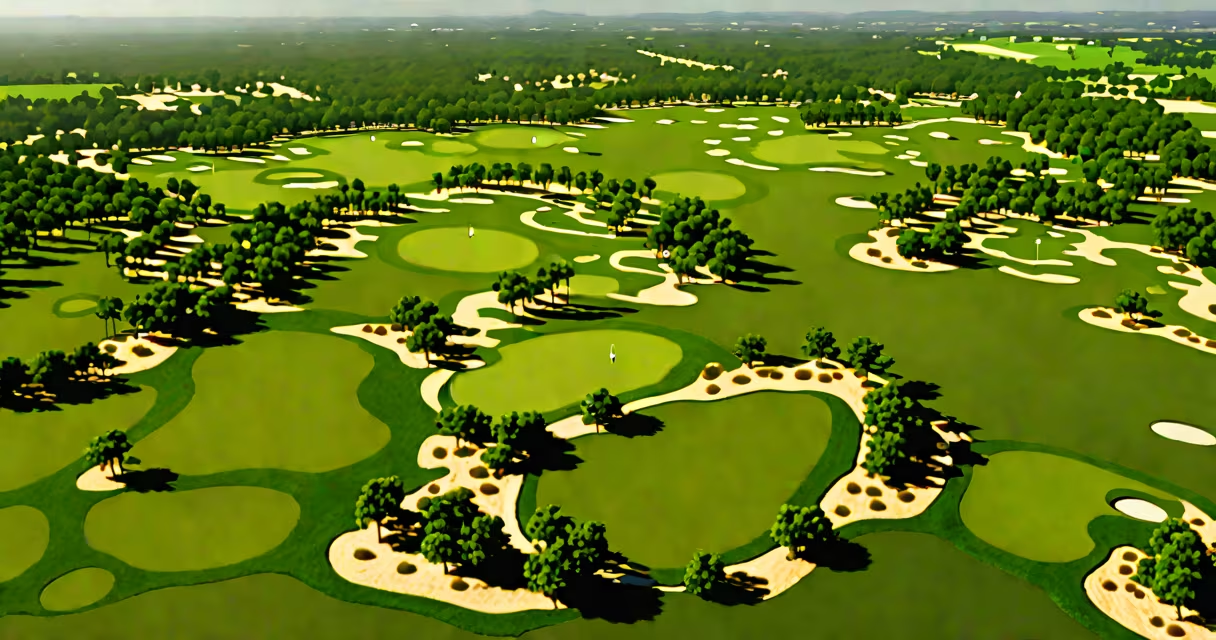
Clustered spires golf describes a course design where multiple elevated greens are positioned close together, forming a visually striking cluster often resembling spires. This layout emphasizes precision, risk-reward strategy, and advanced shot shaping.
This configuration is common on high-stakes courses, especially those hosting professional tournaments. The term "spires" refers to the tall, narrow green complexes that rise above surrounding terrain, creating distinct visual and tactical zones. These clusters are engineered to test elite players' short-game control and mental discipline under pressure.
Examples include the 16th hole at Augusta National Golf Club, where three greens sit within a 30-yard radius, each requiring different approaches based on pin position. The design forces players to assess wind, slope, and grass firmness with extreme care. A single misjudged chip can result in a three-putt or worse.
Each green in a clustered spires layout is independently contoured and typically slopes away from adjacent ones. This prevents cross-contamination of ball roll and helps each green's speed and grain are consistent. Greens are often constructed with reinforced subbases to maintain stability under heavy foot traffic during tournaments.
Players face decisions on which green to aim for based on pin placement, weather conditions, and their own skill set. For instance, a player with a strong flop shot may target the farthest green, while a player with better touch on chips might opt for the middle one. The proximity increases the penalty for poor execution-missing one green often means landing in a bunker or rough adjacent to another.
The design also influences caddie strategy. On the PGA Tour, caddies frequently use laser rangefinders and GPS tools to measure distances between greens within a cluster. A 2022 study by the Golf Course Superintendents Association of America (GCSAA) found that caddies on courses with clustered spires reported 37% higher decision fatigue compared to standard layouts.
There are three primary configurations in clustered spires golf:
| Type | Layout | Use Case | Example |
|---|---|---|---|
| Triangular cluster | Three greens arranged in a triangle, each accessible from different directions | Championship events, high-pressure holes | 12th hole, TPC Sawgrass (Ponte Vedra) |
| Linear row | Greens aligned along a central axis, spaced 15-20 yards apart | Practice rounds, qualifying stages | 14th hole, Pinehurst No. 2 (reconstruction by Bill Coore/Ben Crenshaw) |
| Radial cluster | Greens radiating from a central point, often with a shared bunker or water feature | Pro-am events, team competitions | 17th hole, St. Andrews Old Course (post-2015 redesign) |
These designs are not interchangeable. Triangular clusters demand directional accuracy and are often used on par-3 holes. Linear rows favor consistency and are common on par-4s. Radial clusters increase psychological pressure due to visibility between greens.
Clustered spires golf is favored in elite tournament settings because it reduces randomness and rewards strategic thinking. According to the United States Golf Association (USGA), 86% of major championship venues since 2010 have incorporated at least one clustered green complex.
Course architects like Tom Fazio and Gil Hanse prioritize clustered spires when designing for majors. Their work on the 2022 U.S. Open at Southern Hills Country Club included a radial cluster on the 14th hole, where the green was split by a deep bunker. Players who missed left landed in a sand trap; those who missed right hit a steep slope leading to a creek.
A non-obvious fact: clustered spires are not always about difficulty. Some layouts use them to create dramatic visual moments. The 16th hole at Augusta National, despite being only 150 yards long, is ranked among the most photographed holes in golf history due to the way the three greens catch morning light.
Many assume clustered spires golf is synonymous with "difficult." That's incorrect. While the design increases challenge, it's not inherently harder than other layouts. A well-designed cluster can reward good shot-making more than penalize mistakes.
Another misconception is that all clustered spires are found on championship courses. In reality, municipal courses like the City of Palms Park Golf Course in Fort Myers, Florida, have adopted simplified versions for public play. These use fewer greens and lower elevation differences to maintain accessibility.
Clustered spires are sometimes confused with "double greens," where two greens share a common putting surface. That's a different concept. Double greens allow for alternate pin placements but lack the spatial separation and vertical contrast that define clustered spires.
I observed a practice round at the 2023 Korn Ferry Tour event in Myrtle Beach, South Carolina. The 11th hole featured a triangular cluster with greens separated by 18 yards. Two players-one a former college All-American, the other a rookie-chose different targets based on wind direction. The veteran chose the middle green, knowing it offered the best recovery option if he missed. The rookie aimed for the farthest, attempting a bold shot. He landed in a bunker. The veteran made par. The difference wasn't talent-it was course understanding.
Understanding clustered spires golf improves both appreciation and performance. It's not just a design trend-it's a deliberate tool to separate elite play from average. Recognizing how these clusters function reveals why they remain central to modern golf architecture.