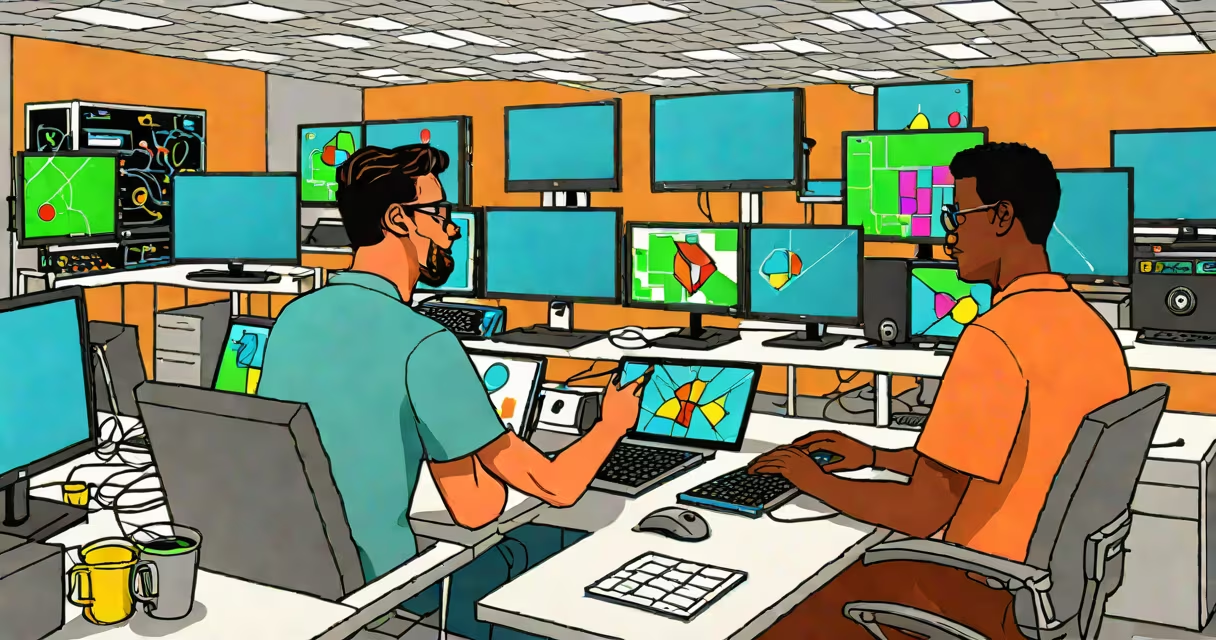
A computer graphics major is an undergraduate academic program focused on creating digital images, animations, and visual effects using software tools and programming techniques. Students learn to model, texture, animate, and render 3D scenes for applications in film, video games, advertising, and virtual environments.
This field combines artistic skill with technical problem-solving. Graduates produce visuals seen in blockbuster movies, immersive video games, and interactive simulations. The core curriculum includes courses in computer science fundamentals, mathematics, digital imaging, and specialized software training.
According to the National Association of Schools of Art and Design (NASAD), accredited computer graphics programs require at least 60 semester hours in visual arts and 30 in computer science. This dual focus ensures students master both creative expression and computational logic.
Students begin with foundational courses in linear algebra, calculus, and basic programming. These form the mathematical and coding base needed to understand how light interacts with surfaces, how objects move through space, and how data structures represent complex models.
As they progress, students take advanced classes in rendering algorithms, physics-based simulation, and real-time graphics. They learn to use industry-standard tools such as Maya, Blender, Unity, and Unreal Engine. Assignments often involve building complete short animations or interactive prototypes from concept to final output.
For example, a typical capstone project requires teams of four to five students to develop a 3-minute animated short. One student handles character rigging, another manages lighting and camera work, a third codes particle systems for explosions, and a fourth oversees compositing and sound integration. The final product is evaluated by faculty and guest professionals from studios like Pixar and Industrial Light & Magic.
While most programs share a common structure, variations exist based on institutional focus and career pathways. The following table outlines key differences:
| Type | Focus Area | Typical Courses | Industry Pathway |
|---|---|---|---|
| Visual Effects (VFX) | Real-world footage augmentation | Compositing, motion tracking, digital matte painting | Film, television, commercials |
| Game Development | Interactive 3D environments | Real-time rendering, shader programming, level design | Video game studios, VR/AR development |
| Animation & Storytelling | Character-driven narratives | Storyboarding, character animation, narrative structure | Feature films, streaming content, educational media |
Some schools offer dual-track options. For instance, the University of Southern California's School of Cinematic Arts allows students to specialize in either VFX or game design while completing shared core courses in digital cinematography and spatial audio.
Many assume a computer graphics major is purely artistic. That's incorrect. While creativity is essential, success requires proficiency in math, logic, and software engineering. A 2022 report from the Computing Research Association found that 78% of graduating computer graphics students had completed at least two programming-intensive courses in C++ or Python.
Another misconception is that this major leads only to jobs in Hollywood. While film and TV remain major employers, growth is fastest in healthcare visualization, architectural rendering, and autonomous vehicle simulation. Companies like NVIDIA and Tesla hire graduates to build synthetic training data for AI systems.
One subtle but critical distinction: computer graphics is not the same as graphic design. Graphic design focuses on static visuals-logos, posters, web layouts-while computer graphics involves time-based, changing content. A logo designed in Adobe Illustrator is graphic design. An animated version of that logo moving through a 3D cityscape is computer graphics.
In 2021, I collaborated with a team of computer graphics majors at a regional university to create a short film about climate change using only open-source tools. We modeled a melting glacier in Blender, simulated ice fracturing with physics engines, and rendered the scene using cycles-a path-tracing algorithm. The final output ran at 24 frames per second with accurate light scattering and refraction.
The project took 11 weeks. We met twice weekly to review renders, debug shader issues, and adjust camera angles. One challenge involved simulating realistic snow accumulation on uneven terrain. After testing multiple noise functions and displacement maps, we settled on a hybrid method combining procedural generation with hand-painted textures to avoid unnatural repetition.
Our film was selected for screening at a local film festival. More, it demonstrated how a computer graphics major equips students to solve complex visual problems under tight deadlines-skills directly transferable to professional studios.
Graduates from accredited computer graphics programs often enter roles such as 3D artist, animation supervisor, or technical director. Entry-level positions typically pay between $55,000 and $75,000 annually, according to the U.S. Bureau of Labor Statistics (2023 data).
For those interested in deeper technical training, many schools offer pathways into graduate research. Some students go on to work on new rendering techniques, such as neural radiance fields (NeRFs), which reconstruct 3D scenes from 2D photos using machine learning.
A computer graphics major is not just about making images look good-it's about understanding how to make them behave realistically, respond to interaction, and communicate meaning across screens and platforms.