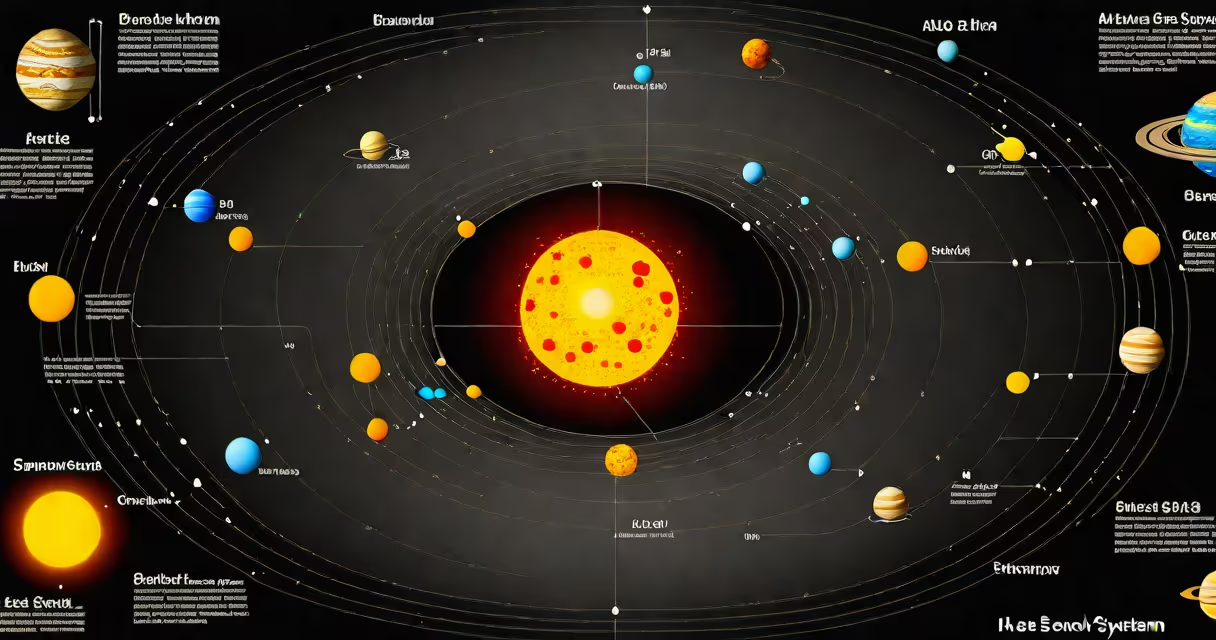
The definition of solar system describes the Sun and all the objects bound to it by gravity, including eight planets, their moons, dwarf planets, asteroids, comets, and interplanetary dust. It is a gravitationally cohesive system centered on a star-our Sun-that formed about 4.6 billion years ago from a collapsing cloud of gas and dust.
Solar systems form when a massive cloud of hydrogen and helium collapses under its own gravity, igniting nuclear fusion in the core to become a star. The remaining material flattens into a rotating disk, where planetesimals collide and grow into planets. Our solar system contains one star, eight planets, five officially recognized dwarf planets, and countless smaller bodies.
According to NASA's Solar System Exploration site, the solar system extends beyond Neptune to the scattered disc and the distant Oort Cloud, which may hold trillions of icy objects. The outer boundary is not sharply defined but is generally accepted to lie around 100,000 astronomical units (AU) from the Sun-about 1.5 light-years away.
Gravity governs motion within the solar system. The Sun's mass-99.86% of the total system mass-determines the orbits of all other bodies. Planets follow elliptical paths, as described by Kepler's laws of planetary motion, with the Sun at one focus of each ellipse.
Each planet moves at a different speed depending on distance from the Sun. Mercury completes an orbit in 88 Earth days; Neptune takes 165 years. This variation results from the balance between gravitational pull and tangential velocity-the faster an object moves sideways, the farther it falls around the Sun rather than into it.
Moons orbit planets, not the Sun directly. Earth's Moon, for example, orbits Earth once every 27.3 days while Earth itself orbits the Sun annually. Some moons, like Jupiter's Ganymede, are larger than the planet Mercury.
The solar system consists of several categories of objects, each with distinct characteristics:
| Type | Examples | Key Features |
|---|---|---|
| Planets | Mercury, Venus, Earth, Mars, Jupiter, Saturn, Uranus, Neptune | Clear orbital path, large enough to be spherical due to self-gravity, have cleared their neighborhood of debris |
| Dwarf planets | Ceres, Pluto, Haumea, Makemake, Eris | Spherical but haven't cleared their orbital zones; located primarily in the Kuiper Belt or asteroid belt |
| Asteroids | Vesta, Pallas, Juno | Rocky remnants from early solar system formation; mostly in the asteroid belt between Mars and Jupiter |
| Comets | Hale-Bopp, Halley's Comet, 67P/Churyumov-Gerasimenko | Ice-rich bodies that develop glowing tails when near the Sun; originate in the Oort Cloud or Kuiper Belt |
| Interplanetary dust | Spaceborne particles from collisions and outgassing | Smaller than 1 mm; contributes to zodiacal light visible from Earth |
One non-obvious fact: the solar system is not flat. While most planets orbit in a plane called the ecliptic, their orbits are slightly tilted. Earth's orbit lies at 0° inclination relative to the ecliptic, but Pluto's orbit is inclined 17°. This tilt allows Pluto to cross Neptune's orbit temporarily, though they never collide due to orbital resonance.
The solar system is the foundation of human space exploration. All spacecraft launched from Earth-Voyager 1, New Horizons, Parker Solar Probe-travel through it. Voyager 1, launched in 1977, became the first human-made object to enter interstellar space in 2012, crossing the heliopause at about 121 AU from the Sun.
Understanding the solar system enables accurate navigation for missions. For example, the Mars Science Laboratory rover Curiosity used precise trajectory calculations based on solar system dynamics to land safely in Gale Crater in 2012. Its entry, descent, and landing sequence relied on knowing the positions of Earth, Mars, and the Sun at that moment.
Earth's position in the habitable zone-where liquid water can exist-makes life possible. The Sun's stable output over billions of years allowed complex chemistry to emerge. Without the solar system's structure, Earth would lack the conditions necessary for biological evolution.
People often confuse the solar system with galaxies. The Milky Way galaxy contains over 100 billion stars, each potentially hosting its own solar system. Our solar system is just one among many in a vast galactic disk.
Another mistake is thinking that all planets orbit the Sun in perfect circles. In reality, all planetary orbits are ellipses. The eccentricity of Mercury's orbit is 0.206, meaning its distance from the Sun varies by nearly 50 million kilometers. This variation affects how much solar energy reaches Mercury's surface.
Some assume that the solar system ends at Neptune. But the Kuiper Belt-a region beyond Neptune-contains thousands of icy bodies. Pluto, once considered the ninth planet, was reclassified in 2006 by the International Astronomical Union (IAU) because it hadn't cleared its orbital path, meeting the criteria for a dwarf planet.
One key distinction: the term "solar system" refers specifically to systems centered on a star. A planetary system around a different star-like Proxima Centauri b-is not a solar system. It is a planetary system, but not a solar system unless it includes our Sun.
I once watched Jupiter rise above the horizon during a late summer night in Arizona. Using a small telescope, I saw its four largest moons-Io, Europa, Ganymede, and Callisto-aligned in a row, shifting positions nightly. That experience confirmed how changing the solar system truly is. The motions aren't static; they're continuous, measurable, and predictable using Newtonian physics and modern computational models.
For educators, the solar system offers a tangible model for teaching gravity, orbital mechanics, and scale. The NASA Jet Propulsion Laboratory's Eyes on the Solar System tool lets users explore real-time data from probes, showing how the solar system changes over time.
When studying the solar system, remember that the definition centers on gravity, origin, and composition. It is not just a collection of shiny lights in the sky-it is a changing, evolving system governed by physical laws. Understanding it reveals how Earth fits into a much larger cosmic structure.
The definition of solar system remains consistent across scientific disciplines: a star and all objects gravitationally bound to it. From ancient observations to modern space missions, this definition guides discovery, exploration, and education.