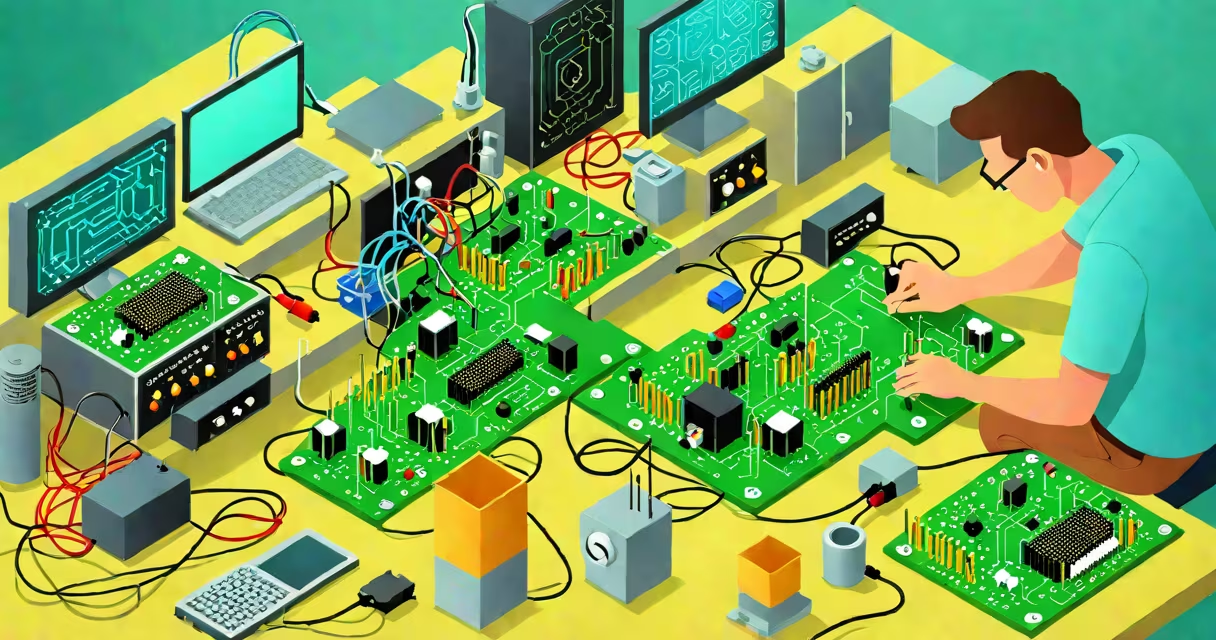
Computer Systems Engineering (CSE) integrates computer science and electrical engineering to design, develop, and test integrated hardware and software systems. It focuses on how processors, memory, sensors, and code work together in devices like smartphones, medical equipment, and autonomous vehicles.
CSE engineering combines principles from both disciplines: computer science's logic, algorithms, and programming, and electrical engineering's circuits, signals, and power management. This dual foundation enables engineers to build systems that perform reliably under real-world constraints such as limited power, space, and processing speed.
For example, a drone's flight controller uses a microprocessor (electrical engineering) running navigation algorithms (computer science) to adjust motors in real time based on sensor input. The entire system must respond within milliseconds-too slow, and the drone crashes. CSE engineers design this balance between speed, accuracy, and energy efficiency.
CSE engineering operates at the intersection of physical components and digital logic. Engineers begin by defining system requirements-such as response time, power consumption, and environmental tolerance-then select appropriate hardware (like microcontrollers or FPGAs) and software architectures.
Design proceeds through iterative stages: simulation, prototyping, testing, and deployment. A key step involves modeling interactions between hardware and software using tools like MATLAB/Simulink or Verilog for FPGA design. These models allow engineers to predict behavior before building physical prototypes.
Testing emphasizes real-time performance. For instance, a CSE team developing a heart rate monitor must verify that the device samples data every 10 milliseconds and alerts users within 50ms of detecting irregular rhythms. Failure in timing or accuracy can lead to life-threatening errors.
CSE engineering includes several specialized areas. The most common are embedded systems, real-time computing, and digital signal processing. Each focuses on different aspects of system integration.
| Type | Focus Area | Real-World Example |
|---|---|---|
| Embedded Systems | Hardware-software integration in dedicated devices | Car engine control units managing fuel injection |
| Real-Time Systems | Guaranteed response times under strict deadlines | Aircraft autopilot adjusting controls every 100ms |
| Digital Signal Processing (DSP) | Filtering and analyzing analog signals digitally | Noise reduction in hearing aids using adaptive filters |
One non-obvious distinction: CSE differs from general computer engineering in its emphasis on tight integration between hardware and software. While computer engineering may focus on building computers or networks, CSE engineers ensure that the system behaves correctly under changing conditions-such as temperature changes or power fluctuations.
For example, a smart thermostat must maintain accurate temperature readings even during power surges. CSE engineers implement watchdog timers and error-checking routines in firmware to prevent system lockups. This level of resilience is often overlooked in software-only development.
CSE engineering is essential in industries requiring high reliability and low latency. Automotive, aerospace, healthcare, and industrial automation rely heavily on CSE-designed systems.
In automotive applications, CSE engineers develop advanced driver-assistance systems (ADAS). These systems process camera, radar, and lidar inputs in real time to detect obstacles. According to the National Highway Traffic Safety Administration (NHTSA), ADAS features like automatic emergency braking reduce rear-end collisions by up to 50%.
Healthcare devices also depend on CSE. Implantable cardiac monitors must operate for years on tiny batteries while transmitting data wirelessly. Engineers use low-power microcontrollers and optimized communication protocols like Bluetooth Low Energy (BLE) to extend battery life. A study published in IEEE Transactions on Biomedical Engineering found that CSE-optimized implants reduced energy use by 37% compared to standard designs.
Industrial automation uses CSE for programmable logic controllers (PLCs) that manage assembly lines. These systems must handle thousands of sensor inputs per second and trigger actions within microseconds. A failure in timing can cause machine damage or production downtime.
CSE engineering is often confused with software engineering or pure electrical engineering. Software engineering focuses on application logic and user interfaces. Electrical engineering typically deals with power systems, analog circuits, or large-scale infrastructure.
CSE is neither. It demands expertise in both domains. For example, writing a program to control a robotic arm requires knowing how the motor drivers work (electrical), how the feedback loop responds (control theory), and how to schedule tasks efficiently (real-time operating systems).
A common mistake is assuming that CSE systems are always complex. Some of the most critical CSE applications are simple-like a smoke detector that triggers an alarm when carbon monoxide levels exceed 30 ppm. The simplicity makes reliability easier to verify, but the consequences of failure remain severe.
I once observed a student project where a team built a solar-powered weather station using a Raspberry Pi and sensors. They initially ran the code on a desktop PC, then moved it to the Pi. The system failed intermittently because they hadn't accounted for voltage drops during cloud cover. Only after adding a power monitoring circuit and adjusting the sampling frequency did it stabilize. That moment taught me: CSE isn't just about writing code-it's about understanding the physical world the system interacts with.
Students entering CSE programs typically take courses in digital logic, microprocessor architecture, real-time operating systems, and embedded software development. Proficiency in C/C++ and Python is expected, along with familiarity with hardware description languages like VHDL or SystemVerilog.
For professionals, certifications such as the Certified Embedded Systems Professional (CESP) or training in ARM Cortex-M processors can improve career paths in robotics, defense, or consumer electronics.
Understanding what is cse engineering reveals its role as the core of modern intelligent systems. From pacemakers to satellites, CSE helps machines don't just run-they respond accurately, safely, and efficiently.