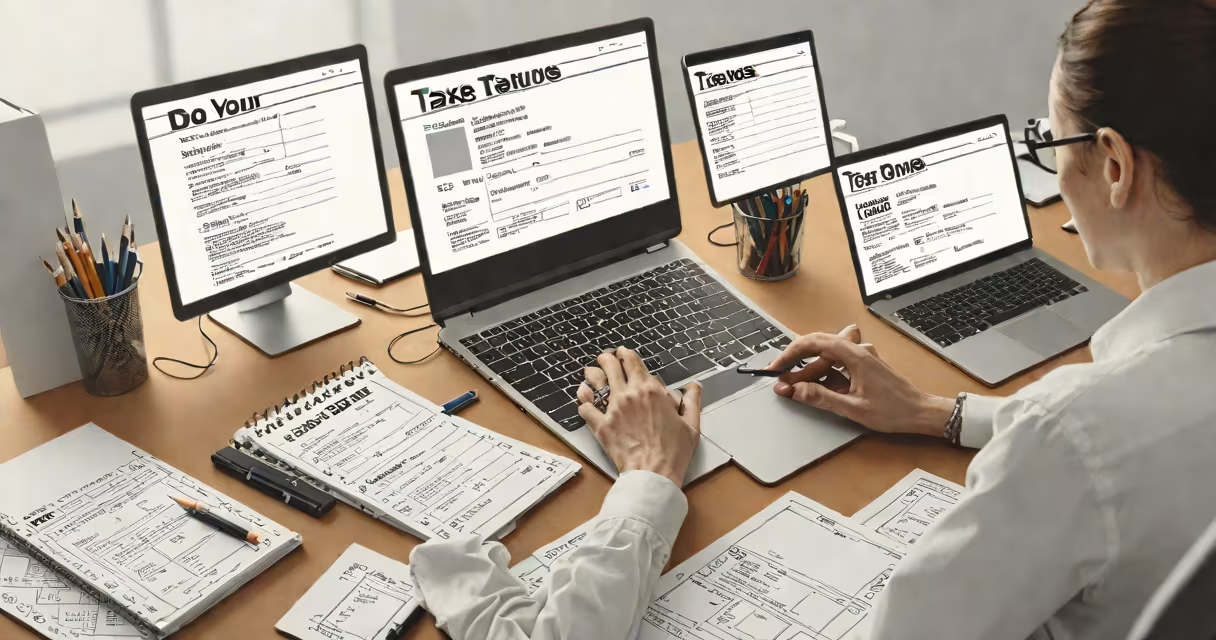
Filing your taxes online means preparing and submitting your federal and state tax returns electronically using IRS-approved software or services, without hiring a professional accountant or tax preparer.
More than 70% of U.S. taxpayers now file their returns digitally. The IRS reports that electronic filing reduced processing times from weeks to days and lowered error rates compared to paper submissions. You can complete your return from home using a computer or mobile device, with most platforms guiding you through required forms and deductions.
Online tax preparation tools verify your inputs against IRS rules in real time. This prevents common mistakes like incorrect Social Security numbers or mismatched income figures. The system checks eligibility for credits such as the Earned Income Tax Credit (EITC) and Child Tax Credit based on your household details.
Start by gathering documents: W-2s from employers, 1099s for freelance or investment income, and records of deductible expenses like charitable donations or medical costs. Most states require you to report state-specific income and deductions separately.
Choose a tax software platform approved by the IRS. Popular options include TurboTax, H&R Block, and FreeTaxUSA. These tools walk you through questions about your filing status, dependents, and income sources. They auto-fill standard forms like Form 1040 and calculate your tax liability.
After reviewing your draft, sign the return electronically using your SSN and a PIN or password. The software then transmits your return directly to the IRS via the IRS e-File system. You receive confirmation within 24 hours if accepted.
Not all online tax services are the same. They differ in cost, complexity, and support features. Choose based on your income level, filing status, and whether you need help with deductions.
| Tool Type | Best For | Cost | IRS Approval |
|---|---|---|---|
| Free basic software | Single filers with simple income under $73,000 | $0 | Yes (e-File certified) |
| Mid-tier packages | Joint filers, dependents, rental income | $30-$60 | Yes |
| Premium services | Self-employed, investors, complex deductions | $100+ | Yes |
Free versions are available through the IRS's Free File program. Eligibility requires adjusted gross income below $73,000 and filing status as single, head of household, or married filing jointly. The program partners with 17 private companies, including TaxAct and FreeTaxUSA.
A key difference between free and paid tools is access to expert support. Paid plans often include phone or chat assistance during filing. Free tools rely on automated guidance and online help centers.
Over 150 million U.S. taxpayers filed electronically in 2023. The IRS reported that 97% of e-filed returns were processed within 21 days, compared to 6-8 weeks for paper filings. Speed and accuracy drive adoption.
People use online filing to save money. Hiring a tax professional averages $200-$300 for a simple return. Using free software cuts that cost to zero. A 2022 study by the National Bureau of Economic Research found that low-income filers who used free tools received refunds 1.8 days faster than those who used paid services.
State tax agencies also accept electronic submissions. In California, 82% of state returns were filed online in 2023. The process mirrors federal e-filing: enter data, review, sign, and submit. Some states offer direct deposit of refunds to bank accounts.
Many assume online filing requires advanced math skills. That's false. Modern tax software handles calculations automatically. You only need to input accurate data from official documents.
Another myth is that the IRS rejects returns filed online. The IRS accepts over 99% of e-filed returns. Rejections usually stem from missing information, incorrect SSNs, or duplicate filings-not the method itself.
Some confuse "do your own taxes online" with "file for free." Free filing is limited to certain income levels and forms. A person earning $80,000 with investment income may still need a paid tool to claim capital gains deductions.
One non-obvious fact: IRS e-File does not store your data. Once submitted, your return is sent directly to the IRS server. The software provider retains only a copy for audit trail purposes. Data encryption standards meet NIST SP 800-53 requirements.
Consider Maria, a single filer with $58,000 in wages, $1,200 in interest income, and $3,500 in student loan interest payments. She claims the standard deduction ($13,850) and qualifies for the American Opportunity Tax Credit ($2,500).
Maria uses FreeTaxUSA, a free tool approved by the IRS. She uploads her W-2 and 1099-INT. The software prompts her to enter student loan interest and confirms she qualifies for the credit. After reviewing, she signs electronically and submits.
Four days later, she receives a refund of $2,100. The IRS confirmed receipt within 12 hours. Her return was processed without issues.
When I filed my own taxes online in 2022, I used the IRS Free File program. I had no prior experience with tax forms. The software guided me step by step, flagged a missing deduction, and corrected a misentered date. I saved $180 compared to a local accountant's quote.
Always keep copies of your return and supporting documents for at least three years. The IRS may request them during audits. Use encrypted storage or cloud backup to protect sensitive data.
do your own taxes online is a secure, efficient way to meet federal and state obligations. With correct documentation and the right tool, millions of Americans file accurately and on time each year.