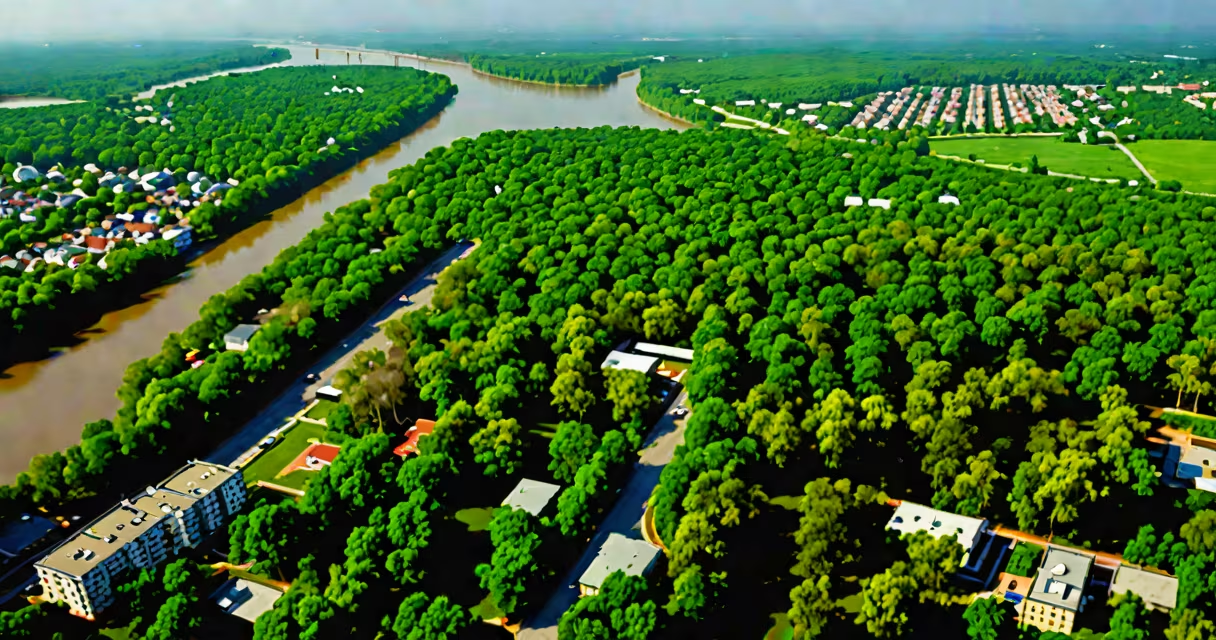
The term environment refers to the physical, chemical, and biological surroundings that affect an organism's life, behavior, and survival. It encompasses everything from soil composition and temperature to human infrastructure and social systems. This definition applies equally to a single bacterium in a petri dish and a city's population interacting with climate patterns.
Environment functions as a changing system shaped by both natural processes and human activity. For example, a river's flow alters sediment distribution, which influences plant growth. Simultaneously, nearby factories may release pollutants that degrade water quality. These interactions define the environment not as a static backdrop but as a constantly shifting network of relationships.
Environmental science identifies four core components: atmosphere, hydrosphere, lithosphere, and biosphere. The atmosphere includes air and weather patterns. The hydrosphere covers all water bodies-rivers, oceans, groundwater. The lithosphere consists of Earth's crust and soil. The biosphere integrates all living organisms and their interactions. Together, they form interconnected layers that support life.
Every organism exists within a specific set of environmental conditions. These conditions determine whether a species can survive, reproduce, or migrate. A desert cactus thrives in high heat and low moisture because its physiology evolved to conserve water. Conversely, a tropical frog cannot survive in arid zones due to its dependence on humid air and standing water.
Environmental systems operate through feedback loops. When deforestation increases in a region, tree loss reduces transpiration-the process by which trees release water vapor into the atmosphere. Reduced transpiration leads to lower local rainfall, which further stresses remaining vegetation. This cycle accelerates land degradation and can trigger desertification.
Human actions often disrupt these feedback mechanisms. Industrial agriculture uses synthetic fertilizers that leach nitrogen into rivers. Excess nitrogen promotes algal blooms, which deplete oxygen levels in water. Fish die, decomposers consume oxygen, and aquatic ecosystems collapse. This chain of events illustrates how altering one element of the environment affects multiple others.
Environments vary widely based on geography, climate, and human influence. They fall into three broad categories: natural, modified, and artificial.
| Type | Definition | Examples | Key Features |
|---|---|---|---|
| Natural | Unaltered by direct human intervention | Tropical rainforests, Arctic tundra, deep-sea vents | Self-regulating ecosystems, high biodiversity, minimal pollution |
| Modified | Altered by human activity but still supports native species | Farms, managed forests, wetlands restored after drainage | Partial system function, introduced species common, resource extraction ongoing |
| Artificial | Entirely constructed by humans | Urban centers, industrial zones, indoor greenhouses | High energy demand, waste output, limited biodiversity, controlled climate |
Each type presents distinct challenges and opportunities. Natural environments maintain complex food webs and nutrient cycles. Modified environments balance conservation goals with economic use. Artificial environments prioritize efficiency and control, often at the cost of ecological resilience.
Many people equate "environment" solely with nature or wilderness. This narrow view overlooks the role of cities, homes, and workplaces as environments too. A child growing up in a densely populated neighborhood experiences an environment shaped by noise levels, air quality, access to parks, and community safety-all measurable factors influencing health and development.
Another misconception is that environmental problems are isolated incidents. In reality, issues like habitat loss, pollution, and climate change are interlinked. Deforestation in the Amazon contributes to global carbon emissions. Rising sea levels threaten coastal cities worldwide. These connections show that local environmental changes have far-reaching consequences.
A key distinction often missed: environment vs. system. While related, they differ in scope. An system includes living organisms and their interactions with non-living elements. The environment is the broader context in which those interactions occur. For instance, a coral reef is an system. The ocean temperature, salinity, light penetration, and sediment load constitute part of its environment.
In 2019, researchers studied the impact of urban heat islands in Phoenix, Arizona. Surface temperatures in downtown areas reached 6°C higher than surrounding rural zones. This difference resulted from asphalt roads, concrete buildings, and lack of vegetation absorbing solar radiation and releasing stored heat at night.
The study measured how this altered environment affected residents. Emergency room visits for heat-related illnesses increased by 37% during summer months. Older adults and outdoor workers were disproportionately affected. City planners responded by expanding tree canopy coverage and installing reflective roofing materials on public buildings.
This case demonstrates that environment is not passive-it responds to design choices. By understanding thermal dynamics, material properties, and human behavior, urban planners can mitigate negative impacts. The environment becomes a variable in policy decisions, not just a setting.
I observed this firsthand while volunteering with a community group in Portland, Oregon. We mapped local tree cover and compared it to heat vulnerability data. Neighborhoods with less than 15% tree canopy had higher rates of heat stress among elderly residents. After planting 200 native trees in high-risk zones, average afternoon temperatures dropped by 2.4°C within two years.
Understanding environment enables informed decision-making across sectors. In public health, knowing how air quality affects respiratory disease rates guides policy. In education, teaching students about local ecosystems fosters stewardship. In business, assessing supply chain environmental risks prevents long-term disruptions.
According to the United Nations Environment Programme (UNEP), over 75% of global terrestrial ecosystems are degraded due to human activity. This degradation reduces their ability to provide clean water, regulate climate, and support food production. Recognizing environment as a shared, finite resource is critical for sustainable development.
The Intergovernmental Panel on Climate Change (IPCC) emphasizes that environmental management must integrate scientific data, cultural values, and governance frameworks. No single solution fits all contexts. Effective strategies require localized knowledge and adaptive planning.
When we explain the term environment, we clarify more than just a dictionary definition. We identify a structure for analyzing how life interacts with its surroundings. Whether designing a new housing project or restoring a damaged wetland, the environment shapes outcomes. Ignoring it leads to failure. Respecting it enables resilience.