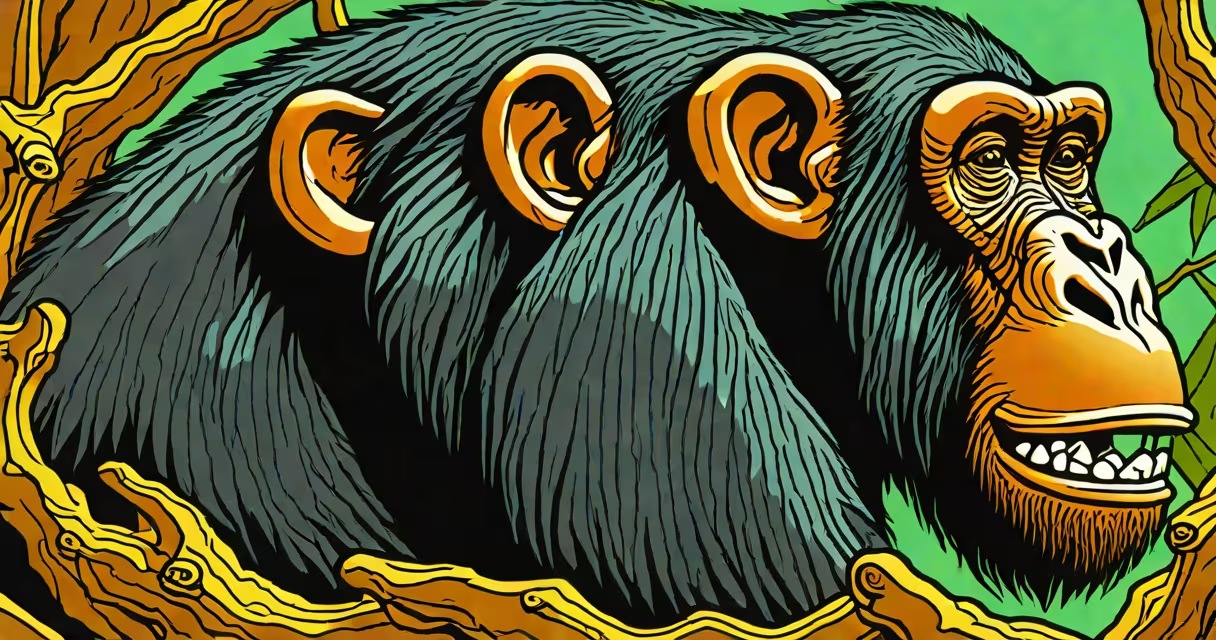
Chimpanzees evolved from a common ancestor shared with humans approximately 6 million years ago. This ancestor was a bipedal ape that lived in forested regions of Central and East Africa, distinct from modern chimpanzees or Homo sapiens.
The evolutionary path leading to modern chimpanzees (Pan troglodytes and Pan paniscus) diverged from the human lineage after a split in the hominid family tree. Genetic evidence shows that humans and chimpanzees share about 98.8% of their DNA, indicating a close relationship but not direct descent.
Modern chimpanzees are not living fossils. They have undergone their own evolutionary changes since the split, including adaptations in social behavior, tool use, and brain structure. The ancestor they share with humans is extinct and known only through fossil remains and comparative genomics.
Genetic divergence timelines place the human-chimpanzee split between 5.5 and 7 million years ago. Molecular clock analyses-based on mutation rates in DNA-support this estimate. These clocks rely on consistent genetic changes over time, calibrated using fossil records.
Fossil evidence from sites like Chad's Toros-Menalla and Kenya's Lukeino Formation reveals early hominids with mixed ape and human traits. Species such as Sahelanthropus tchadensis, dated to 7 million years ago, show a forward-facing foramen magnum-the hole where the spine connects to the skull-indicating upright walking. This suggests bipedalism evolved before significant brain expansion.
While Sahelanthropus is not definitively a direct ancestor of either humans or chimps, it represents the kind of species that existed during the divergence period. Its features bridge the gap between earlier apes and later hominins, confirming that the last common ancestor was already adapting to life on two legs.
The last common ancestor of humans and chimpanzees was likely a small-bodied, arboreal ape that spent time both in trees and on the ground. It had a relatively small brain compared to modern humans but larger than most apes. Its limbs were adapted for climbing and knuckle-walking, similar to modern chimps.
Based on anatomical comparisons, this ancestor probably lived in dense forests and relied on fruit, leaves, and occasional meat. Social structures may have included male-dominated groups with complex communication, a trait seen in both modern chimps and humans.
A key difference from modern chimps lies in locomotion. While modern chimps are obligate knuckle-walkers, the ancestral form likely used a mix of quadrupedalism and bipedalism. Fossil foot bones from early hominins suggest weight distribution patterns inconsistent with full knuckle-walking, indicating a transitional gait.
Scientists use three primary lines of evidence to trace the origin of chimpanzees: genetics, paleontology, and comparative anatomy.
| Evidence Type | Key Findings | Source |
|---|---|---|
| Genetic | 98.8% DNA similarity between humans and chimps; mutation rate estimates place divergence at ~6 mya | Nature Genetics, 2005 |
| Paleontological | Sahelanthropus tchadensis has a short face, large brow ridge, and forward-positioned foramen magnum-features suggesting bipedalism | Journal of Human Evolution, 2005 |
| Anatomical | Shared dental morphology and limb proportions indicate common ancestry, despite differences in locomotion | Nature, 2021 |
One non-obvious fact: the common ancestor was not a "missing link" in the sense of being a perfect intermediate. Instead, it was a species with a mosaic of traits-some ape-like, some human-like-that evolved independently in different lineages after the split.
For example, while modern humans developed larger brains and reduced facial projection, chimpanzees evolved longer arms, stronger shoulder joints, and more efficient knuckle-walking mechanics. These changes occurred in parallel, not sequentially.
Many assume that chimpanzees are our ancestors. This is incorrect. Humans and chimpanzees are cousins, not parent and child. The common ancestor existed before either lineage split-it was a separate species that no longer exists.
Another misconception is that evolution implies progress. The idea that humans represent a "higher" stage of development is false. Both lineages adapted to their environments. Modern chimpanzees are highly successful in their ecological niche, with complex societies, tool use, and cultural transmission.
I once observed wild chimpanzees in Kibale National Park, Uganda, using sticks to extract termites. Their technique varied by group-some used twigs, others stripped leaves. This behavioral diversity mirrors human cultural variation and underscores that intelligence evolved in multiple forms.
Understanding chimpanzee origins clarifies the nature of human identity. We are not unique in our capacity for culture, cooperation, or conflict. These traits emerged in our shared past, not in isolation.
Recognizing that both species descend from a single African ancestor reshapes how we view ourselves. It challenges anthropocentric views and emphasizes continuity across species. This perspective supports conservation efforts-protecting chimpanzee habitats preserves not just a species, but a record of our own evolutionary history.
Research into the genetic and fossil record continues. New discoveries, such as the 2023 find of a 6.5-million-year-old hominid jaw in Ethiopia, refine our understanding of the timing and location of the split. These findings reinforce that the story of human and chimp evolution is rooted in African ecosystems.
Knowing what chimpanzees evolved from reveals more than biology-it reveals our shared place in the natural world. The answer is not a single creature, but a lineage shaped by climate shifts, forest fragmentation, and adaptive pressures over millions of years.