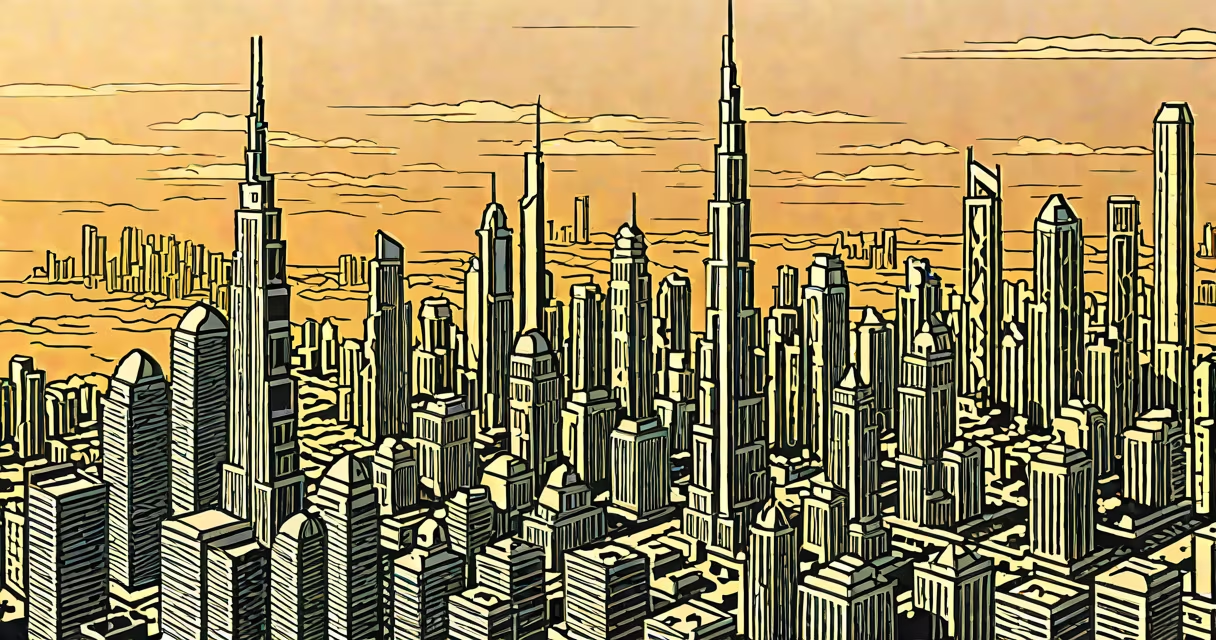
The highest building in the world is the Burj Khalifa in Dubai, United Arab Emirates, measuring 828 meters (2,717 feet) from ground to tip. Completed in 2010, it holds the record for tallest freestanding structure and the tallest building globally.
Designed by Skidmore, Owings & Merrill (SOM), the Burj Khalifa uses a bundled-tube structural system inspired by the geometry of a desert flower. This design distributes wind forces efficiently across its tapering form, reducing sway and allowing stability at extreme heights. The building's core is reinforced concrete, while its exterior features high-performance glazing to manage solar gain in Dubai's desert climate.
Construction began in 2004 and took six years to complete. Over 12,000 workers were involved, and more than 31,000 cubic meters of concrete were poured. The project cost approximately $1.5 billion, funded by Dubai World, a government-owned entity. The building houses offices, residential units, and the Armani Hotel, with observation decks on floors 124 and 148 offering panoramic views.
The Burj Khalifa's height is sustained through a combination of material strength, aerodynamic shaping, and advanced mechanical systems. Its foundation consists of a 3.7-meter-thick mat of reinforced concrete supported by 192 bored piles driven 50 meters into bedrock. This ensures load distribution across unstable desert soil.
To counteract wind loads, the building's Y-shaped floor plan rotates 120 degrees between levels, breaking up vortex shedding. Wind tunnel testing confirmed that this configuration reduced lateral movement by 40% compared to a symmetrical design. At the summit, wind speeds reach 160 km/h, but internal sway remains below 10 centimeters-within safe thresholds for occupants.
Climate control is managed via a chilled water system using 12,000 tons of refrigeration capacity. The HVAC system draws air from 100 meters above ground, where temperatures are cooler, to reduce energy consumption. Water is recycled through on-site treatment plants, meeting 30% of the building's non-potable needs.
Buildings are classified by height: high-rise (30-40 stories), supertall (300-600 meters), and megatall (over 600 meters). The Burj Khalifa qualifies as megatall. Only 17 buildings worldwide exceed 300 meters, and 11 of them are located in Asia.
| Category | Height Range | Examples |
|---|---|---|
| High-rise | 30-40 stories | Chrysler Building (319 m) |
| Supertall | 300-600 m | Shanghai Tower (632 m), Taipei 101 (508 m) |
| Megatall | Over 600 m | Burj Khalifa (828 m), Merdeka 118 (452 m) |
Despite being the tallest, the Burj Khalifa is not the most occupied. That title belongs to the Shanghai Tower, which has 128 usable floors and hosts over 10,000 people daily. The Burj Khalifa has 160 habitable floors, but only 100 are designated for permanent residents.
Many assume the Burj Khalifa is the tallest man-made structure. It is not-the title belongs to the Tokyo Skytree (634 m), a broadcast tower. The Burj Khalifa is the tallest freestanding structure, meaning it stands independently without guy wires or external supports.
Another misconception is that the building's height was achieved solely through innovation. In reality, it relied heavily on existing technologies-high-strength concrete, advanced cranes, and modular construction techniques refined over decades. The key breakthrough was integrating these elements into a unified design.
A lesser-known fact: the Burj Khalifa's elevator system moves at 10 meters per second, faster than most commercial aircraft during taxi. The elevators travel from ground level to the 124th-floor observation deck in under a minute. They use regenerative braking to recover energy during descent, saving up to 25% of electrical usage.
I visited the Burj Khalifa in 2018 and witnessed the precision of its vertical transport. At the 148th-floor viewing platform, the city sprawls beneath-a grid of streets and green spaces stretching toward the desert. The air pressure drops noticeably as you ascend, and the silence inside the elevator cabins is absolute.
Urban planners cite the Burj Khalifa as a model for sustainable density. By concentrating 30,000 people in a single site, it reduces car dependency and public space fragmentation. Dubai's skyline now includes 16 other supertall structures, many within a 2-kilometer radius of the Burj Khalifa.
Environmental concerns remain. The building consumes 120 million kWh annually-enough to power 10,000 homes. However, its integrated solar panels and waste heat recovery systems offset 15% of energy demand. The city plans to phase in renewable-powered infrastructure across all new developments by 2030.
The Burj Khalifa serves as a symbol of economic ambition and technological achievement. It hosts corporate headquarters, luxury residences, and international events such as New Year's Eve fireworks displays visible across the Persian Gulf.
Its primary function is commercial and residential. The upper floors contain penthouses priced above $20 million. The building's management uses AI-driven maintenance systems to monitor 10,000 sensors across plumbing, HVAC, and security networks. Predictive algorithms identify issues before failure occurs.
For tourism, the Burj Khalifa attracts over 1.2 million visitors annually. Ticket prices range from $25 to $180, depending on access level. The highest deck, at 555 meters, offers 360-degree visibility and is reserved for premium experiences.
The highest building in the world is not just a feat of engineering-it is a functional, inhabited space that reshapes how cities grow vertically. Its existence proves that human-built environments can stretch beyond natural limitations, guided by precise planning and materials science. As urban populations rise, the principles behind the Burj Khalifa inform future designs across the world.