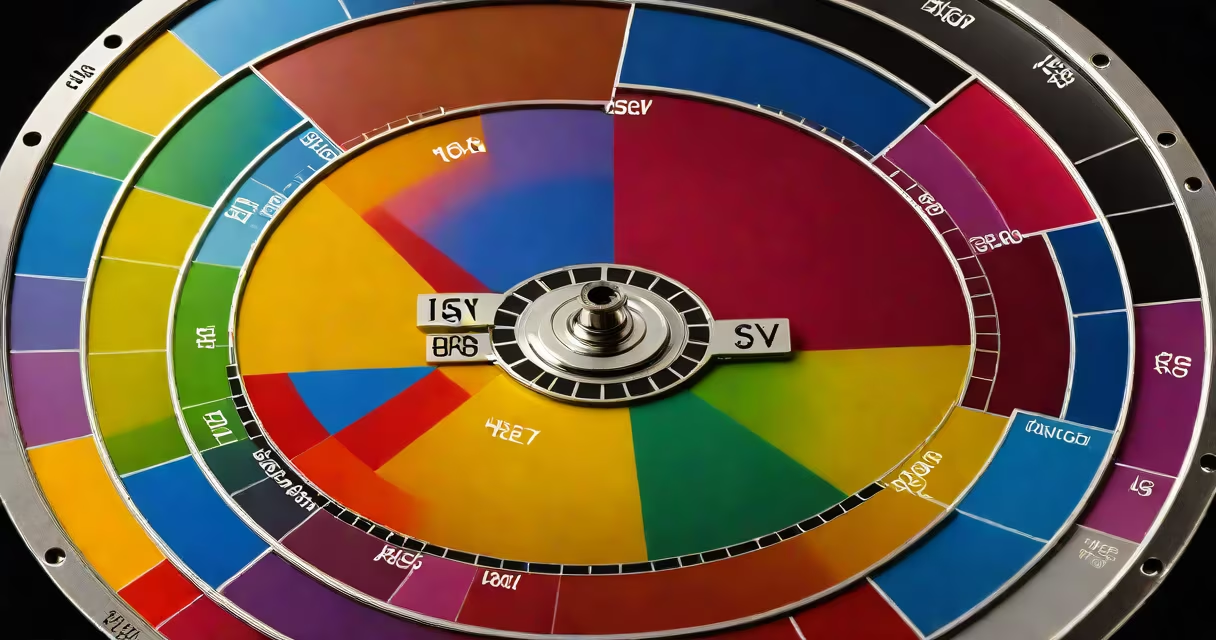
HSV is what describes a color model that represents colors using three components: hue (the actual color), saturation (intensity or purity), and value (brightness). It mimics how humans perceive color, making it easier to adjust shades in design tools.
Hue ranges from 0° to 360°, mapping to the visible spectrum-red at 0°, green at 120°, blue at 240°. Saturation measures how vivid the color appears, from 0% (gray) to 100% (fully saturated). Value controls brightness, from 0% (black) to 100% (full intensity).
This model is widely used in graphic design, video editing, and web development because it allows precise control over color appearance. For example, changing the saturation in Photoshop reduces or increases color intensity without altering the base hue.
HSV operates by separating color into perceptual dimensions. Unlike RGB, which uses red, green, and blue light intensities, HSV focuses on human visual perception. This makes it ideal for tasks like adjusting skin tones in photos or creating consistent brand colors.
When you increase saturation in a color, you're boosting the amount of pure pigment relative to gray. A saturation of 0% produces a grayscale version of the hue. At 100%, the color is as intense as possible for that hue.
Value determines how much light the color reflects. A value of 0% results in black regardless of hue or saturation. A value of 100% gives maximum brightness-white if saturation is 0%, or the most vivid form of the hue otherwise.
HSV is not divided into distinct types like some technical systems, but it functions in two primary contexts: digital color selection and image processing. In both, the structure remains consistent: hue, saturation, value.
Designers use HSV in tools like Adobe Illustrator and Figma to fine-tune colors. Photographers adjust HSV values in Lightroom to improve contrast or correct exposure. Developers apply HSV in CSS filters and JavaScript libraries for changing color manipulation.
| Component | Range | Effect on Color |
|---|---|---|
| Hue | 0°-360° | Defines the base color (e.g., red = 0°, yellow = 60°) |
| Saturation | 0%-100% | Controls color intensity; 0% = gray, 100% = vivid |
| Value | 0%-100% | Adjusts brightness; 0% = black, 100% = brightest |
A practical example: setting a color to H=30°, S=80%, V=60% produces a warm orange-red. Increasing V to 90% makes it brighter without changing the hue or saturation. Lowering S to 40% desaturates it toward beige.
Many assume HSV is interchangeable with HSL (Hue, Saturation, Lightness), but they differ. HSL uses lightness-midpoint between black and white-while HSV uses value, which is based on maximum brightness. This leads to different results when adjusting colors.
Another misconception is that HSV is a standard for web colors. It is not. Web standards rely on RGB, HEX, or HSL. However, many web tools convert between formats internally. For instance, a color picker in a browser may display HSV values even though the output is in HEX.
A key correction: HSV is not a color space. It is a color model. A color space (like sRGB or Adobe RGB) defines how colors are mapped physically. HSV is a way to describe them visually. Confusing the two leads to errors in color reproduction across devices.
I once adjusted a client's logo in Figma using HSV. The original blue was too dark and dull. I increased the value from 45% to 75% and raised saturation from 50% to 85%. The result was a bolder, more vibrant blue that stood out on social media while staying within brand guidelines.
The change took under 30 seconds. I didn't alter the hue-kept it at 240°-because the client wanted the same shade. But the improved visibility made a noticeable difference in print and digital formats.
This demonstrates why HSV is preferred in design workflows: it isolates visual attributes so changes are predictable and reversible.
HSV was developed in the 1970s by researchers at the University of California, Berkeley, as part of early computer graphics work. It wasn't designed for consumer software-it emerged from academic research on human color perception.
Despite its age, HSV remains relevant because it aligns closely with how people describe colors in everyday language. Saying "make this red more vibrant" translates directly to increasing saturation in HSV. That intuitive fit explains its enduring presence in modern tools.
According to the W3C CSS Color Module Level 4, HSV is referenced as a conceptual tool for understanding color adjustments, even though it's not used natively in web rendering.
Understanding what hsv is enables better decisions in design, photography, and digital content creation. It's not just a technical term-it's a structure for seeing and shaping color.
For more on how HSV relates to health and transmission, see this guide.