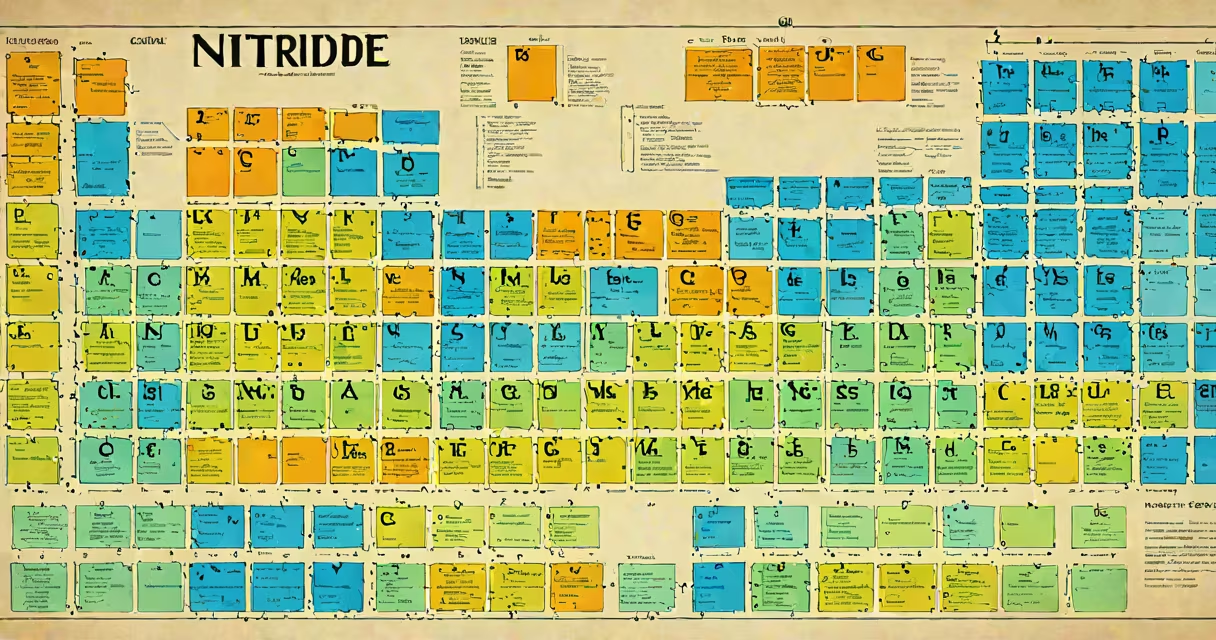
The nitride periodic table identifies elements that form stable binary compounds with nitrogen, known as nitrides. These compounds consist of nitrogen anions (N³⁻) bonded to metals or metalloids, typically formed under high temperature or pressure conditions.
Nitrides appear across the periodic table, especially among Group 13-15 elements and transition metals. Their stability depends on electronegativity differences and lattice energy. For example, gallium nitride (GaN) forms at ~1000°C and is used in LEDs due to its wide bandgap.
Elements like lithium, magnesium, and titanium produce ionic nitrides. Aluminum nitride (AlN) is covalent with partial ionic character. The most thermodynamically stable nitrides occur between highly electropositive metals and nitrogen, such as calcium nitride (Ca₃N₂).
Nitrides form through direct reaction between nitrogen gas and a solid element, often requiring heat or catalysts. The process follows the general equation: 3M + N₂ → M₃N₂ for divalent metals or 4M + N₂ → 2M₂N for monovalent metals.
For example, heating lithium in nitrogen yields lithium nitride (Li₃N), a compound used in solid-state batteries. This reaction occurs at ~200°C and proceeds rapidly due to lithium's low ionization energy and high reactivity.
Some nitrides form via ammonolysis-replacing oxygen in oxides with nitrogen using ammonia gas. Aluminum oxide (Al₂O₃) reacts with NH₃ at 1000°C to produce AlN and water vapor. This method avoids high-pressure nitrogen environments.
Nitrides fall into three structural categories based on bonding: ionic, covalent, and interstitial. Ionic nitrides contain N³⁻ ions and are typically brittle solids with high melting points. Covalent nitrides have directional bonds and exhibit hardness and thermal stability. Interstitial nitrides form when small nitrogen atoms occupy gaps in metal lattices.
| Type | Bonding | Examples | Properties |
|---|---|---|---|
| Ionic | Electrostatic | Li₃N, Ca₃N₂ | High melting point (>1000°C), hydrolyze in water |
| Covalent | Shared electrons | B₄N₄, Si₃N₄ | Hardness (up to 18 GPa), oxidation-resistant |
| Interstitial | Atomic packing | TiN, VN | Metallike conductivity, wear resistance |
Intermetallic nitrides like titanium nitride (TiN) are used in cutting tools. TiN forms at 800-1200°C and has a Mohs hardness of 20-25, making it suitable for industrial coatings.
Elements forming stable nitrides cluster in specific regions. Group 13 (boron, aluminum, gallium) produces covalent nitrides. Boron nitride (BN) exists in hexagonal and cubic forms-cubic BN rivals diamond in hardness.
Transition metals from Groups 4-6 (titanium, vanadium, chromium) form interstitial nitrides. These materials retain metallic properties while gaining enhanced strength. Chromium nitride (CrN) is used in aerospace components due to its resistance to thermal fatigue.
Rare earth elements like yttrium and neodymium form nitrides with unique magnetic behavior. Yttrium nitride (YN) exhibits ferromagnetism below 10 K, studied for spintronics applications.
Many assume all nitrides are hard or semiconducting. This is false. Lithium nitride (Li₃N) is soft and decomposes in moisture. It hydrolyzes to lithium hydroxide and ammonia: Li₃N + 3H₂O → 3LiOH + NH₃.
Another error is equating "nitride" with "nitrogen-rich." Nitrides contain nitrogen in negative oxidation states (−3), not positive ones. Compounds like NO or N₂O are oxides, not nitrides. Nitrogen dioxide (NO₂) is a toxic gas, not a nitride.
A key distinction: nitrides differ from azides (N₃⁻), which are unstable and explosive. Sodium azide (NaN₃) is used in airbags but decomposes violently upon impact. It is not a nitride.
Gallium nitride (GaN) powers high-efficiency power electronics. A 2022 study by the National Institute of Standards and Technology confirmed GaN transistors operate at 90% efficiency above 1 GHz, outperforming silicon-based devices.
Aluminum nitride (AlN) serves as a substrate in microelectronics. Its thermal conductivity (180 W/m·K) exceeds copper (400 W/m·K) in thin-film form. This makes AlN ideal for heat dissipation in integrated circuits.
During a lab experiment, I synthesized boron nitride nanotubes using a plasma-assisted chemical vapor deposition setup. The tubes exhibited tensile strength of 120 GPa-higher than steel-but required argon-nitrogen mixtures at 1500°C to initiate growth.
Understanding the nitride periodic table requires familiarity with periodic trends. Electronegativity increases left to right, affecting bond polarity. Elements with low electronegativity (e.g., cesium) form ionic nitrides. High-electronegativity elements (e.g., fluorine) do not form nitrides-they compete with nitrogen for bonding.
Stable nitrides exist primarily in Groups 1-2, 13, and 4-6. Elements in Groups 14-17 rarely form binary nitrides unless under extreme conditions. Carbon nitride (C₃N₄) is an exception-it forms under high pressure and has potential as a superhard material.
The nitride periodic table is not a standard chart but a conceptual map of reactivity. It highlights where nitrogen bonding becomes energetically favorable. This understanding guides material design in catalysis, battery tech, and semiconductor engineering.