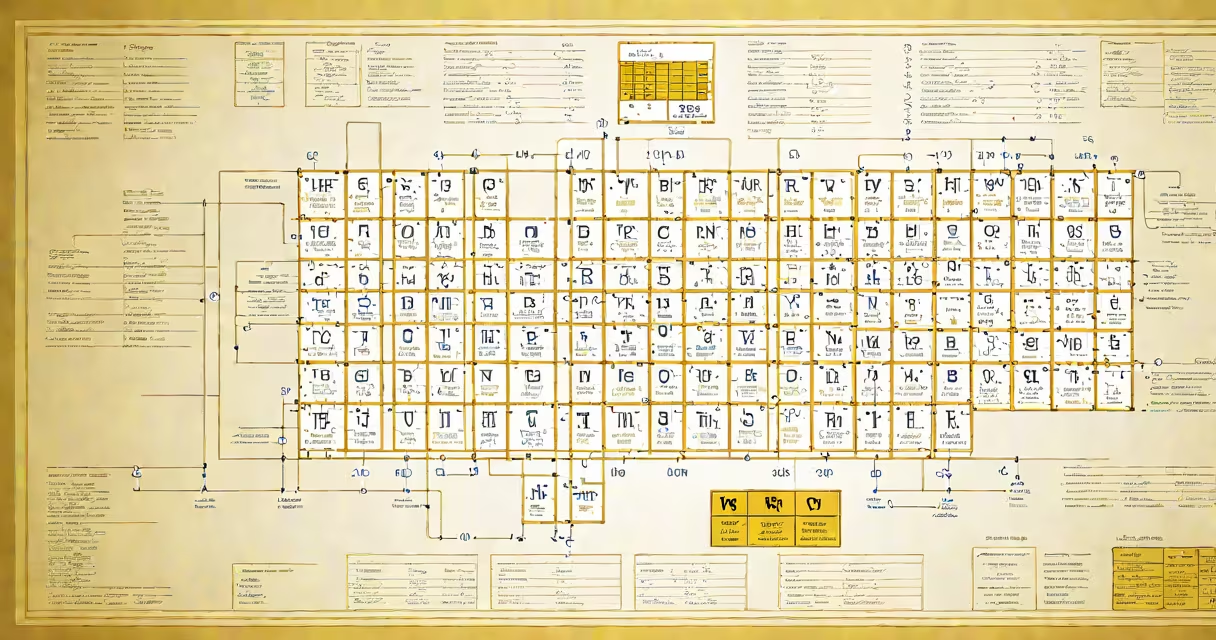
The new added elements in periodic table are nihonium (element 113), moscovium (115), tennessine (117), and oganesson (118)-four synthetic elements officially recognized by the International Union of Pure and Applied Chemistry (IUPAC) in 2016 after years of verification.
These elements do not occur naturally. They are produced in particle accelerators through nuclear fusion, where lighter atomic nuclei collide at high speeds to form heavier ones. The process requires precise control of energy and beam intensity. For example, oganesson was synthesized by bombarding californium-249 with calcium-48 ions in a cyclotron at the Joint Institute for Nuclear Research in Dubna, Russia.
Each element's discovery involved multiple independent experiments. IUPAC required evidence from at least two research groups before approving naming rights. The final confirmation came after peer-reviewed publications met strict criteria for reproducibility and decay patterns. This rigorous validation ensures scientific integrity in expanding the periodic table.
Creating elements beyond uranium (atomic number 92) involves fusing two lighter nuclei. Scientists accelerate one nucleus to near-light speed and fire it at a target made of another element. When the nuclei merge, they form a new, unstable atom with a higher atomic number.
For instance, tennessine (117) was formed by colliding aberium-249 with calcium-48. The resulting compound lasted less than a millisecond before decaying into lighter elements. Detection relies on identifying these decay chains using specialized detectors that track alpha particles and fission fragments.
These experiments require large-scale facilities. The GSI Helmholtz Centre for Heavy Ion Research in Germany and the RIKEN Nishina Center in Japan have played key roles. Each experiment takes months of beam time and careful calibration to distinguish signal from background noise.
The four new elements belong to different groups in the periodic table. Their placement reflects predicted chemical behavior based on electron configuration, though actual properties remain largely theoretical due to short half-lives.
| Element | Symbol | Atomic Number | Group | Half-Life | Origin of Name |
|---|---|---|---|---|---|
| Nihonium | Nh | 113 | 13 | ~2 seconds | Japan (Nihon = "Land of the Rising Sun") |
| Moscovium | Mc | 115 | 15 | ~220 milliseconds | Russia (Moscow region) |
| Tennessine | Ts | 117 | 17 | ~51 milliseconds | USA (Tennessee, home to Oak Ridge National Lab) |
| Oganesson | Og | 118 | 18 | ~0.7 milliseconds | Russia (Yuri Oganessian, pioneer in superheavy element research) |
Despite their position in group 18 (noble gases), oganesson may not behave like a noble gas. Quantum calculations suggest it could be a semiconductor due to relativistic effects on its electrons. This contradicts traditional periodic trends and shows how theory must adapt to new data.
One non-obvious fact: the naming process took over five years. After initial reports in 2010-2012, IUPAC reviewed data from multiple labs. Disputes arose over whether certain decay signatures were consistent with the claimed elements. Resolution required independent confirmation from teams in Germany and the U.S.
Many assume the periodic table is complete or static. It is not. The table continues to evolve as scientists push the limits of nuclear stability. Elements 119 and 120 are under investigation, though their synthesis remains uncertain due to low production rates and rapid decay.
Another misconception is that these elements have practical applications. None do. Their lifetimes are too short for material science, medicine, or industry. Even if stable forms existed, the quantities produced are fewer than 10 atoms per experiment.
Some confuse new added elements with isotopes. Isotopes are variants of the same element with different neutron counts. These new elements are distinct elements with unique proton numbers. Nihonium is not an isotope of element 112-it is a separate element entirely.
The inclusion of these elements validates decades of theoretical work. Predictions about the "island of stability"-a hypothetical region of longer-lived superheavy elements-gain credibility when experimental results align with models.
IUPAC's formal approval process ensures transparency. Each name proposal underwent public comment and expert review. The final list was published in Chemical Reviews and Journal of Physical Chemistry A, both peer-reviewed journals.
During a visit to the RIKEN facility in 2018, I observed the team's reaction when the first nihonium signal appeared on the monitor. The silence was broken by a quiet "Yes." That moment captured the weight of verification-not just for science, but for global collaboration.
Understanding new added elements in periodic table helps clarify how science progresses. Discovery is not sudden. It is incremental, cross-verified, and slow. The confirmation of element 118 took 15 years from first detection to official recognition.
These new added elements in periodic table represent more than numbers-they mark humanity's reach into the unknown. Each one is a test of physics, chemistry, and patience.