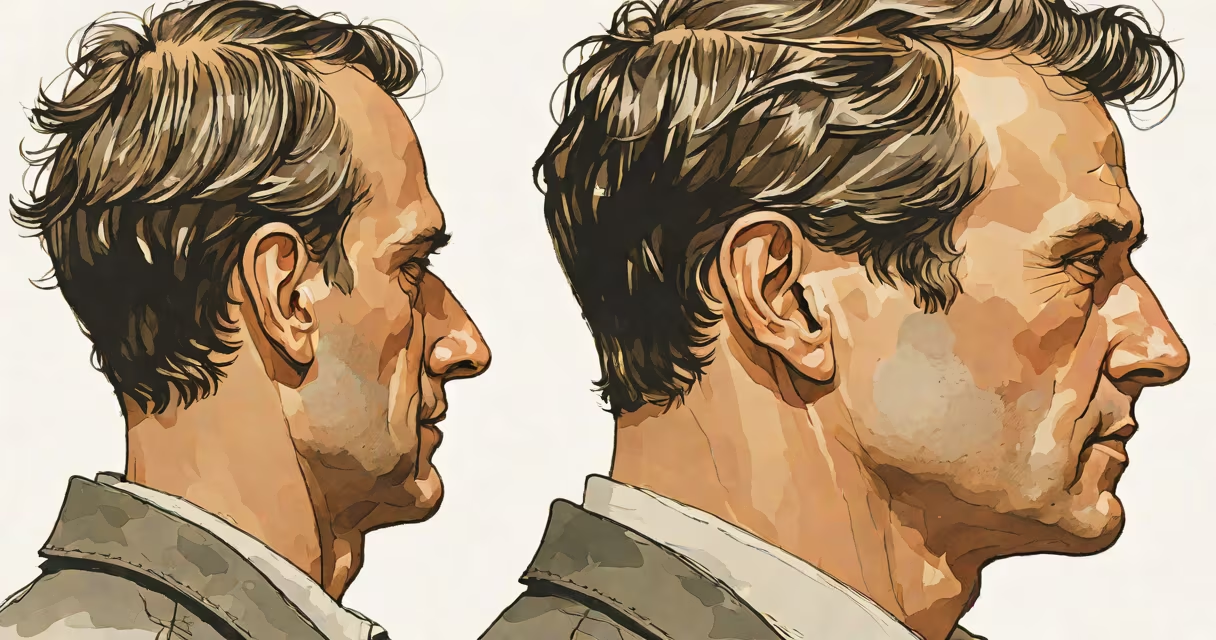
Norwood 5 hair describes a stage of male pattern baldness marked by a receding hairline that reaches the mid-temporal region and significant thinning at the crown, leaving a distinct horseshoe-shaped band of hair around the sides and back of the scalp.
This classification comes from the Norwood scale, a system developed by Dr. O'Tar Norwood in the 1970s to categorize the progression of male pattern baldness. The scale ranges from Type I (minimal recession) to Type VII (extensive hair loss). Norwood 5 sits between early and advanced stages, representing a clear shift from mild to noticeable hair loss.
At this stage, the frontal hairline typically recedes to the level of the temples, forming a U-shape. The crown area shows visible thinning, often with reduced density and increased scalp visibility. The remaining hair forms a continuous band along the sides and back, which is critical for future hair restoration planning.
Male pattern baldness follows a predictable genetic pattern driven by dihydrotestosterone (DHT), a hormone derived from testosterone. DHT binds to receptors in genetically susceptible hair follicles, shrinking them over time and shortening their growth phase. This leads to progressively finer, shorter hairs until they stop growing altogether.
By Norwood 5, the process has advanced beyond initial thinning. The frontal recession is stable but pronounced, and the crown area may show patchy thinning. Not all individuals progress at the same rate-some stabilize at Norwood 5 with minimal further loss, while others move toward Norwood 6 or 7 within 3-5 years without intervention.
A 2021 study published in the Journal of Clinical and Aesthetic Dermatology found that 42% of men aged 30-45 with Norwood 5 hair had measurable progression over a 3-year period when untreated. Early medical therapy can slow this decline, but surgical options become increasingly necessary for aesthetic restoration.
While the standard Norwood 5 presents symmetrical frontal recession and central thinning, variations exist based on individual anatomy and hair distribution patterns.
| Variant | Description | Relevance to Treatment |
|---|---|---|
| Classic Norwood 5 | Frontal hairline recedes to mid-temporal area; crown thinning visible. | Most common. Ideal candidate for FUT or FUE hair transplant. |
| Asymmetric Norwood 5 | One side recedes more than the other; crown thinning uneven. | Requires precise donor planning and custom design to avoid imbalance. |
| High Forehead Norwood 5 | Recession begins higher on the forehead due to natural hairline position. | More challenging for natural-looking results; may require multiple sessions. |
One non-obvious distinction: Norwood 5 does not always mean complete baldness in the center. Some patients retain enough density in the mid-scalp to support a single transplant session, while others have extensive thinning requiring two or more procedures.
Recognizing Norwood 5 is essential for both clinical evaluation and treatment planning. It marks the threshold where non-surgical therapies like minoxidil and finasteride begin to lose effectiveness as standalone solutions. At this stage, hair transplants offer the most reliable long-term outcome.
For surgeons, Norwood 5 defines a key window for intervention. The remaining donor hair on the sides and back of the scalp must be sufficient to cover both the frontal and crown areas. A 2019 analysis in the International Journal of Trichology showed that patients with Norwood 5 who underwent FUE transplants achieved 78% graft survival and 85% patient satisfaction at 12 months.
When designing a new hairline, surgeons aim for a natural curve that mimics the original hairline's growth pattern. The ideal front hairline should follow the "rule of thirds"-placed at the midpoint between the eyebrows and the nose tip, with subtle variation in density from center to edges.
Many assume Norwood 5 means irreversible baldness. That's incorrect. With proper treatment, hair restoration can achieve dense, natural-looking results. The myth persists because many clinics market "miracle" products that claim to regrow lost hair-but no topical treatment can restore follicles that have permanently entered telogen (resting) phase.
Another misconception: Norwood 5 requires large numbers of grafts. While crown reconstruction often demands 1,500-2,500 grafts, the frontal area may need only 800-1,200. Total graft count depends on individual donor supply and desired density-not just the Norwood stage.
One overlooked fact: the temporal region (temples) is often the hardest to restore naturally. Grafts placed too close to the natural hairline edge can create a "pluggy" look. Surgeons use micro-follicular unit extraction (FUE) with 0.8mm-1.0mm punch sizes to minimize scarring and improve integration.
In 2022, a 38-year-old male presented with Norwood 5 hair loss. His medical history included a 5-year history of progressive thinning. He had tried minoxidil twice (1% and 5%) with minimal improvement. His donor area showed good density (about 35-40 follicular units per cm²).
The surgeon planned a two-stage procedure: 1,800 grafts for the frontal hairline and 1,200 for the crown. The first session focused on creating a natural-looking hairline with gradual density decrease from center to temples. The second session, six months later, addressed crown coverage using recipient sites prepared with microneedling to improve graft take.
Post-op photos at 12 months showed 80% of grafts in active growth. The patient reported improved confidence and no visible scarring. He continues using finasteride (1 mg daily) to maintain results.
Progression to Norwood 6 involves merging of the frontal and crown areas, leaving only a narrow band of hair behind the ears and at the nape. Norwood 7 represents near-total baldness with only a small strip of hair remaining at the back.
Patients at Norwood 5 should consider surgery before advancing to Norwood 6. Once the donor supply becomes limited, outcomes degrade. A 2020 study in the journal *Plastic and Reconstructive Surgery* found that patients who delayed transplant until Norwood 6 required 40% more grafts and had lower long-term survival rates.
Understanding your Norwood stage is not about labeling yourself-it's about making informed decisions. Norwood 5 hair is not a death sentence for your hairline. It's a milestone that signals the need for proactive care.
For those exploring options, consulting a board-certified dermatologist or hair restoration surgeon is essential. They can assess your donor supply, evaluate your expectations, and recommend a personalized plan. The goal isn't just to replace hair-it's to restore confidence through natural-looking results.
With proper planning and execution, Norwood 5 hair can be effectively managed. The right treatment strategy turns a visible sign of aging into a manageable condition with lasting results.