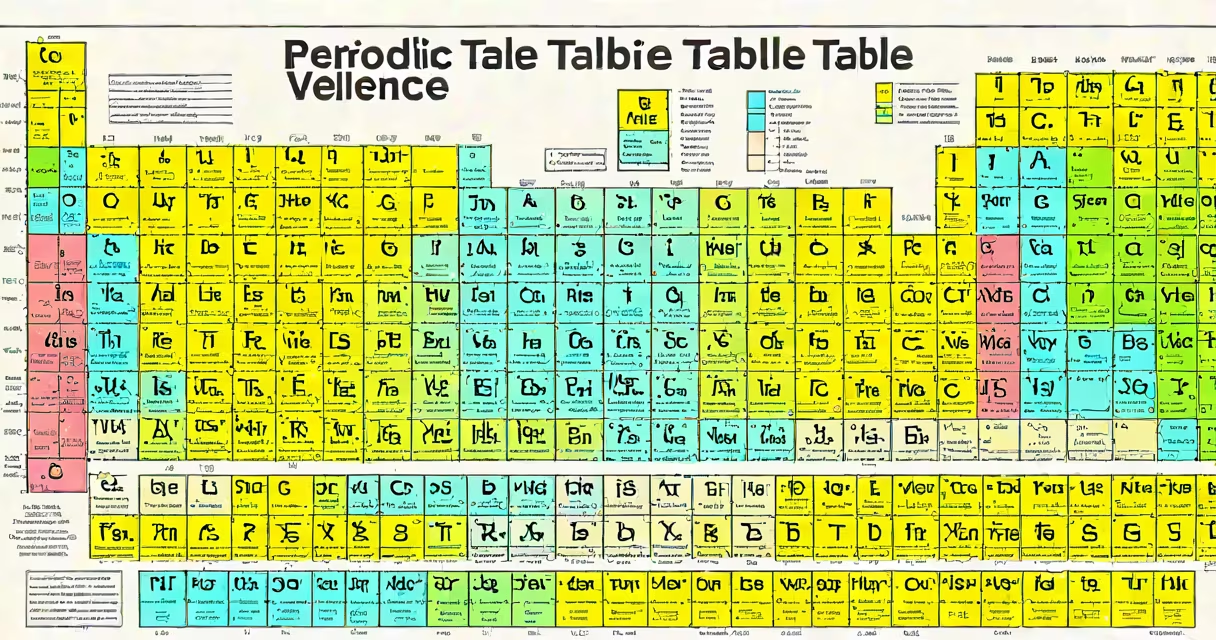
Periodic table valence refers to the number of electrons in an atom's outermost shell that participate in chemical bonding. These electrons determine how atoms interact, form compounds, and achieve stable configurations.
Valence electrons are the key to understanding chemical reactivity. Elements in the same group (vertical column) have similar valence electron counts, which explains their shared chemical properties. For example, all alkali metals in Group 1 have one valence electron and readily lose it to form +1 ions.
The periodic table arranges elements by atomic number, but the layout reveals deeper patterns in electron configuration. The s, p, d, and f blocks correspond to subshells filled in specific orders. Valence electrons occupy the highest principal energy level and are responsible for bonding behavior.
Each element's position on the periodic table indicates its electron configuration. The period (row) shows the highest occupied energy level. The group (column) reveals the number of valence electrons for main-group elements.
For main-group elements (Groups 1, 2, and 13-18), the group number directly corresponds to valence electron count. Group 1 elements have 1 valence electron, Group 2 have 2, and Group 18 noble gases have 8 (except helium, which has 2).
Transition metals (d-block) complicate this pattern. Their valence electrons include both s and d electrons from the outermost shell. Iron (Fe), for example, has two 4s electrons and six 3d electrons, making its valence electrons variable depending on context. This variability enables multiple oxidation states.
Valence electrons fall into four categories based on orbital type:
| Orbital Type | Valence Electron Count Range | Example Elements | Chemical Behavior |
|---|---|---|---|
| s-block | 1-2 | Lithium (Li), Calcium (Ca) | Readily lose electrons to form cations |
| p-block | 3-8 | Oxygen (O), Chlorine (Cl) | Gain or share electrons to complete octet |
| d-block | 1-12 | Iron (Fe), Zinc (Zn) | Variable oxidation states; form colored compounds |
| f-block | 1-14 | Uranium (U), Europium (Eu) | Complex chemistry; often exhibit multiple oxidation states |
Non-metals in the p-block typically gain electrons to achieve a full octet. Oxygen, with six valence electrons, gains two to reach eight - forming O²⁻ ions or covalent bonds in water (H₂O).
A non-obvious fact: hydrogen behaves like both Group 1 and Group 17 elements. It has one valence electron and can lose it to form H⁺ (like alkali metals), or gain one to form H⁻ (like halogens). This dual nature explains its unique role in molecular structures.
Valence electrons dictate bond formation. Sodium (Na) has one valence electron and transfers it to chlorine (Cl), which has seven. Both achieve stable configurations - Na⁺ and Cl⁻ - forming sodium chloride (NaCl).
In organic chemistry, carbon's four valence electrons allow it to form long chains and rings. This versatility underpins life's complexity. Methane (CH₄) illustrates this: carbon shares its four valence electrons with four hydrogen atoms, each contributing one.
Industrial applications rely on valence predictions. Semiconductors like silicon (Si) have four valence electrons. Doping silicon with phosphorus (five valence electrons) creates n-type material, essential for transistors and solar cells.
Many assume valence equals group number for all elements. This fails for transition metals. Scandium (Sc), in Group 3, has three valence electrons (4s² 3d¹), but its common oxidation state is +3, not +1.
Another error: thinking noble gases don't react because they lack valence electrons. Neon (Ne) has eight valence electrons and is inert under normal conditions. But xenon (Xe), also a noble gas, forms compounds like XeF₄ due to larger atomic size and lower ionization energy.
Some confuse valence with oxidation state. Oxidation state is a hypothetical charge assigned in compounds, while valence refers to actual electrons available for bonding. In CO₂, carbon has a +4 oxidation state but four valence electrons.
Consider boron trifluoride (BF₃). Boron (B) is in Group 13 - it has three valence electrons. Fluorine (F), in Group 17, has seven. Each fluorine needs one electron to complete its octet.
Boron shares its three valence electrons with three fluorine atoms. Each bond is a single covalent bond. The molecule has trigonal planar geometry and is electron-deficient - boron has only six electrons around it. This makes BF₃ highly reactive, accepting lone pairs from other molecules.
This behavior is exploited in industrial processes. BF₃ acts as a Lewis acid catalyst in Friedel-Crafts alkylation, where it accepts electron density from aromatic rings.
I once constructed physical models of molecules using ball-and-stick kits. When assembling ammonia (NH₃), I noticed nitrogen had five valence electrons - three bonded to hydrogens and one lone pair. The model showed a pyramidal shape, matching experimental data. This hands-on exercise clarified how valence electrons dictate geometry.
Understanding periodic table valence allows accurate prediction of reactivity, bond types, and molecular shapes. It's foundational for chemistry, materials science, and drug design.