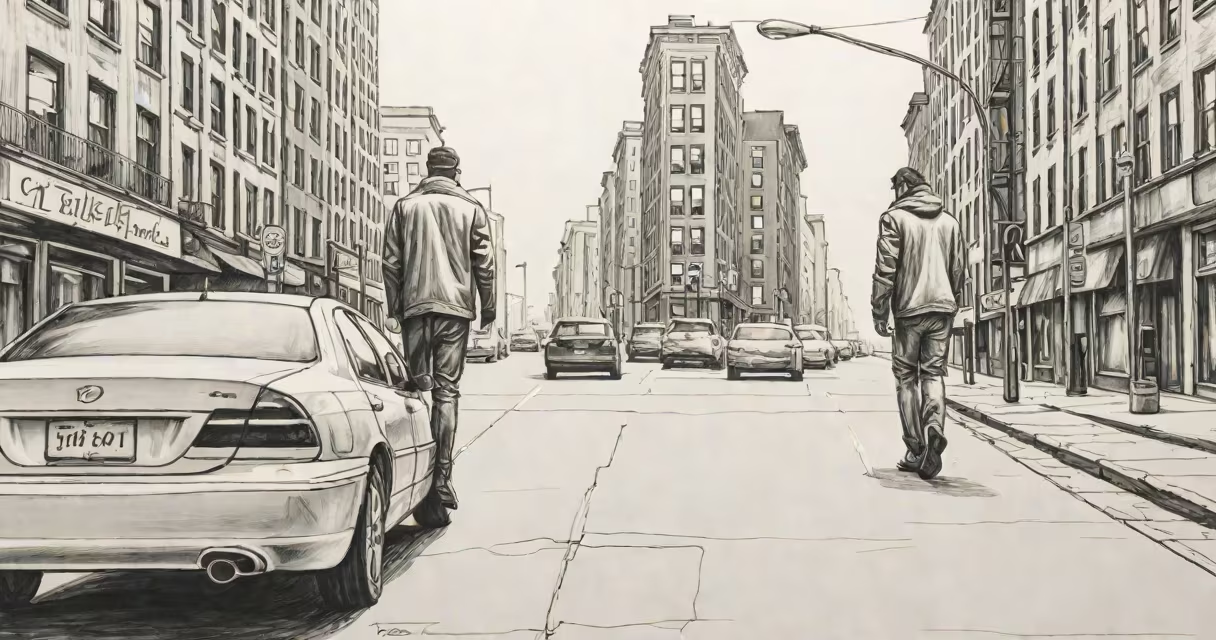
"To pull up" means to arrive suddenly or unexpectedly, especially in a vehicle. The phrase describes a physical arrival, often with a sense of immediacy or surprise.
The expression is common in informal spoken English, particularly in urban or youth-driven contexts. It typically implies movement toward a location, often in a car, but can apply to any mode of transport or even a sudden appearance in person.
For example: "I was waiting at the bus stop, and then my friend pulled up in a red SUV." The speaker didn't expect the arrival, and the word "pulled up" signals that the event happened quickly and visibly.
The phrase functions as a verb phrase rooted in spatial awareness. "Pull up" refers to the act of driving a vehicle to a stop at a specific location. It's not about leaving or departing-it's about arriving and stopping.
When someone says "He pulled up," they're describing a moment when a car reached a destination and came to rest. The action is often abrupt enough to catch attention. This makes the phrase useful for storytelling, especially in dialogue-heavy settings like film scripts or social media posts.
"She pulled up at the diner at 11:47 p.m. with the lights off," suggests both timing and atmosphere. The lack of headlights adds tension. The phrase doesn't just report arrival-it sets a scene.
While the core meaning stays consistent, context changes how the phrase is used. Below are common scenarios:
| Context | Meaning | Example |
|---|---|---|
| Literal arrival | Vehicle stops at a location | "The delivery guy pulled up at the front door." |
| Sudden appearance | Person shows up unexpectedly | "My ex pulled up at the bar last night." |
| Dramatic entrance | Arrival with impact or flair | "They pulled up in a black stretch limo." |
"Pulling up" can imply social weight. A car pulling up at a party often draws eyes. The vehicle becomes a symbol of presence. In music videos, artists frequently "pull up" in luxury cars to signal status or confidence.
Even in written narratives, authors use "pulled up" to mark turning points. For instance, in Colson Whitehead's novel *The Underground Railroad*, characters arrive at stations via train or carriage, described with phrases like "the wagon pulled up at dawn." The moment marks a shift in momentum.
Many people mistake "pull up" for "show up" or "arrive," but those are not interchangeable. "Show up" emphasizes presence without implying motion. "Pull up" always involves movement and stopping.
Another error is assuming "pull up" means "to start a vehicle." That's incorrect. You don't "pull up" when you turn on the engine. You "start" the car. "Pull up" happens after the engine runs and the car moves to a destination.
A third misconception is thinking the phrase only applies to cars. While most common with vehicles, "pull up" can describe any mobile arrival. For example: "The drone pulled up beside the rooftop garden." Though less frequent, this usage is valid in technical or poetic language.
Consider this exchange from a real-life text message chain:
Me: "Where are you?"
Friend: "I'm five minutes away. I'll pull up at the corner."
The friend isn't saying they'll walk or call. They're confirming they'll arrive by car and stop at a known spot. The phrase gives precise timing and method of arrival.
Now imagine the same scene using "show up": "I'll show up at the corner." That leaves room for walking, biking, or even teleportation. "Pull up" narrows the possibility to a moving vehicle.
"To pull up" is rarely metaphorical. Unlike phrases such as "hit the ground running" or "break the ice," which carry symbolic weight, "pull up" refers to actual physical movement.
However, in narrative contexts, the phrase gains emotional resonance. When a character pulls up at a childhood home after years away, the moment feels charged-not because the words are abstract, but because the action is concrete and vivid.
As noted in the Oxford Learner's Dictionary, "pull up" means "to stop a vehicle at a place." The definition includes examples like "The taxi pulled up outside the hotel." This confirms the term's grounding in real-world behavior.
Similarly, Merriam-Webster defines "pull up" as "to bring to a stop" in vehicles. The dictionary cites usage from 19th-century British literature, proving the phrase predates modern slang.
I once waited at a subway station during a rainstorm. A man in a dark coat stepped out of a blue sedan and walked toward the entrance. I didn't recognize him until he said, "Sorry I pulled up late." He wasn't just late-he'd arrived in a car, stopped at the curb, and gotten out. The phrase captured the entire sequence: motion, stop, emergence.
That moment showed me how "pull up" compresses time and space into a single phrase. It's not just about transportation. It's about arrival as a narrative event.
"To pull up" shares roots with other phrasal verbs involving movement and stopping. "Pull over" means to move to the side of the road. "Pull in" means to enter a driveway or parking spot. These are distinct but related.
"Pull up" is also sometimes confused with "pull up a chair" or "pull up your socks"-idioms with entirely different meanings. The former refers to seating, the latter to personal effort. Context determines the correct interpretation.
Understanding "to pull up meaning" requires seeing it not as a standalone idiom, but as part of a larger system of movement-based language. It's about arrival, visibility, and timing-all anchored in physical reality.