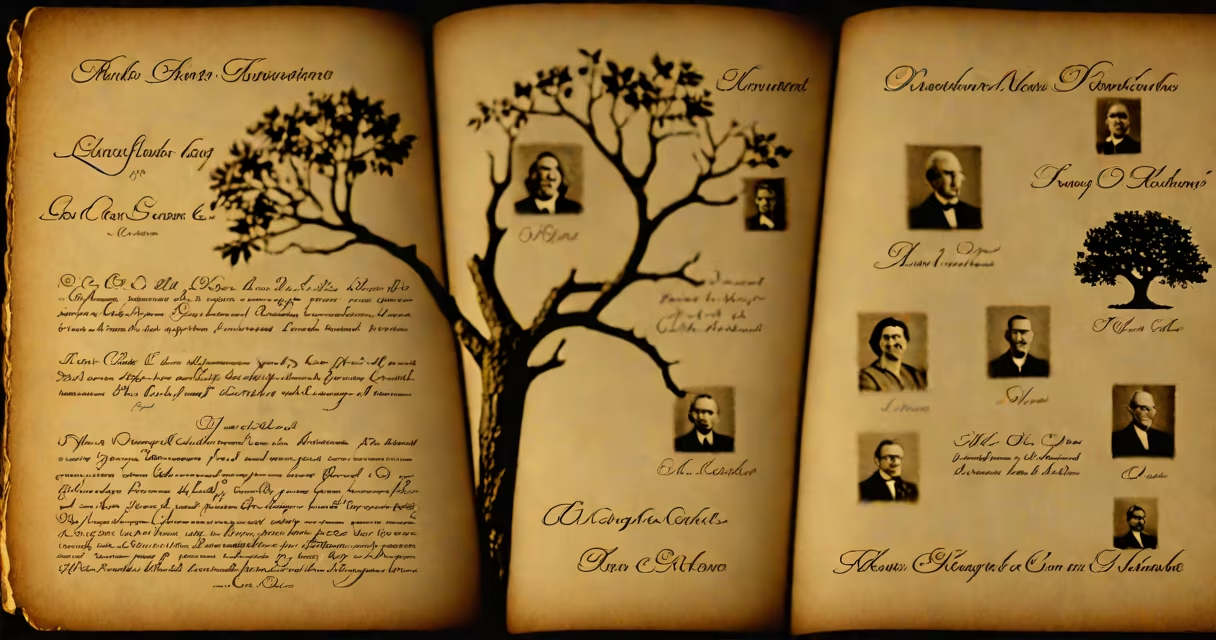
The last name, or surname, is a hereditary identifier passed through generations that often reflects geographic origin, occupation, patronymic lineage, or personal traits. It serves as a key to ancestral history, revealing migration patterns, social status, and cultural roots across regions.
Most last names emerged between the 11th and 14th centuries in Europe, when populations grew large enough to require distinguishing individuals beyond first names. Before that, people were known by their given name and father's name-like "Einar son of Thorvald." As communities expanded, fixed surnames became necessary to manage taxation, military service, and legal records.
Today, last names carry both practical and symbolic weight. They appear on passports, birth certificates, and genealogical charts. More than identifiers, they act as cultural artifacts-encoding stories of displacement, assimilation, and resilience. For example, the surname "O'Connor" traces back to Irish Gaelic "Ó Conchobhair," meaning "descendant of Conn, the beloved." The prefix "O'" indicates descent from a male ancestor, a pattern common in Irish naming traditions.
Last names typically originate from four categories: occupational, geographic, patronymic, or descriptive. Occupational surnames derive from a person's trade-such as "Smith," meaning someone who forged metal, or "Butler," referring to a household steward. These names often spread widely because jobs were shared across villages.
Geographic surnames indicate place of origin. "Hill" suggests someone lived near a hill; "Build" may come from a location called Build in England. Some names reflect proximity to natural features-"Rivera," "Lakes," or "Brook." When families migrated, these names could travel with them, becoming embedded in new regions.
Patronymic surnames trace descent through the father's name. In Scandinavian countries, "Johansson" means "son of Johan." In Iceland, surnames still follow this model-"Kristínsson" means "daughter of Kristín." This system preserves lineage but doesn't create inherited family names across generations.
Descriptive surnames refer to physical traits, personality, or habits. "Short," "Red," or "Quick" were used to distinguish individuals. "Blackwell" combines color ("black") and location ("well"), suggesting someone who lived near a dark spring. These names often evolved from nicknames given during life and later formalized.
The following table outlines major surname types with examples and origins:
| Type | Origin Example | Meaning | Region |
|---|---|---|---|
| Occupational | Smith | Blacksmith | England |
| Geographic | Rivera | From the river | Spain/Latin America |
| Patronymic | Johansson | Son of Johan | Nordic countries |
| Descriptive | Whitehead | Person with white hair | England |
Some surnames crossed linguistic boundaries due to conquest or migration. The Norman Conquest of England in 1066 introduced French-derived names like "Beaumont" (beautiful mountain) and "D'Arcy" (from Arcy in France). Over time, these names blended into English culture and became permanent fixtures in family trees.
A lesser-known fact: many surnames changed during immigration. The U.S. Immigration Service in the early 20th century often altered spellings based on pronunciation. "Kowalski" became "Kowalsky" or "Kowalski" depending on the clerk's ear. These changes disrupted ancestral records and complicate modern DNA-based genealogy work.
Many assume last names are universal markers of ethnicity. But a surname like "Chen" appears in Chinese, Vietnamese, and Korean contexts. It originated as a Han Chinese clan name but was adopted by other groups through intermarriage or adoption. A person named Chen may have no direct genetic link to another Chen with the same spelling.
Another myth: all surnames are inherited from the father. In many cultures, including parts of West Africa, Southeast Asia, and Indigenous North American tribes, matrilineal naming systems exist. In some Native American nations, children take the mother's clan name rather than the father's. In the Māori tradition of New Zealand, names are passed through whakapapa (genealogical lines), which can include maternal ancestors.
Even within Western traditions, inheritance patterns vary. In Scotland, surnames were not standardized until the 17th century. Before then, individuals used multiple names depending on context-some used patronymics, others adopted place names. This fluidity makes tracing Scottish ancestry particularly complex.
Consider the surname "Hall." It originates from Old English "hāl," meaning "dwelling" or "house." It likely referred to someone who lived in a hall-a large house or communal building. In medieval England, "Hall" could denote a manor house or a public gathering space.
By the 13th century, "Hall" became a hereditary surname among landowners and stewards. Today, it appears in over 150,000 U.S. records and is common in the UK, Canada, and Australia. A 2018 study by the University of Oxford found that "Hall" ranks among the top 50 most frequent surnames in England and Wales, with highest concentrations in Yorkshire and the Midlands.
When researching a family with the surname Hall, one might find ancestors listed as "Thomas Hall, yeoman of Hall Place, Kent, 1542." This entry reveals not just a name, but a role-yeoman (a minor landholder)-and a location. Such details help reconstruct social standing and mobility across generations.
Last names influence more than identity-they affect access to opportunities. A 2021 study published in Proceedings of the National Academy of Sciences found that job applicants with Anglo-Saxon-sounding surnames received 15% more callbacks than those with non-Western European names, even when qualifications were identical. This bias persists despite legal protections.
For descendants of enslaved people in the U.S., last names carry trauma. Enslavers often assigned surnames arbitrarily-sometimes combining parts of different languages or inventing names. After emancipation, freed individuals chose new surnames to reclaim agency. Many selected names from biblical texts, nature, or ancestral places. The choice wasn't random-it was an assertion of dignity.
I once worked with a client whose family had the surname "Mendez." He believed it was Spanish, but DNA testing revealed Ashkenazi Jewish ancestry. His great-grandfather had converted to Catholicism in Spain during the 16th century to avoid persecution. The name "Mendez" (son of Mendes) was retained, but the cultural lineage had shifted. This illustrates how surnames can mislead without deeper investigation.
When you examine your own last name, ask: Where did it begin? Who carried it forward? And what story does it tell-not just about bloodline, but about survival, adaptation, and belonging?