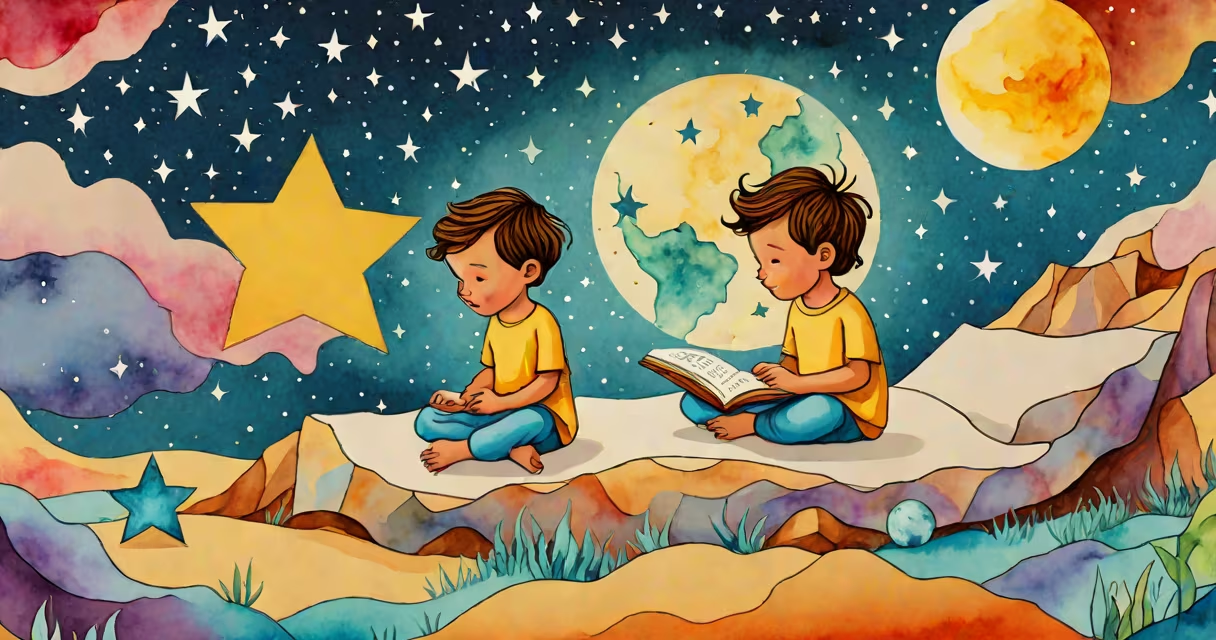
A creation story for kids is a simplified narrative that explains how the universe, Earth, or life began, told in language and imagery appropriate for young minds. These stories often feature animals, magical beings, or gentle gods, avoiding violence or complex theology. They serve both educational and emotional purposes, helping children grasp big ideas like origin, purpose, and belonging.
Most creation stories for kids are adapted from oral traditions, religious texts, or cultural myths. They strip away adult themes-such as war, sacrifice, or divine punishment-and focus on wonder, care, and curiosity. A story might describe the sky as a mother's blanket, the sun as a friendly fireball, or mountains as the bones of ancient giants. The goal is not scientific accuracy but emotional resonance and cognitive accessibility.
According to the American Psychological Association, children aged 3 to 7 begin developing a sense of time and causality. Creation stories support this stage by offering a structure for understanding "before" and "why." These narratives aren't meant to be believed literally, but they help kids process abstract concepts like infinity, birth, and change through metaphor and repetition.
These stories follow a basic structure: a void or emptiness exists, then a force (often personified) acts to bring form, light, or life. The action is usually gentle and intentional. For example, in a popular version of the Navajo creation story adapted for children, the world is formed layer by layer, with each level representing a stage of growth. The people emerge from the earth through a sacred doorway, guided by spiritual helpers.
Language is key. Words like "once upon a time," "long ago," or "in the beginning" signal that the story is not historical fact. Children learn to distinguish fantasy from reality through such cues. Narrators often use rhythm, repetition, and sound effects-"thump-thump" for footsteps, "whoosh" for wind-to engage attention and aid memory.
Research from the University of Michigan shows that children who hear consistent, emotionally warm storytelling develop stronger narrative skills and empathy. A study published in *Child Development* found that kids exposed to culturally grounded stories showed greater interest in their heritage and improved long-term recall compared to those who heard generic tales.
Creation stories for kids fall into categories based on cultural origin and narrative style. Some emphasize natural forces; others center on divine beings or animal ancestors. The following table outlines common types and their features:
| Type | Origin | Key Features | Example |
|---|---|---|---|
| Earth-diver | Indigenous North America | Water covers everything; a creature dives to retrieve soil from the bottom | The turtle carries land on its back; birds drop seeds to grow forests |
| World egg | Various (China, Egypt, India) | An egg splits open to release sky, earth, and life | A golden egg floats in darkness; inside, a god emerges and shapes the world |
| Divine word | Abrahamic traditions (Jewish, Christian, Muslim) | God speaks creation into existence; order follows speech | "Let there be light," says God. Light appears. Day begins. |
| Animal ancestors | West African (Yoruba, Akan) | Animals build the world or teach humans how to live | Spider creates the sky and weaves the first human from threads |
Each type reflects values relevant to the culture. Earth-diver stories show patience and cooperation. World egg tales stress transformation and potential. Divine word stories emphasize intention and authority. Animal ancestor stories celebrate wisdom and connection to nature.
These stories appear in homes, preschools, libraries, and religious education programs. Parents read them at bedtime. Teachers use them during cultural units. Librarians recommend them during story hour. They're especially common in early childhood curricula focused on identity, community, and emotional development.
For example, a kindergarten teacher in Portland, Oregon, uses a modified version of the Maori creation story-where the sky father and earth mother are separated by their children-to discuss family relationships. She replaces violent elements with peaceful separation and focuses on how love persists even when space grows between people. The story helps children process feelings of distance, whether from parents, friends, or pets.
One non-obvious point: many adults assume creation stories for kids are purely fictional. But they're often rooted in real beliefs. The Zulu story of Unkulunkulu-the first man-originally described a spiritual being who taught humans how to farm and pray. Modern versions for children remove references to ritual and sacrifice, but the core idea-that life began with guidance from elders-remains. This preserves cultural continuity while adapting to child development stages.
People often confuse creation stories for kids with religious doctrine. They're not theological instruction. A story about the moon being made from a girl's tears isn't meant to prove the moon's composition-it's meant to explain why night feels safe. The focus is emotional truth, not physical accuracy.
Another mistake: assuming all creation stories are about gods. While many involve deities, others rely on natural processes. The Inuit story of Sedna, the sea goddess, includes her becoming part of the ocean after being cast out. But a child-friendly version might simply say: "She became the home of whales and seals, because she loved the water too much to leave." The magic remains, but the trauma is softened.
I once read a version of the Greek myth of Gaia and Uranus to a group of five-year-olds. The original tale involves violent conflict and castration. I replaced it with a gentle scene: "The sky and earth were close, like two hands holding each other. When the sky grew tired, he gently stepped back. The earth stayed still, and the stars appeared above." The children asked, "Why did the sky go away?" I said, "Maybe he needed rest. Maybe he wanted to watch from afar." That moment taught me that adaptation isn't distortion-it's care.
Creation story for kids is not about getting facts right. It's about giving children a safe way to ask "how?" and "why?" through imagination. These stories help build mental models of time, space, and belonging. They don't replace science, but they prepare young minds to receive it later.
When choosing a creation story for kids, look for ones that honor the culture of origin, avoid fear-based imagery, and invite curiosity. Avoid versions that portray gods as angry or nature as dangerous. Instead, seek stories where light comes from kindness, mountains grow from patience, and the world begins with a whisper.