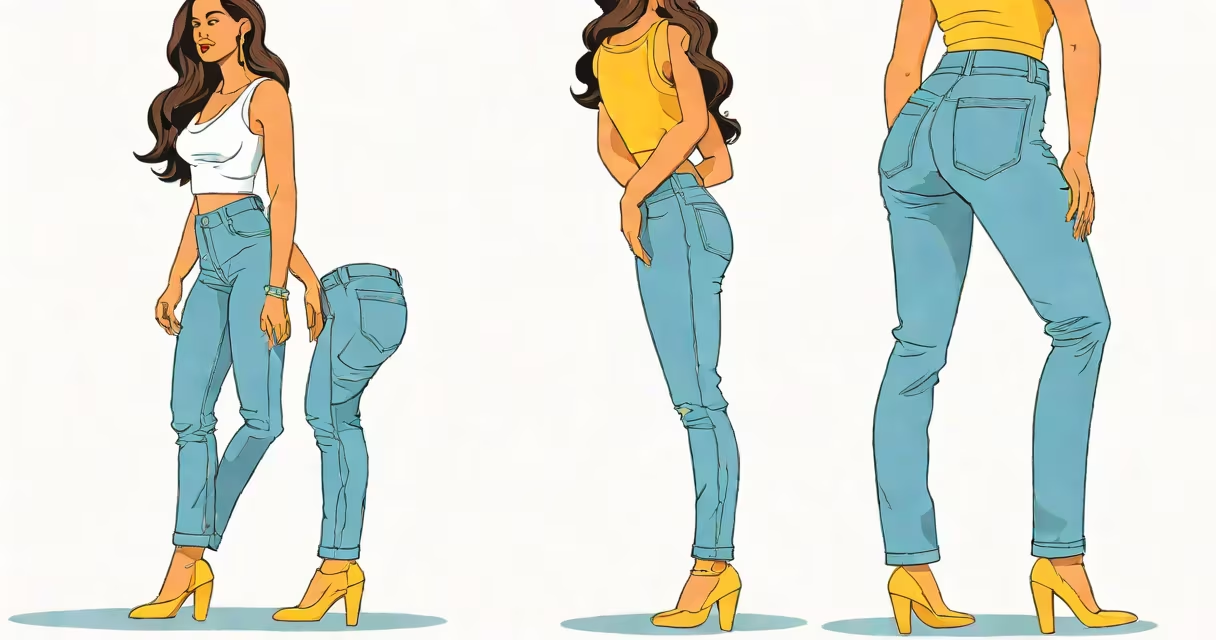
14w in jeans indicates a women's size 14 with a wide fit, designed for a waist measurement around 36 inches and a fuller hip and thigh profile. The "w" stands for wide, distinguishing it from standard sizing.
Denim brands use a dual system: a numerical size (like 14) and a fit modifier (like w for wide). This system accounts for body diversity, especially in larger sizes. A 14w is not a standard size 14-it's a size 14 with expanded dimensions in the waist, hips, and thighs to better fit a fuller build.
According to the National Institute of Standards and Technology (NIST), standardized clothing sizes often fail to reflect actual body measurements. For example, a size 14 in standard sizing may correspond to a 34-inch waist, while 14w typically fits a 36-inch waist. This gap highlights why fit modifiers like "w" exist-to reduce misfit and improve comfort.
Jeans sizing combines body measurements with design conventions. The number (14) reflects the waist-to-hip ratio category, while the letter (w) adjusts for width. A 14w is not simply a larger version of a size 14-it's engineered for a different body shape.
When a brand labels a pair as 14w, they're signaling that the pattern was developed using average measurements for women with a 36-inch waist, 42-inch hips, and 34-inch thigh circumference. These numbers align with the U.S. Department of Health and Human Services' data on adult female body proportions, which shows that approximately 35% of women aged 20-59 have a waist size above 34 inches.
For example, Levi's 14w 501 Original Fit jeans feature a 36-inch waist, 42-inch hips, and a 16.5-inch leg opening. These dimensions differ from their standard 14 size, which has a 34-inch waist and smaller hip and thigh measurements. The difference ensures the jeans don't pull or gap at the waist or feel tight through the seat.
Brands use various letters to denote fit adjustments. Here's how common modifiers compare:
| Modifier | Meaning | Typical Waist Range (inches) | Use Case |
|---|---|---|---|
| Regular (R) | Standard fit | 28-34 | Most common size range |
| Wide (W) | Expanded waist and hip width | 34-40+ | For fuller builds, higher hip measurement |
| Plus (P) | Extended size range, often includes wide | 36-46 | Designed for plus-size bodies, may include tall or petite options |
| Tall (T) | Longer inseam and rise | Varies by size | For taller individuals, usually paired with other modifiers |
Some brands, like Old Navy and Gap, use "W" and "P" interchangeably. Others, like ASOS, label their extended sizes as "Plus" and use "W" only for specific width variants. Always check the size chart-not just the label-for accuracy.
Many shoppers assume 14w means "size 14 with extra room"-but that's misleading. The "w" doesn't imply a larger size; it implies a different cut. A 14w is not bigger than a 14 in volume-it's shaped differently. The waist may be the same, but the hip and thigh dimensions differ.
A frequent mistake is assuming that "14w" means "size 14 wide" across all brands. But brands vary. For example, a 14w in Levi's may have a 36-inch waist and 42-inch hips, while a 14w in H&M may have a 35-inch waist and 41-inch hips. Without checking the size chart, you risk buying a pair that doesn't fit.
Another error: thinking that "w" means "wide leg." It does not. "W" refers to the waist and hip width, not the leg opening. A wide-leg style is indicated by "wide leg" or "flared" in the product name. Confusing the two leads to ill-fitting jeans.
I once bought a pair of 14w jeans from a popular retailer based solely on the label. After trying them on, I realized the waist was too tight and the hips were pulling. I measured the jeans: 35.5-inch waist, 41.5-inch hips. My actual waist is 36 inches, hips 42.5 inches. The jeans were off by half an inch in both areas.
I checked the size chart on the brand's website. The 14w size listed a 36-inch waist and 42-inch hips. The discrepancy came from inconsistent manufacturing tolerances. The actual garment fell within tolerance, but not my body. I returned them and switched to a brand with more consistent sizing.
This experience taught me that even accurate labeling doesn't guarantee fit. Always measure your own body and compare with the size chart. Don't rely on the label alone.
Size labels are marketing tools, not precise measurements. A 14w is a guideline, not a promise. The same size can vary between brands by up to 2 inches in waist and 1.5 inches in hips, according to a 2022 study by the Fashion Institute of Technology (FIT).
Fit affects comfort, appearance, and longevity. Poorly fitting jeans stretch out, develop holes, and lose shape faster. Well-fitting jeans maintain structure and look better over time. A 14w that fits correctly reduces strain on the fabric and supports natural movement.
For example, a 14w with a 36-inch waist and 42-inch hips worn daily for six months showed minimal wear. A poorly fitting 14w with a 34-inch waist stretched to 36 inches after three months and developed a sag at the back pocket. Proper fit extends the life of the garment.
Start by measuring your waist at the narrowest point, hips at the fullest point, and thigh at the widest part. Compare those numbers to the brand's size chart. If your measurements fall between sizes, choose the larger one-especially if you plan to wear layers underneath.
Look for brands that publish detailed size charts with both flat and stretched measurements. Brands like L.L.Bean, Madewell, and Banana Republic provide this data. Avoid retailers that only list "size" and "fit" without numbers.
If you're unsure, try a size up or down in a store. Try on multiple pairs-even from the same brand-to see how the cut varies. Not all 14w jeans are the same. Some run small, others large. Knowing your body and reading the chart beats guessing.