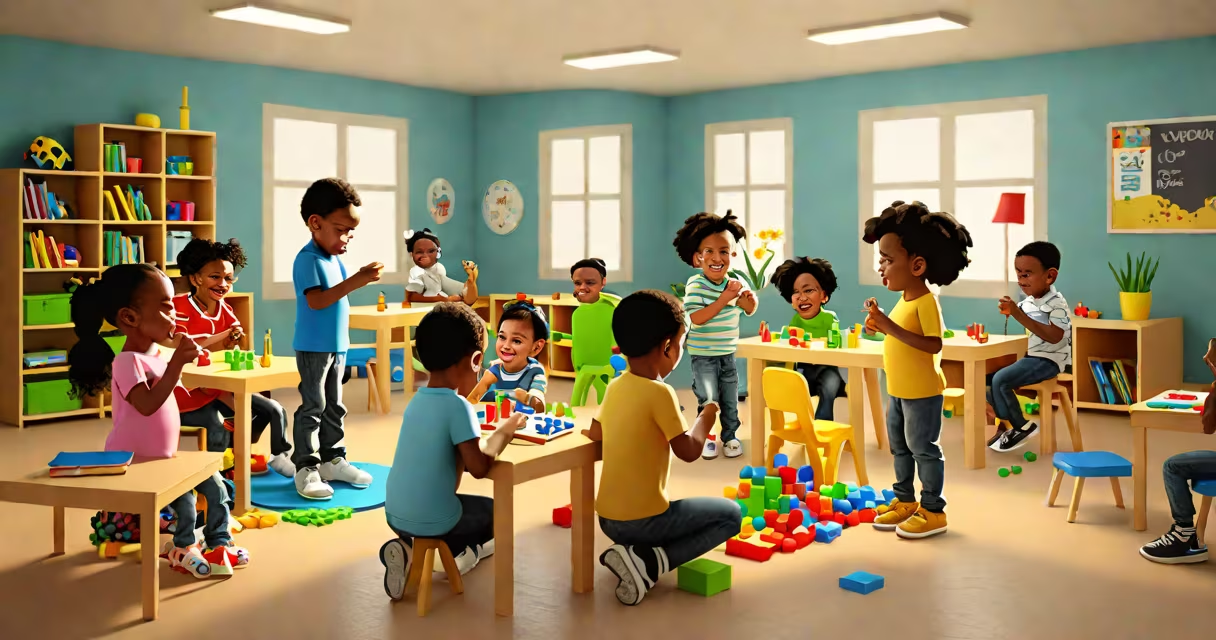
Developmental milestones of middle childhood refer to the predictable physical, emotional, cognitive, and social changes that typically occur in children between ages 6 and 12. These shifts reflect growing independence, improved reasoning, and deeper peer relationships.
Children in this phase move beyond early childhood's focus on immediate experiences. They begin to understand cause and effect, follow multi-step instructions, and grasp abstract concepts like time and fairness. Their bodies grow steadily-height increases by about 2 inches per year, and fine motor skills allow them to write neatly, tie shoelaces, and use tools with precision.
The American Academy of Pediatrics notes that most children reach major milestones by age 8, including reading fluently, solving basic math problems mentally, and participating in team sports. The Centers for Disease Control and Prevention (CDC) tracks these changes through standardized checklists used by pediatricians and educators.
These milestones emerge from brain maturation, increased life experience, and structured environments like school. Neural pathways strengthen through repetition, practice, and feedback. For example, a child who practices subtraction daily improves not just in math but in attention span and problem-solving endurance.
Environmental factors play a direct role. A child attending a school with consistent routines, clear expectations, and opportunities for collaboration develops better self-regulation. Research from the National Institute of Child Health and Human Development shows that children in such settings demonstrate higher executive function scores by age 9.
Milestones aren't rigid benchmarks. A child may master long division at 8 but struggle with sharing during group projects. That's normal. Variability reflects individual temperament, family dynamics, and cultural context-not delay.
Developmental milestones of middle childhood span four core domains: cognitive, emotional, social, and physical. Each builds on earlier foundations but introduces new complexity.
| Domain | Typical Milestones (ages 6-12) | Example |
|---|---|---|
| Cognitive | Understands time, follows complex instructions, uses logic | A 9-year-old plans a weekend trip using a map and schedule. |
| Emotional | Manages frustration, understands others' feelings, shows empathy | A 7-year-old apologizes after breaking a classmate's toy. |
| Social | Forms lasting friendships, plays cooperatively, resolves conflict | Two 10-year-olds negotiate roles in a game without adult help. |
| Physical | Runs smoothly, jumps rope, writes legibly, uses scissors safely | A 6-year-old cuts out a paper heart for Mother's Day with minimal errors. |
One non-obvious distinction: children don't suddenly "get" emotions. Emotional regulation develops gradually. A 10-year-old may express sadness but still cry during a movie because they haven't yet learned to suppress emotional responses in public.
Another common misunderstanding is equating milestones with IQ. A child who reads at grade level by age 7 doesn't necessarily have high intelligence. Reading ability reflects access to books, parental engagement, and language exposure-not innate talent.
Developmental milestones of middle childhood are central to academic success. Teachers use them to design lessons, assess progress, and identify students needing extra support. A child who struggles with sequencing events in a story may qualify for reading intervention.
Healthcare providers screen for delays during annual visits. The CDC recommends checking for milestones at 6, 9, 12, 18, 24, and 30 months-but many primary care clinics extend monitoring into middle childhood. A child who cannot name all U.S. states by age 10 may be referred for a learning evaluation.
I observed this firsthand while volunteering at a rural elementary school. One 8-year-old boy consistently failed to complete homework despite showing no signs of behavioral issues. After a teacher noticed he couldn't read past the second-grade level, a speech-language pathologist diagnosed dyslexia. With targeted instruction, his reading speed improved by 40% within six months.
Parents often mistake delayed milestones for laziness or defiance. A child who avoids group work may not lack motivation-it could indicate anxiety or difficulty interpreting social cues. The National Association of School Psychologists warns against labeling behavior without assessing underlying causes.
Some assume milestones are universal. But cultural norms influence timing. In collectivist societies, children may develop conflict-resolution skills earlier due to frequent family and community interaction. In individualistic cultures, independence is emphasized earlier. The World Health Organization recognizes this variation in its global development guidelines.
Another error: comparing siblings. Two children in the same family may differ in development. One may start writing stories at 7; another may not until 10. Neither is abnormal. Genetic differences, birth order, and parenting styles contribute to this variance.
Finally, milestones aren't linear. A child may excel in math but struggle with handwriting. This is not a red flag. The brain develops unevenly. A 9-year-old might solve algebraic equations but still need help organizing their backpack.
These milestones are not rigid tests. They are signposts along a process of growth. Recognizing them doesn't mean pushing children to meet standards. It means knowing when to step in-and when to step back.