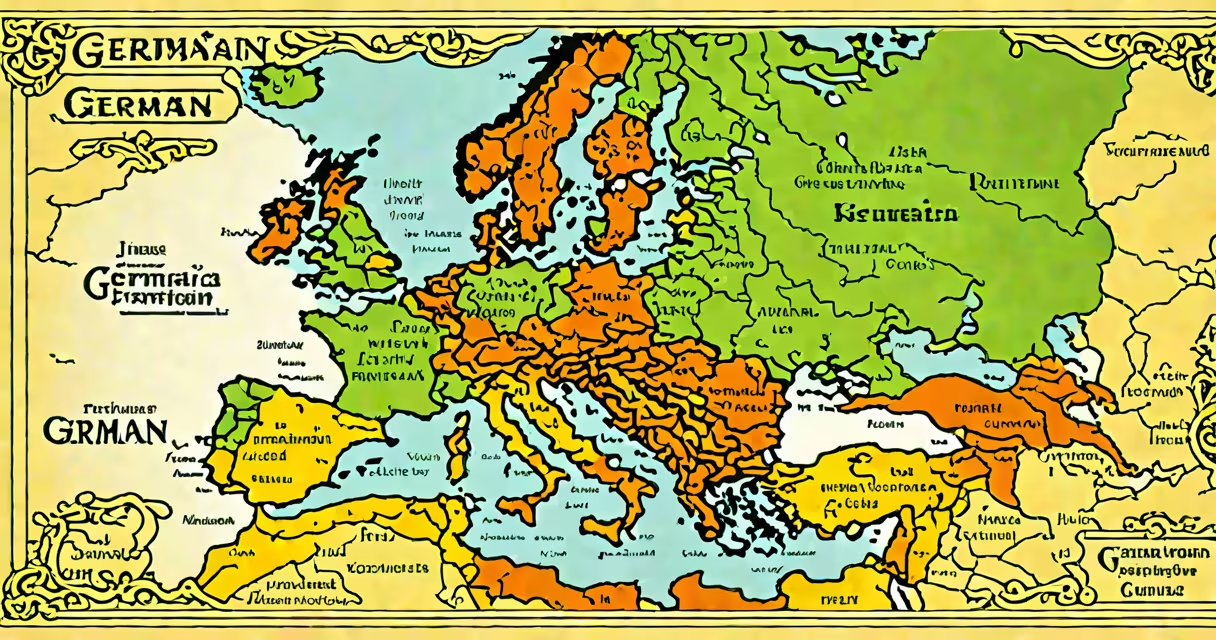
The name German originates from the Latin word Germani, used by Julius Caesar to describe a group of tribes living east of the Rhine River. It refers to an ethnic and linguistic identity rooted in Central Europe, not a modern nationality. The term was later adopted into English and other languages to denote people from the German-speaking region.
Caesar first recorded Germani in his Commentarii de Bello Gallico around 58 BCE. He described them as fierce warriors who lived beyond the Rhine and were distinct from the Gauls. The Romans did not use the term to refer to the modern nation-state of Germany, which did not exist until 1871. Instead, Germani labeled a cultural and linguistic grouping, not a political entity.
By the 6th century CE, the term had entered Old High German as diutisc, meaning "of the people" or "popular." This evolved into Middle High German deutsch, which eventually became the modern German word for "German" and "German language." The English word "German" derives from the Old English þeodisc, meaning "belonging to the people," reflecting the same root.
The shift from Germani to modern national identity was gradual. During the Holy Roman Empire (962-1806), the term referred to speakers of Germanic dialects across a fragmented collection of states and principalities. There was no unified German state until the 19th-century unification under Prussian leadership.
When the German Empire was proclaimed in 1871 at Versailles, the term "German" gained formal political weight. The new empire included territories from modern-day Germany, Belgium, Luxembourg, and parts of Poland and Denmark. National identity became tied to shared language, culture, and citizenship, though regional differences persisted.
Today, "German" describes both a nationality and a language group. The German language belongs to the West Germanic branch of the Indo-European family. It shares roots with English, Dutch, and Frisian. Modern German has over 100 million native speakers worldwide, primarily in Germany, Austria, Switzerland, and parts of Eastern Europe.
German names fall into several categories based on origin and structure. Common types include:
| Type | Origin | Examples | Meaning |
|---|---|---|---|
| Old High German | Pre-11th century | Adalbert, Giselher | "Noble" and "pledge" or "warrior" |
| Latinized Christian | Medieval Church influence | Matthias, Elisabeth | "Gift of God," "God is my oath" |
| Modern compound | 19th-20th century | Christoph, Sabine | "Christ-bearer," "from the tribe of Sabe" |
| Regional variants | Local dialects | Heinz, Lieselotte | Shortened forms of longer names; common in Bavaria and Swabia |
Many German surnames reflect occupational roles, geographic features, or personal traits. For example, Müller (miller), Schmidt (smith), and Bauer (farmer) were historically used to identify someone's trade. Others, like Neumann ("new man") or Wagner ("wagon maker"), indicate social status or lineage.
A lesser-known fact: German names often carry regional pronunciation differences. The name Reinhard is pronounced "Rine-hart" in northern Germany and "Rine-hart" with a softer "r" in southern regions. These variations stem from historical dialect boundaries, not spelling changes.
People often confuse "German" with "Swiss-German" or "Austrian." While all three share linguistic roots, they differ in accent, vocabulary, and grammar. Swiss-German dialects, such as Bernese or Zurich German, are mutually unintelligible with Standard German in spoken form. Austrian German includes unique expressions like Grüß Gott (hello) and servus (hi), which are not used in Germany.
Another misconception is that "German" implies ethnicity. Not all Germans are ethnically German. The country has significant populations of Turkish, Polish, Russian, and other descent due to migration. The term "German" in legal and administrative contexts refers to citizenship or language proficiency, not race or ancestry.
Historically, the term was weaponized during World War II. Nazi propaganda used "German" to promote racial purity and territorial expansion. After the war, the Allied powers discouraged the use of ethnic nationalism in public discourse. Today, German identity emphasizes civic values, pluralism, and constitutional democracy.
Consider the name Hans. It is a shortened form of Johann (John), widely used in German-speaking countries since the Middle Ages. In 19th-century Germany, Hans was the most common male given name. By 1875, over 1.2 million people in Germany bore the name.
Hans appears in literature, music, and film. In Goethe's Faust, Hans is a minor character representing the common man. In the 1943 film Der Fuehrer's Face, a cartoon version of Hans symbolizes the average German soldier under Nazi rule. These uses show how deeply embedded the name is in cultural memory.
Today, Hans remains popular. In 2023, it ranked #14 among male names in Germany. Its enduring presence reflects continuity in naming traditions despite modernization.
I once met a man named Klaus in Berlin whose family had lived in the city for six generations. His ancestors arrived in the 1700s from the Palatinate region. When I asked about his name, he explained that Klaus was a variant of Nicholas, introduced by Protestant reformers who preferred shorter biblical names. He wore a silver pendant shaped like a medieval German cross. The name meant more than identity-it was a thread connecting him to a long lineage of people who spoke the same language, endured the same wars, and rebuilt their lives after 1945.
The name German is not merely a label for a people or a place. It is a linguistic artifact shaped by conquest, migration, religion, and national identity. Its meaning shifts depending on context-historical, political, or personal. But at its core, it points to a shared past, a common language, and a complex relationship between language and belonging.