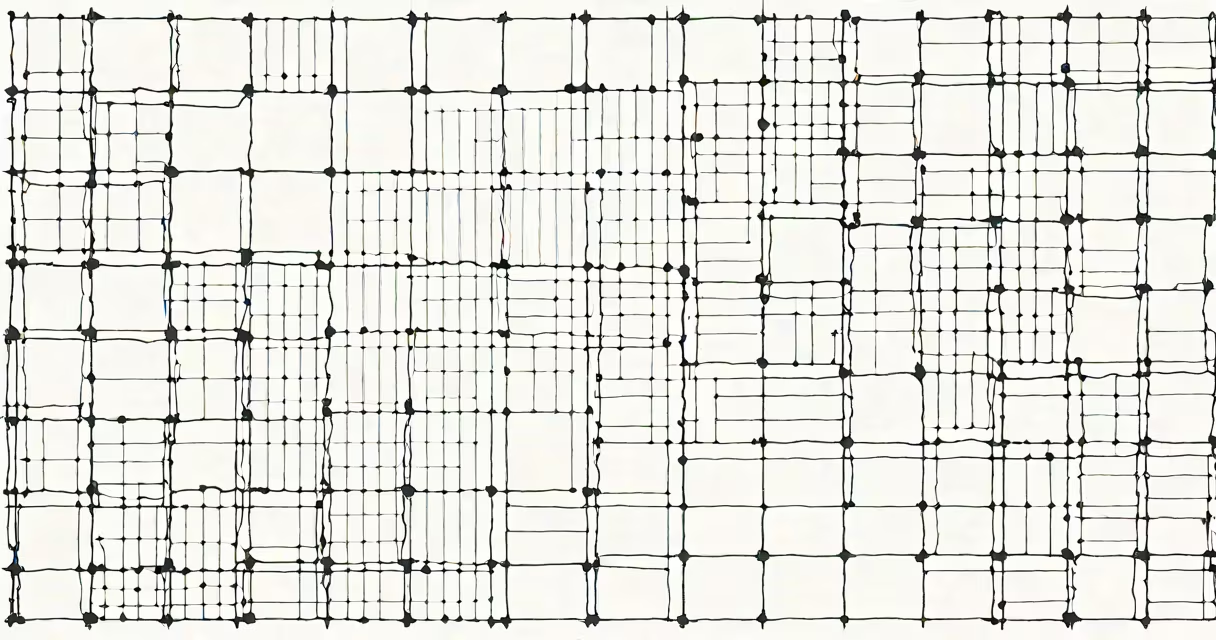
Sparse data consists of datasets where most entries are zero or null, meaning the majority of values are absent or have no meaningful information. This pattern occurs frequently in large-scale systems like recommendation engines, natural language processing, and scientific simulations.
Sparse data is not missing data-it's structured to minimize storage and computation by explicitly storing only non-zero elements. For example, a 10,000×10,000 matrix with only 100 non-zero values is sparse. Storing such data as a full range would waste memory and slow processing.
According to the TensorFlow documentation, sparse representations reduce memory usage by up to 99% compared to dense formats in high-dimensional applications. The SciPy library supports multiple sparse matrix formats optimized for different operations, including CSR (Compressed Sparse Row) and CSC (Compressed Sparse Column).
Instead of allocating space for every element, sparse data uses specialized structures that track only the positions and values of non-zero entries. A coordinate list (COO) format stores tuples of (row, column, value), while CSR compresses rows by storing start indices and non-zero values separately.
For instance, consider a user-item rating matrix in a movie recommendation system. With 1 million users and 10,000 movies, the full matrix would require 10 billion entries. But if each user rates only 10 movies, only 10 million entries are non-zero-just 0.1% of the total. Using CSR format, this can be stored in under 100 MB instead of 80 GB.
Operations like matrix multiplication or dot products are optimized for sparse formats. Libraries such as scikit-learn implement sparse-aware algorithms that skip zero values during computation, reducing runtime.
Different formats suit different use cases based on access patterns and update frequency. Here's a comparison:
| Format | Best For | Memory Use | Speed for Operations |
|---|---|---|---|
| COO (Coordinate) | Constructing matrices, adding new entries | Low | Slow for math operations |
| CSR (Compressed Sparse Row) | Row-wise access, matrix-vector multiplication | Medium | Fast for linear algebra |
| CSC (Compressed Sparse Column) | Column-wise access, solving systems of equations | Medium | Fast for column operations |
When building a document-term matrix for text classification, CSR is typically preferred because it enables efficient row-based operations during training. Switching between formats may be necessary depending on terms (columns).
Sparse data appears in real-world systems where data is inherently incomplete or high-dimensional. In natural language processing, word embeddings often represent sentences as vectors with thousands of dimensions-most set to zero. A single sentence like "I love cats" might map to a 10,000-dimensional vector with only three non-zero values.
Recommendation systems rely heavily on sparse data. Netflix's user-movie interaction matrix is sparse-most users haven't watched most movies. By modeling this sparsity correctly, systems avoid false assumptions about preferences and improve accuracy.
A 2021 study published in IEEE Transactions on Knowledge and Data Engineering found that using sparse representations improved model convergence speed by 40% in collaborative filtering tasks. The authors noted that dense approximations introduced noise due to artificial filling of zeros.
Some assume sparse data is always inefficient or hard to process. In reality, proper handling makes it faster and more accurate. A common mistake is converting sparse data to dense form during preprocessing, which increases memory load and slows training.
Another misconception is that sparse data equals low-quality data. But many high-value datasets are sparse by design. For example, medical imaging scans may contain vast regions of zero intensity (background pixels), yet those zeros are essential for identifying anatomical structures.
I once built a customer segmentation model using transaction logs from a retail chain. The original dataset had 500,000 customers and 10,000 product SKUs. A naive dense representation would have required 5 billion floating-point numbers. Instead, we used a CSR matrix to store only 2 million actual purchases. Training time dropped from 4 hours to 22 minutes.
Sparse data is sometimes mistaken for missing data. Missing data implies absence due to error or omission-like a survey response left blank. Sparse data is intentional and structured. Every zero represents a known absence, not a gap to be filled.
Also, sparse data isn't the same as low-rank data. Low-rank matrices have redundancy across rows/columns and can be compressed via singular value decomposition. Sparse matrices may still be full rank-they just have many zero entries.
For example, a 100×100 identity matrix is both sparse (99% zeros) and full rank. Converting it to dense form adds no benefit and wastes resources.
Understanding what is sparse data allows better design of systems that handle large, high-dimensional inputs efficiently. It's not a problem to solve-it's a structural feature to use. When working with data that spans millions of features but has few active values, choosing the right sparse format can make the difference between a feasible model and one that crashes under memory pressure.