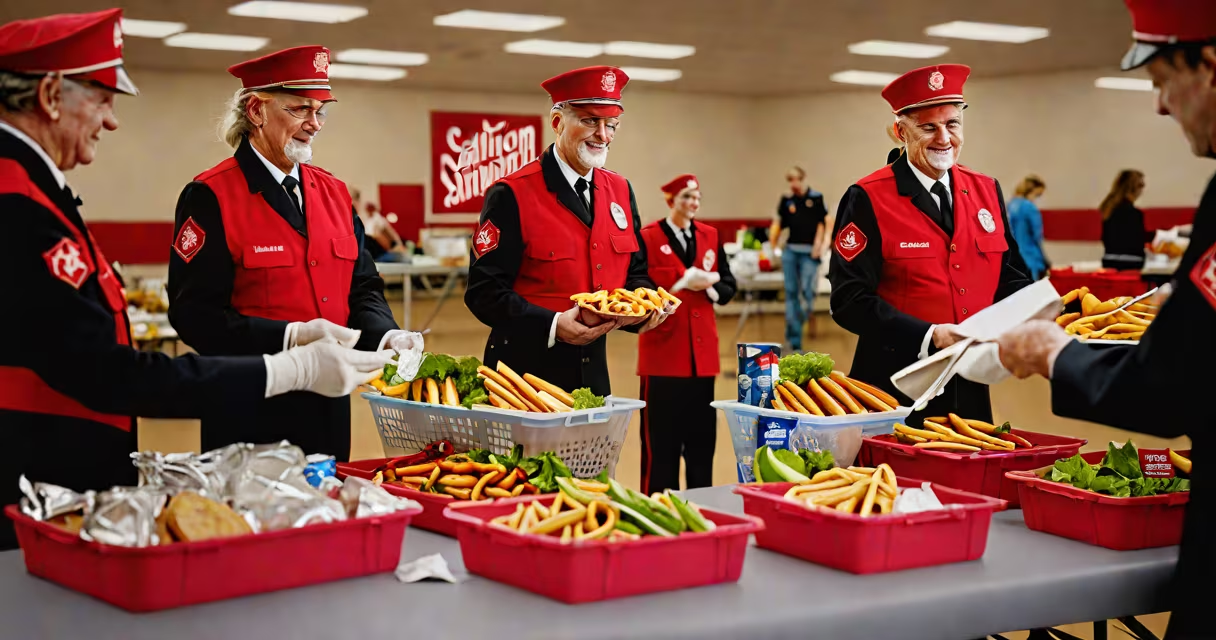
The Salvation Army offers emergency shelter, food assistance, disaster relief, addiction recovery programs, job training, and youth services. These services are available to individuals and families regardless of faith, income, or background.
Founded in 1865 in London, The Salvation Army operates in over 130 countries. Its mission centers on meeting immediate human needs while offering long-term support. Services are delivered through local corps (churches), community centers, and mobile units. The organization relies on donations and volunteer labor to maintain operations.
According to the IRS Form 990 filings, The Salvation Army reported $2.3 billion in revenue in 2022, with 83% directed toward program services. This includes direct aid such as food distribution, housing, and rehabilitation. The organization is recognized as a 501(c)(3) nonprofit under U.S. tax law.
Each service begins with a needs assessment. For example, someone seeking emergency shelter must complete a brief intake form. Staff verify identity and assess risk factors such as mental health or history of violence. No one is turned away due to lack of documentation.
Food programs operate on a first-come, first-served basis. Distribution sites open daily during set hours. Meals are prepared on-site or sourced from local suppliers. In 2023, The Salvation Army served over 15 million meals in the United States alone.
Disaster response teams deploy within 24 hours of a declared emergency. They set up temporary shelters, distribute hygiene kits, and provide psychological first aid. During Hurricane Ian in 2022, Salvation Army units served 1.2 million meals and distributed 100,000 hygiene packages across Florida.
The Salvation Army categorizes its services into five core areas:
| Service Type | Examples | Eligibility |
|---|---|---|
| Emergency Assistance | Food pantries, winter clothing, utility bill help | Households below 150% of federal poverty level |
| Housing & Shelter | Transitional housing, emergency shelters, family shelters | No ID required; no time limit on stays |
| Addiction Recovery | Residential treatment, outpatient counseling, 12-step programs | Open to all ages; no admission fee |
| Job Training & Employment | Resume workshops, interview prep, skills labs | Available to adults and seniors; free enrollment |
| Youth & Family Support | After-school programs, summer camps, parenting classes | Children aged 6-18; free participation |
Each service is administered locally. A corps in rural Alabama may focus on food and shelter, while an urban location in Los Angeles runs a full-scale addiction recovery center. National guidelines ensure consistency, but implementation varies by region.
Salvation Army centers are located in nearly every U.S. city and town. In 2023, there were 3,000 active locations across the country. Most are housed in repurposed buildings such as former churches or storefronts.
People seek help during economic downturns, natural disasters, or personal crises. A 2021 study by the Urban Institute found that 68% of Salvation Army clients were unemployed or underemployed. Another 22% reported recent eviction or homelessness.
One client, Maria from Detroit, accessed emergency housing after losing her job during the pandemic. She stayed in a transitional unit for 90 days and completed a job readiness course. She now works as a medical assistant. "They didn't ask for my past," she said. "They asked what I wanted."
Many assume The Salvation Army is solely a religious charity. While it is affiliated with the Christian denomination, it serves people of all beliefs. No one is required to attend worship services to receive aid.
Another misconception is that all services require donations. This is false. All food, shelter, and crisis intervention services are free. The organization funds operations through public donations, grants, and corporate partnerships.
A key distinction lies in how The Salvation Army differs from secular nonprofits. Unlike many agencies, it maintains a national network with rapid deployment capabilities. When wildfires hit California in 2020, Salvation Army units arrived within 12 hours, whereas other groups took up to 72 hours to mobilize.
It's also incorrect to think that donations go primarily to administrative costs. According to Charity Navigator, The Salvation Army earns a 4-star rating with 83% of funds going directly to programs. This exceeds the national average for charities (72%).
In February 2021, a winter storm caused widespread power outages across Texas. The Salvation Army activated 22 mobile canteens and deployed 120 volunteers. Over five days, they served 42,000 meals and distributed 5,000 blankets and 3,000 hygiene kits.
One team operated from a converted school bus equipped with a kitchen and generator. Volunteers cooked meals using donated ingredients and served them door-to-door in neighborhoods without electricity. The effort was coordinated through a central command center in San Antonio.
This model allows for rapid response even in remote areas. The same mobile units later supported recovery efforts after Hurricane Harvey in 2017.
The organization does not provide legal representation, medical care, or long-term housing. It also does not accept or store firearms, illegal substances, or large quantities of cash. Items brought to donation centers are inspected for safety and condition.
For example, while The Salvation Army accepts clothing and household goods, it does not take electronics unless they are part of a formal recycling program. Used laptops or phones are sent to certified e-waste processors, not resold.
It's also important to clarify that The Salvation Army does not run government-funded social programs. It operates independently and funds its own initiatives. This independence allows faster decision-making during emergencies.
What services does the Salvation Army provide? Emergency shelter, food, disaster relief, addiction recovery, job training, and youth programs. These services are accessible to anyone in need, regardless of religion, income, or background.