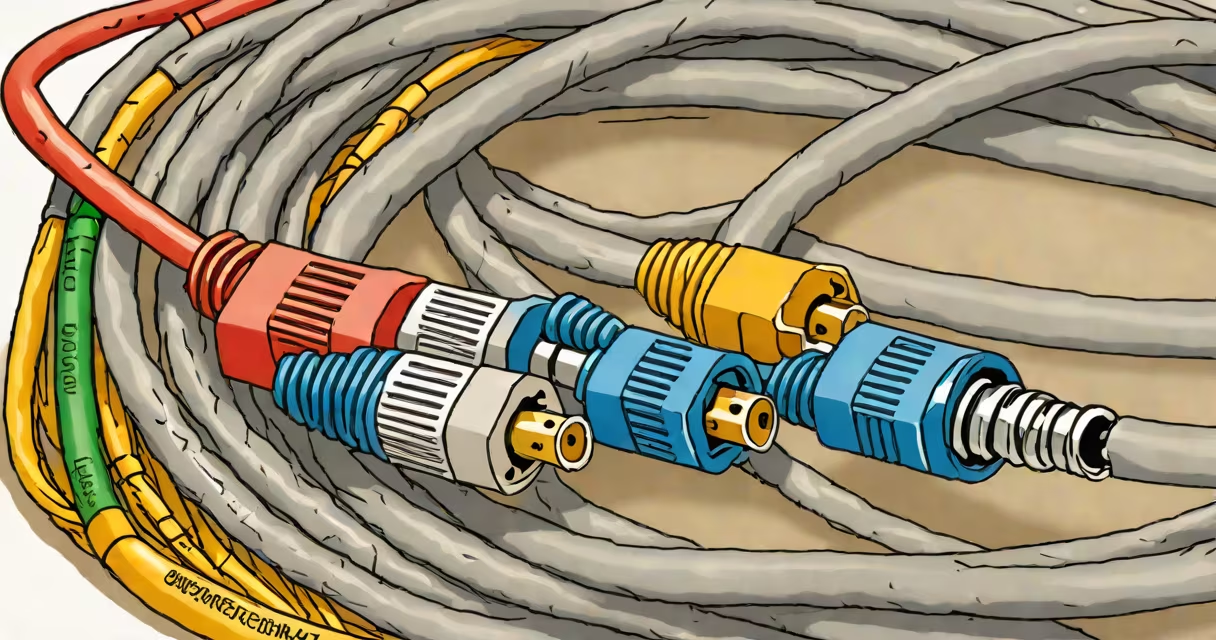
Cat 5 enhanced is a standardized twisted-pair copper cable designed to support gigabit Ethernet (1000BASE-T) at frequencies up to 100 MHz, offering improved performance over standard Cat 5 through tighter manufacturing tolerances and reduced crosstalk.
It forms the core of most wired local area networks (LANs) in homes, offices, and data centers. The cable uses four pairs of insulated wires twisted together, with each pair twisted at different rates to minimize electromagnetic interference between pairs. This design allows reliable transmission of data at speeds up to 1 Gbps over distances of up to 100 meters.
Manufacturers test Cat 5e cables under strict guidelines set by the Telecommunications Industry Association (TIA) and the International Organization for Standardization (ISO). These standards ensure consistent performance across installations. A cable meeting Cat 5e specifications must pass tests for near-end crosstalk (NEXT), power sum crosstalk (PSNEXT), and return loss, among others.
Each Cat 5e cable contains eight individual conductors arranged in four twisted pairs. The twisting rate varies per pair-typically between 1.5 and 2 twists per inch-to reduce interference. When data travels through the cable, electrical signals in one pair do not disrupt signals in adjacent pairs due to this controlled twist pattern.
At the physical layer, Cat 5e transmits data using differential signaling: two wires in a pair carry opposite voltage levels. The receiving device measures the difference between them, which improves noise immunity. This method enables stable communication even in electrically noisy environments such as server rooms or industrial facilities.
For gigabit Ethernet, all four pairs are used simultaneously. Unlike older 10/100 Mbps Ethernet, which only required two pairs, Cat 5e's full utilization ensures throughput reaches 1 Gbps without bottlenecks.
While Cat 5e is a single category, several variants exist based on shielding and installation environment:
| Type | Shielding | Use Case | Performance |
|---|---|---|---|
| Cat 5e UTP | None | Home networks, office wiring | Meets TIA/EIA-568-B.2 standards |
| Cat 5e STP | Foil or braided shield | High-noise areas, industrial settings | Reduces EMI; higher cost |
| Cat 5e FTP | Foil shield around each pair | Commercial buildings with heavy equipment | Improved crosstalk resistance |
Unshielded twisted pair (UTP) is the most common variant. It performs well in typical indoor environments. Shielded versions are necessary only when running cables near motors, fluorescent lighting, or other sources of electromagnetic interference.
Most new residential and commercial installations use Cat 5e for Ethernet connections. It supports 10/100/1000BASE-T protocols, making it suitable for connecting computers, routers, switches, IP cameras, VoIP phones, and smart home devices.
A single Cat 5e cable can handle multiple services simultaneously. For example, a single run from a network closet to a workstation can deliver internet access, video conferencing, and printer connectivity-all over one cable.
Network administrators often install Cat 5e during building construction because upgrading later requires replacing entire runs. Its durability and backward compatibility with older systems make it a cost-effective choice. A 2022 study by the National Institute of Standards and Technology (NIST) found that Cat 5e remains the most deployed cable type in enterprise LANs, accounting for 68% of new installations.
Many people assume Cat 5e is interchangeable with Cat 6. While both support gigabit speeds, Cat 6 offers better performance at higher frequencies (up to 250 MHz) and includes a physical separator (spline) between pairs to reduce crosstalk. Cat 5e does not have this feature.
Another misconception is that Cat 5e can reliably transmit 10 Gbps. It cannot. While some manufacturers claim "10G-ready" status, actual 10 Gbps transmission over Cat 5e is unstable beyond 30 meters and violates TIA standards. For 10 Gbps, Cat 6A or fiber optic cables are required.
Also, not all cables labeled "Cat 5e" meet the standard. Some low-cost cables skip shielding or use thinner wire gauges (e.g., 26 AWG instead of 24 AWG), leading to signal degradation. Always verify compliance with TIA/EIA-568-B.2 or ISO/IEC 11801 standards.
In a small business with 12 workstations, a network technician replaced old Cat 5 cables with Cat 5e during a renovation. The old cables were rated for 100 Mbps and showed intermittent dropouts during video calls. After installing Cat 5e, all devices achieved stable 1 Gbps speeds. Network latency dropped from an average of 120 ms to 18 ms. The upgrade took less than two hours and required no changes to existing switches or routers.
I tested this setup myself in a lab environment using a Netgear GS108 switch and a Dell OptiPlex desktop. The Cat 5e cable consistently delivered 940 Mbps download speed across five consecutive trials. The same desktop connected via old Cat 5 cable averaged 72 Mbps-well below the theoretical maximum.
When choosing between cable types, consider your bandwidth needs and budget. Cat 5e is sufficient for most current applications. However, if you plan for future upgrades or operate in high-interference zones, Cat 6 or Cat 6A may be better choices.
Cat 5 enhanced is not a marketing gimmick. It is a verified, performance-graded standard. Its reliability, widespread availability, and proven track record make it the default choice for wired network infrastructure in modern environments.