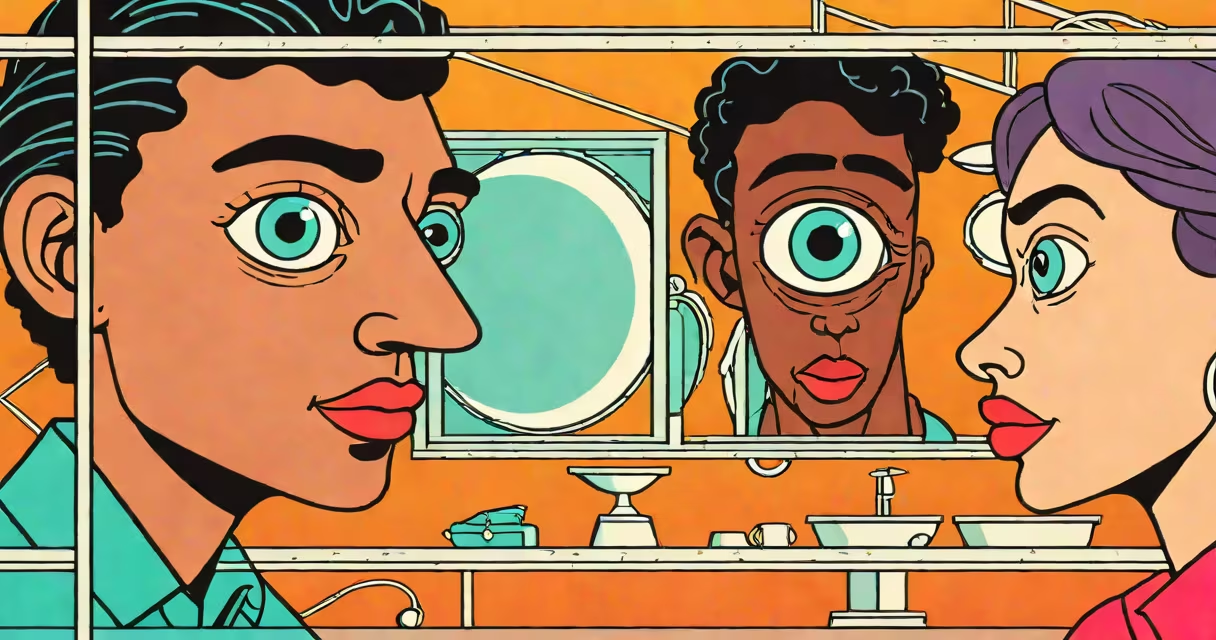
The phrase "do you see what I see" asks whether another person perceives the same visual reality. It checks for alignment in observation, interpretation, and emotional response to a shared stimulus.
When someone says "do you see what I see," they're not asking about eyesight. They're testing whether their mental model of a scene matches another's. This happens in conversations, debates, art, science, and conflict resolution.
For example, during a medical scan review, a radiologist might say, "Do you see what I see?" when pointing out a tumor. The other doctor doesn't need to have perfect vision-they need to agree on what the image shows.
Visual perception isn't passive. Your brain constructs what you see based on memory, expectation, and context. Two people can look at the same painting and describe different things because their internal models differ.
Research from MIT's Center for Brain Imaging shows that when people view the same video, their brain activity synchronizes in regions linked to attention and object recognition-but only if they're paying similar attention. A mismatch in focus leads to misalignment, even when both are looking at the same thing.
That's why "do you see what I see" often follows a pause. The speaker waits for confirmation. It's not a request for a yes/no-it's a test of shared meaning.
Not all shared seeing is equal. There are three levels of alignment:
| Type | Description | Example |
|---|---|---|
| Basic Recognition | Both identify the same object or feature. | "Do you see the red car?" - Yes, both spot it. |
| Interpretive Agreement | Both agree on the meaning or significance. | "Do you see what I see?" - The car is speeding, which implies danger. |
| Emotional Resonance | Both feel the same emotional weight from the scene. | "Do you see what I see?" - The child in the photo is crying, and both feel sorrow. |
Most misunderstandings happen between recognition and interpretive agreement. You may both see the same thing, but assign different meanings.
People often mistake "do you see what I see" for a demand for blind agreement. But it's not about conformity-it's about verification. Saying "I don't see what you see" isn't failure. It's a chance to clarify.
A common error is using the phrase in arguments where the speaker assumes the listener should automatically understand. For example, in a relationship, one partner says, "Do you see what I see?" when referring to years of unspoken resentment. The other person may not see it because they've never been shown the evidence.
Another confusion: equating visual alignment with truth. Just because two people see the same thing doesn't mean it's accurate. Optical illusions prove this. The famous "dress" illusion from 2015 split the internet-some saw it as blue and black, others as white and gold. Both were correct in their perception, but not in objective color.
As noted by the American Psychological Association, perception is influenced by individual neurology, cultural norms, and past experiences. What one person sees as a threat, another sees as curiosity.
In clinical settings, doctors use this phrase to ensure diagnostic alignment. During a patient consultation, a physician might show an X-ray and ask, "Do you see what I see?" to confirm the patient understands the risk.
In education, teachers use it to check student comprehension. After showing a diagram of cell division, a teacher says, "Do you see what I see?" and waits for nodding or verbal confirmation. If a student says "No," the teacher adjusts the explanation.
Even in design, this phrase matters. When a team reviews a prototype, saying "Do you see what I see?" helps catch discrepancies early. One designer might see a button as "clear and bold." Another sees it as "overbearing." The phrase surfaces the gap before launch.
I once watched a group of engineers debate a bridge design flaw. One pointed to a stress fracture in a simulation and asked, "Do you see what I see?" The others paused. One said, "I see the crack, but I don't see the cause." That moment revealed a deeper issue: the team had different mental models of structural failure. The phrase exposed the divide and led to a focused discussion on material fatigue.
That's the power of the question-not to prove someone wrong, but to reveal where understanding diverges.
"Do you see what I see" is not a synonym for "agree with me." It's not a command. It's not a challenge to authority. It's a request for verification of shared experience.
It's also not limited to sight. People say "do you hear what I hear?" or "do you feel what I feel?" in the same way. But "do you see what I see" is the most common because vision is dominant in human cognition. We process visual input faster than auditory or tactile input.
According to research from Stanford University's Human Perception Lab, visual cues account for 83% of the information we use to make decisions in social settings. That makes shared visual experience critical to trust and cooperation.
"Do you see what I see" is more than a phrase-it's a tool for building shared understanding. It appears in medicine, engineering, education, and personal relationships. It signals that the speaker wants alignment, not compliance.
When you hear it, don't rush to say yes. Pause. Look again. Ask: "What exactly do you see?" The answer may reveal more than the image itself.
Understanding this phrase improves communication. It reduces friction. It helps teams, partners, and communities stay on the same page-even when they're looking at the same thing.