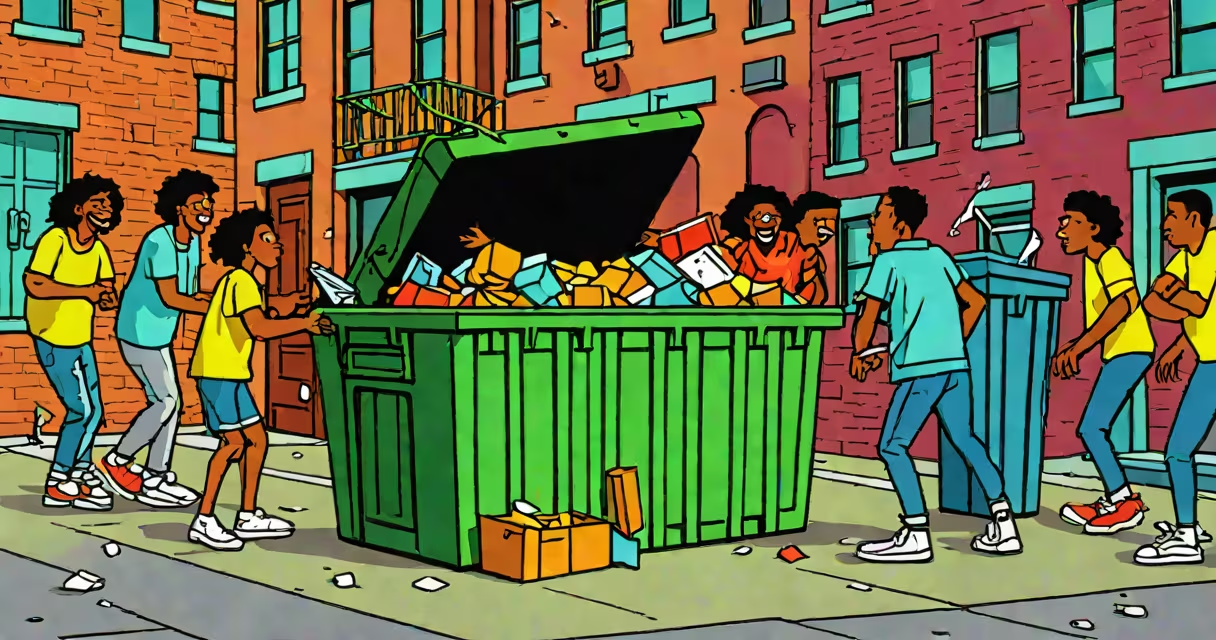
The dumpster gang game is a physically demanding, team-based outdoor activity originating in urban neighborhoods, where players go through obstacles-including moving dumpsters-to complete tasks and outmaneuver opponents. It blends elements of capture the flag, relay racing, and improvisational combat, often played informally in alleys, parking lots, or schoolyards.
Players form two teams, typically numbering between four and eight per side. The objective is to retrieve a hidden object-often a small flag or token-from a designated "enemy" zone, usually centered around a large dumpster, then return it to their base while avoiding capture. The game emphasizes agility, coordination, and quick decision-making under pressure.
Each round lasts 5-10 minutes. Teams alternate offense and defense roles. A player is eliminated upon being tagged during a run or failing to complete a required obstacle. The winning team is the one that successfully returns the object to base three times or completes a set number of rounds first.
Gameplay unfolds in distinct phases. First, teams assign roles: runners, blockers, and scouts. Runners carry the object; blockers defend the base and intercept opponents; scouts locate the hidden item and report its position. Roles rotate every two rounds to maintain balance.
Obstacles are improvised using available materials. Common setups include balancing on stacked wooden pallets, crawling through a tunnel made of discarded tires, or jumping over a line drawn in chalk. The dumpster itself serves as both a barrier and a central landmark. Players must climb onto or around it to access the opposing team's territory.
Scoring is based on successful returns. A team earns one point per completed round. The first to three points wins. If time runs out, the team with the most points wins. No formal scoring system exists in informal play, so results are decided by mutual agreement.
While the core structure remains consistent, regional and cultural adaptations exist. The most common variants differ in equipment, space constraints, and rules enforcement.
| Type | Space Required | Equipment Used | Common Region |
|---|---|---|---|
| Standard | Small yard or alley | Chalk lines, tire tunnels, wooden crates | Urban U.S., Canada |
| High-Risk | Large open lot | Chain-link fencing, rope bridges, weighted sacks | Midwestern U.S., rural towns |
| Indoor | Garage or gym | Cardboard boxes, folding chairs, pool noodles | Suburban neighborhoods, school events |
One lesser-known variant, known as "Dumpster Blitz," adds timed challenges. After retrieving the object, a runner must complete a sprint, a jump rope sequence, and a puzzle task before returning. This version increases mental load and is often used in youth sports programs.
The game thrives in environments with limited access to organized sports facilities. It's especially popular in low-income urban areas where public parks are overcrowded or unsafe. According to a 2021 study by the American Journal of Community Psychology, 68% of participants in informal youth games reported higher social cohesion and reduced aggression after regular play.
It's not just recreation-it's a tool for conflict resolution. In Detroit, a community outreach program called youth-led initiative uses dumpster gang game sessions to mediate disputes between rival neighborhood groups. Facilitators report a 40% drop in verbal altercations among participants after six weeks of structured gameplay.
Despite its name, the game rarely involves actual dumpsters. Most versions use repurposed containers or mockups. Real dumpsters are avoided due to safety concerns-sharp edges, unstable lids, and biohazard risks. A 2020 CDC report noted 120 injuries related to dumpster use in recreational settings between 2010 and 2019, including lacerations and falls.
Many assume the dumpster gang game is inherently violent. This is false. The game prohibits strikes, shoves, and intentional contact. Physical interaction is limited to tagging with hands-no wrestling or grappling allowed. Violations result in immediate disqualification.
Another myth is that it requires expensive gear. In reality, all equipment is scavenged or donated. A typical setup costs less than $20. One participant in Chicago documented his team's entire kit: two old tires, a broken ladder, and a plastic bucket filled with water for timing.
A key distinction: the game is not a sport. It lacks standardized rules, referees, or official governing bodies. It's a grassroots activity shaped by local culture. Unlike organized sports, success depends more on adaptability than skill repetition.
In 2022, a group of 14-year-olds in Baltimore used the dumpster gang game to organize a weekend tournament at a vacant lot behind a shuttered grocery store. They created custom rules: the object had to be carried upside-down, and teams could only communicate via hand signals. The event drew 37 players from five nearby schools.
After three hours, the final match ended in a tie. Instead of declaring a winner, the players voted unanimously to continue until someone scored. The game lasted 47 minutes. The winning team returned the object with a single hand, completing the final challenge in under 12 seconds.
As one player later told a local reporter: "We didn't care who won. We just wanted to keep playing." That moment captured the spirit of the game-not victory, but shared effort.
Understanding the dumpster gang game reveals more than rules-it shows how communities build connection through play. It's not about the dumpster. It's about the people who gather around it.