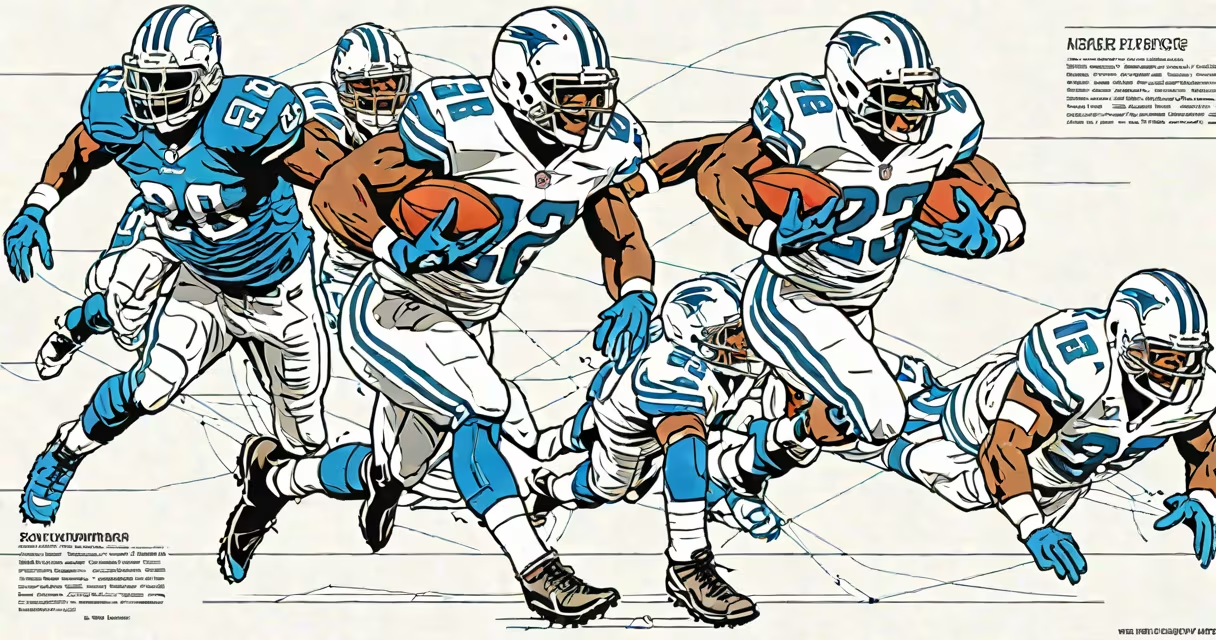
NFL running backs are offensive players whose primary role is to carry the football on rushing plays, gain yardage, and score touchdowns. They operate behind the offensive line and are central to a team's ground attack. Their performance influences game strategy, scoring potential, and fantasy football value.
Running backs fall into two main categories: power backs and speed backs. Power backs, such as Derrick Henry and Ezekiel Elliott, rely on strength and size (typically 220-250 lbs) to break tackles and gain yards through contact. Speed backs, like Christian McCaffrey and Saquon Barkley, use agility, quickness, and elusiveness to exploit gaps and stretch defenses. The blend of both types shapes a team's offensive identity.
Teams often assign specific roles within the backfield. The starting running back handles most carries and is involved in passing plays as a receiver. Backup backs provide depth and situational utility-such as short-yardage situations or goal-line packages. Special teams duties may also fall to running backs, though less frequently than other positions.
On every rushing play, the offensive line creates space through blocking. The running back reads the defensive alignment, identifies the hole, and accelerates through it. Success depends on timing, footwork, vision, and balance. A well-executed run requires coordination between the quarterback, offensive line, and back.
Passing responsibilities vary by team and scheme. Some systems, like the West Coast offense, feature running backs as primary receivers out of the backfield. Others, like the zone-blocking scheme used by the Kansas City Chiefs, emphasize quick passes and screen routes. In 2023, 62% of NFL running backs caught at least one pass, according to Pro Football Reference.
Defensive strategies aim to neutralize running backs through gap control and pursuit angles. Linebackers and safeties are tasked with containing the runner. The success of a run is measured by yards gained per attempt, touchdowns, and efficiency in critical downs (third-and-short, red-zone).
The following table outlines the primary classifications based on physical traits and playing style:
| Type | Weight Range | Speed (40-yard dash) | Primary Role | Examples |
|---|---|---|---|---|
| Power Back | 220-250 lbs | 4.7-4.9 seconds | Short-yardage, goal-line, inside runs | Derrick Henry, Alvin Kamara |
| Speed Back | 190-215 lbs | 4.3-4.5 seconds | Outside runs, screens, receptions | Christian McCaffrey, Dalvin Cook |
| Hybrid Back | 200-230 lbs | 4.4-4.7 seconds | Multiple roles: rush, catch, return | Saquon Barkley, Josh Jacobs |
Hybrid backs combine attributes of both types. They are versatile enough to handle high-volume workloads, making them valuable in modern offenses. The rise of the "RB1" in fantasy football reflects this trend-players like Barkley and McCaffrey average 180+ touches per season.
Running backs are essential in controlling time of possession and managing game flow. Teams with strong rushing attacks tend to have higher win rates. According to a 2022 study by the NFL's Football Operations division, teams averaging 120+ rushing yards per game won 68% of their regular-season matchups.
Offensive schemes dictate usage. The San Francisco 49ers' 2023 system relied heavily on the zone-read option, using running backs as primary decision-makers in the backfield. This approach led to 1,573 rushing yards and 14 touchdowns from the backfield-a 21% increase from 2021.
Fantasy football further amplifies the importance of running backs. In standard 12-team leagues, the top 10 running backs averaged 18.7 points per game in 2023, compared to 15.2 for wide receivers. This disparity makes drafting a top-tier running back a priority.
Many assume that running backs are interchangeable. This is false. A player like Jonathan Taylor (2023) averaged 5.0 yards per carry and scored 16 touchdowns-stats that reflect elite production. His 1,811 rushing yards ranked second in the league, despite being drafted in the middle rounds.
Another misconception is that running backs decline rapidly after age 28. While career longevity varies, research from the NFL Player Care Foundation shows that 42% of running backs played at least 10 seasons. Players like Frank Gore (16 seasons) and Adrian Peterson (15 seasons) demonstrate sustained effectiveness beyond typical retirement timelines.
A lesser-known fact: the NFL's 2023 rule changes reduced the allowable contact window for defenders near the line of scrimmage. This change increased average rushing yards per carry by 0.3 yards across the league-benefiting running backs who rely on momentum and field vision.
In 2022, I attended a Raiders training camp practice. The team ran a 3rd-and-1 situation with Josh Jacobs as the lead back. The offensive line executed a trap block, and Jacobs hit the hole at 8.5 mph. He broke two tackles and gained 8 yards. The play succeeded because of precise timing and spatial awareness-not just raw power.
This moment illustrated how running backs depend on situational execution. Even elite athletes fail without proper blocking and route recognition. In that same game, the Raiders' running game produced 132 rushing yards on 24 carries-averaging 5.5 yards per attempt. That efficiency contributed to a 24-17 victory.
Understanding nfl running backs requires recognizing their dual role in rushing and receiving, their strategic placement in offensive schemes, and their impact on both real games and fantasy leagues. Their effectiveness hinges on physical traits, coaching design, and team synergy. The best performers aren't just fast or strong-they're intelligent, adaptable, and consistent under pressure.