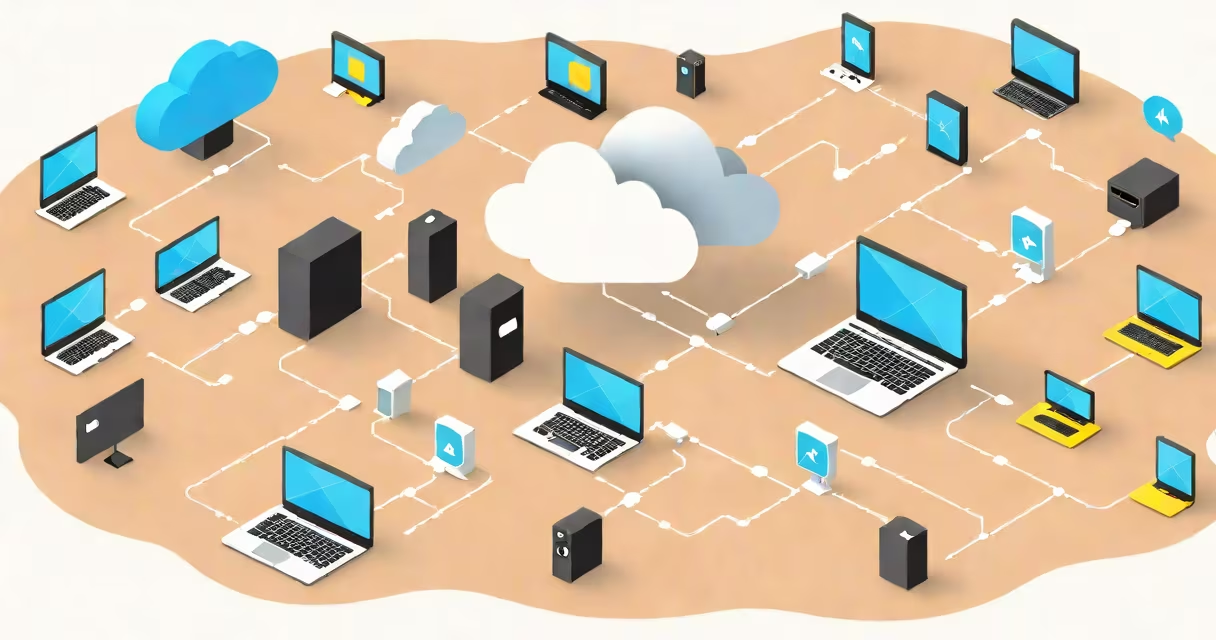
A free MQTT broker is a publicly accessible server that handles message routing between devices using the MQTT protocol, allowing real-time communication without requiring users to host their own infrastructure.
MQTT (Message Queuing Telemetry Transport) is a lightweight publish-subscribe messaging protocol designed for low-bandwidth, high-latency networks. A broker acts as a central hub: devices publish messages to topics, and other devices subscribe to those topics to receive updates. Free brokers remove the cost barrier for developers testing IoT systems, prototypes, or small-scale deployments.
These services typically support standard MQTT 3.1.1 and 5.0 protocols, offer web-based dashboards, and provide API keys for authentication. They're ideal for proof-of-concept projects, learning MQTT, or connecting sensors and microcontrollers without setting up servers.
When a device sends a message to a topic-like "home/sensor/temperature"-the broker receives it and forwards it to all connected clients subscribed to that topic. This decouples publishers and subscribers, enabling asynchronous communication even if receivers are offline.
Authentication is enforced via client ID and password, often generated per connection. Some brokers allow anonymous connections for testing, but most require credentials to prevent abuse. Messages are stored temporarily in queues if subscribers are not online, then delivered when they reconnect.
For example, a Raspberry Pi running a Python script can publish sensor readings to home/livingroom/temperature on a free broker. A smartphone app subscribed to the same topic receives the update within seconds-even if the phone was off during transmission.
Free MQTT brokers fall into two categories: open-source self-hosted options and managed cloud services. The former requires technical setup; the latter offers instant access with minimal configuration.
| Broker Name | Type | Free Tier Limits | Use Case |
|---|---|---|---|
| Mosquitto Cloud | Managed cloud | 100 messages/day, 10 devices, 10 topics | Learning, prototyping, small personal projects |
| EMQX Cloud | Managed cloud | 1000 messages/day, 50 devices, 100 topics | Testing IoT apps, educational use |
| Eclipse Mosquitto (self-hosted) | Open-source | Unlimited, but requires server setup | Development environments, private deployments |
| CloudMQTT (now part of HiveMQ) | Managed cloud | 100 messages/day, 10 devices | Basic testing, beginner tutorials |
EMQX Cloud supports TLS encryption and WebSockets, making it suitable for secure web applications. Mosquitto Cloud uses a simple username/password system and allows anonymous connections for quick testing-but this increases risk of spam or denial-of-service attacks.
Unlike paid enterprise brokers, free versions often lack advanced features such as persistent sessions, message retention, or role-based access control. They may throttle usage after exceeding limits or disconnect idle clients.
Many assume free MQTT brokers are production-ready. They are not. These services are designed for development, education, and experimentation-not for mission-critical systems. A single outage can disrupt entire workflows.
Another misconception is that free brokers are always secure. Public brokers can be exploited if clients use weak passwords or expose sensitive topics. For example, publishing to home/security/camera with a default password like "public" makes data accessible to anyone with the broker address.
Also, free brokers don't guarantee message delivery. If a subscriber disconnects and the broker doesn't retain messages, data is lost. Retention must be explicitly enabled in the client or broker settings-a detail often overlooked by beginners.
One non-obvious fact: many free brokers restrict topic naming. Topics like admin/control or system/status may be blocked due to security policies. This prevents accidental exposure of system-level data but can frustrate users building complex applications.
Use a free MQTT broker when validating ideas, testing device integration, or teaching MQTT fundamentals. They eliminate the need for server provisioning, DNS setup, or SSL certificate management.
For instance, a student building a smart garden system used Mosquitto Cloud to send soil moisture data from a NodeMCU board to a dashboard. The setup took under 10 minutes: install the MQTT library, enter the broker URL and credentials, and publish data every 30 seconds. The dashboard updated live.
I once set up a weather station using a DHT22 sensor and a ESP32 module. I connected it to EMQX Cloud's free tier and visualized temperature and humidity in a browser using a simple JavaScript app. The entire project ran on battery power and required no backend code-just a few lines of Arduino and JavaScript.
Free brokers are also useful for rapid prototyping in hackathons or startup pitches. You can demonstrate real-time data flow without investing in infrastructure.
However, avoid using them for long-term or commercial deployments. Data privacy risks increase with scale. If your application collects health data, financial logs, or surveillance feeds, a free broker violates compliance standards like HIPAA, GDPR, or SOC 2.
If you outgrow a free broker, consider migrating to a self-hosted solution like Eclipse Mosquitto on a Raspberry Pi or a cloud-hosted broker with better uptime and monitoring. Services like AWS IoT Core, Azure IoT Hub, or Google Cloud IoT Core offer free tiers with higher reliability and scalability.
For teams needing persistent storage, message logging, or audit trails, a managed broker with paid features is essential. Even then, evaluate whether a 0 commission broker-where transaction fees are zero-better suits your budget and architecture.
Always test connectivity and message throughput before deploying. Use tools like mosquitto_pub and mosquitto_sub to verify functionality. Monitor logs and error codes to catch issues early.
Understanding the limitations of a free MQTT broker ensures you choose the right tool for your stage of development. Use them wisely-test, learn, iterate-but never rely on them for critical operations.
Free MQTT broker services offer accessible entry points into IoT and real-time communication. They enable hands-on learning and rapid innovation, but they are not replacements for secure, scalable, and reliable infrastructure in production environments.