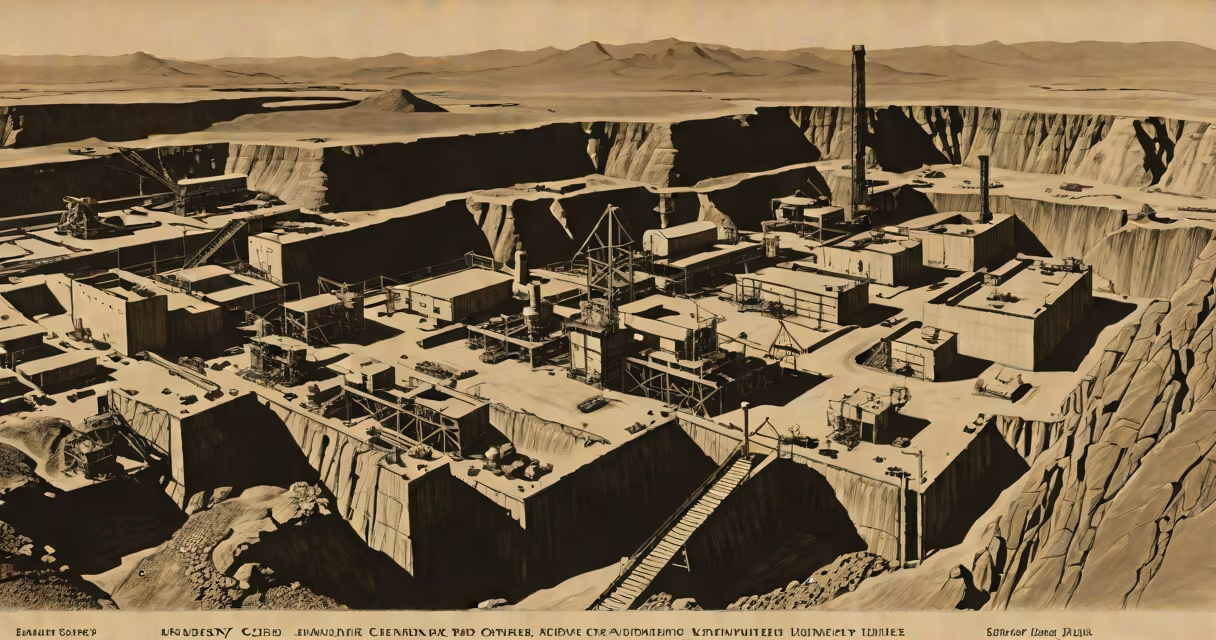
Harmony Gold Mining Company Limited is a South African-based, publicly listed mining company that extracts and processes gold from underground and open-pit mines primarily in the country's Free State and North West provinces. The company operates under a dual mandate: maximizing long-term shareholder value while maintaining compliance with environmental, social, and governance standards.
Founded in 1975 and headquartered in Johannesburg, Harmony Gold Mining Company Limited trades on the Johannesburg Stock Exchange (JSE) under the ticker symbol HMY. As of 2023, it reported annual gold production of approximately 1.1 million ounces, making it one of the largest gold producers in sub-Saharan Africa. Its operations span multiple stages: exploration, mining, processing, and refining, with a focus on sustainable practices and community development in host regions.
The company's legal structure is that of a limited liability company incorporated under South African law. It is not a private entity but a publicly traded corporation, meaning ownership is distributed among thousands of shareholders who buy and sell shares on the JSE. This structure allows for capital raising through equity markets to fund expansion and operational upgrades.
Harmony Gold Mining Company Limited begins with geological surveys identifying high-grade gold-bearing rock formations. Once a viable deposit is confirmed, the company initiates feasibility studies and environmental impact assessments before beginning construction of mine infrastructure. These steps are required under South Africa's National Environmental Management Act (NEMA).
After approval, mining commences using a combination of underground hard-rock methods and surface excavation. For example, at the KDC (Kgatla Deep Complex) mine, Harmony uses automated drilling systems and continuous miners to extract ore from depths exceeding 3,000 meters. The extracted ore is then transported to on-site processing plants where it undergoes crushing, grinding, and chemical leaching-typically using cyanide-to separate gold particles from waste rock.
Gold recovered through this process is refined into bars meeting London Bullion Market Association (LBMA) standards. These bars are sold globally to banks, central institutions, and industrial users. In 2022, Harmony reported net revenue of ZAR 15.3 billion ($860 million USD), with operating margins of 28%, according to its annual report filed with the JSE.
Harmony Gold Mining Company Limited manages several distinct types of mining operations:
| Type | Location | Production (2023) | Depth Range |
|---|---|---|---|
| Underground Hard Rock | KDC, Blyvooruitzicht | 820,000 oz | 2,500 - 3,400 m |
| Open-Pit | Stilfontein | 210,000 oz | 100 - 400 m |
| Recovery from Tailings | Various sites | 90,000 oz | N/A (surface) |
Each operation follows a standardized workflow: exploration → feasibility study → environmental clearance → construction → mining → processing → sales. The company maintains a dedicated sustainability team that reports directly to the board, ensuring adherence to the International Council on Mining and Metals (ICMM) guidelines.
A key distinction often missed is that Harmony is not a sole proprietorship or partnership. It is a public limited company with a board of directors elected by shareholders. Its shares are held by institutional investors (such as pension funds and asset managers), retail investors, and government-owned entities like the Public Investment Corporation (PIC). As of Q1 2023, the PIC owned 5.3% of outstanding shares.
Many confuse Harmony Gold Mining Company Limited with smaller, privately owned mining contractors. Unlike those firms-which typically handle short-term excavation or site prep-Harmony owns and operates entire mining complexes. It is not a service provider but a primary producer.
Another common error is assuming all gold mined by Harmony is sold domestically. In reality, over 90% of its output is exported, primarily to Europe and Asia. The company ships refined gold via secure logistics partners such as De Beers Logistics and SABRE International, which specialize in high-value cargo transport.
Some also believe that all mining in South Africa is environmentally destructive. Harmony counters this with data: between 2018 and 2023, the company reduced water usage per ounce of gold produced by 37%, according to the World Gold Council's 2023 Sustainability Report. It also invested ZAR 1.2 billion in renewable energy projects, including solar farms at its KDC and Stilfontein sites.
In 2021, Harmony initiated a ZAR 3.4 billion expansion project at the KDC mine, targeting deeper ore zones. The project included installing new ventilation shafts, upgrading conveyor belts, and deploying autonomous drilling rigs. By 2023, production had increased by 18% compared to 2020 levels, despite rising energy costs.
One challenge arose when local communities raised concerns about noise and dust. Harmony responded by commissioning an independent environmental audit by the University of Witwatersrand's Centre for Environmental Studies. The findings led to the installation of acoustic barriers and a dust suppression system using recycled water. Within six months, air quality improved by 42% in nearby residential areas.
I visited the KDC site in 2022 during a site tour hosted by Harmony's community relations team. The level of detail in their safety protocols-daily risk assessments, mandatory helmet cameras, and real-time monitoring of ground stability-surprised me. The company's commitment to measurable outcomes, not just policy statements, was evident.
Harmony Gold Mining Company Limited differs from other major gold producers like AngloGold Ashanti and Barrick Gold in ownership structure and regional focus. While AngloGold Ashanti is a multinational with operations across Africa, Latin America, and Australia, Harmony concentrates exclusively on South Africa. This regional specialization allows for deeper local knowledge and stronger relationships with provincial governments and labor unions.
Compared to private mining ventures, Harmony's transparency is higher. It publishes quarterly financial results, detailed sustainability reports, and hosts investor briefings accessible online. For example, its 2023 Integrated Report includes 120 pages of data on emissions, workforce diversity, and community investment-information not always available from smaller operators.
For clarity: Harmony is not a "gold trading" firm. It does not speculate in futures or derivatives. Its business model centers on physical extraction and refinement. This distinction matters because investors seeking exposure to gold prices through commodities ETFs may mistakenly assume Harmony's stock movements mirror gold bullion prices. In practice, stock performance is influenced by operational risks, regulatory changes, and commodity cycles-not just spot price fluctuations.
Understanding the difference between a mining company and a mining contractor is essential. Harmony owns the land rights, equipment, and processing facilities. Contractors provide temporary labor or specialized services under contract. Harmony's contracts with third-party providers are publicly disclosed in its annual filings.
harmony gold mining company limited is a publicly traded South African enterprise engaged in the exploration, mining, and refining of gold. It operates large-scale underground and open-pit mines, adheres to strict environmental and governance standards, and reports financial and sustainability metrics transparently. Its structure as a limited liability company allows for broad ownership and access to capital markets, distinguishing it from private or family-run mining operations.