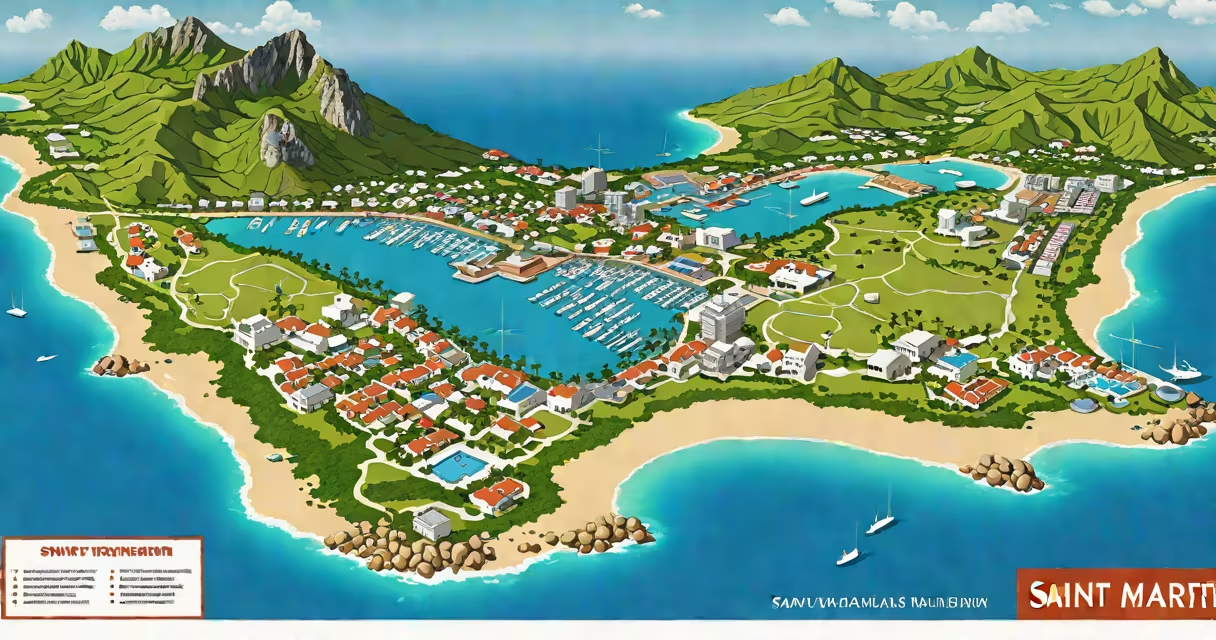
Saint Maarten Island is a Caribbean island divided between two sovereign nations: the Netherlands (Dutch side) and France (French side). The island lies just south of the Tropic of Cancer, with the capital city of Philipsburg on the Dutch side and Marigot on the French side.
The island's unique political structure stems from its colonial history. In 1648, the Treaty of Westphalia formally recognized the division of the island between the Dutch and French, making it one of the few places in the world where two countries share a single landmass. The Dutch portion is an autonomous country within the Kingdom of the Netherlands, while the French portion is an overseas collectivity of France.
Despite the split, both sides operate under separate governments but maintain close coordination on cross-border issues such as immigration, customs, and emergency services. The border between the two halves is marked by a simple yellow line on the road, with no physical barriers. Travelers can walk across the border freely, though they must carry valid identification.
Each side of Saint Maarten operates independently in governance, currency, and legal systems. The Dutch side uses the Netherlands Antillean guilder (ANG), while the French side uses the euro (EUR). This creates a practical challenge for visitors: money exchanged on one side may not be accepted on the other.
Customs enforcement is handled separately. On the Dutch side, travelers arriving from the U.S. Virgin Islands or other Caribbean islands must declare goods exceeding $100 in value. On the French side, customs checks are less frequent but still enforced. The lack of a formal border checkpoint allows for smooth movement, but it also increases the risk of smuggling and informal trade.
A notable example occurred in 2017 when Hurricane Irma devastated both sides. The Dutch government deployed military personnel and aid through the Royal Netherlands Navy, while France sent medical teams and supplies via the French Air Force. Coordination between the two governments was swift, but logistical challenges arose due to differing standards in infrastructure repair and housing allocation.
The island is divided into distinct zones based on function and geography:
| Side | Primary Use | Key Features | Population (2023 est.) |
|---|---|---|---|
| Dutch (Sint Maarten) | Tourism, commerce | Philipsburg, duty-free shops, Maho Beach | 38,000 |
| French (Saint-Martin) | Tourism, luxury real estate | Marigot, Grand Case, Le Marigot port | 35,000 |
On the Dutch side, the economy centers on tourism and offshore finance. The island attracts over 1 million visitors annually, most arriving via cruise ships or private charter flights. The airport, Princess Juliana International Airport, is famous for its low-flying aircraft that pass just meters above the beach at Maho Beach, drawing thousands of tourists each year.
The French side focuses on high-end tourism and residential development. Grand Case is known for its upscale restaurants and boutique hotels. The area around the L'Ilet à Cabrit nature reserve hosts protected sea turtle nesting sites, requiring strict visitor regulations.
Many assume Saint Maarten is a single country or a tourist resort with a unified government. In reality, it is a geopolitical anomaly-a single island governed by two different nations with distinct laws, currencies, and passports. Visitors often mistake the border for a tourist attraction, but crossing it requires valid ID and awareness of jurisdictional differences.
Another misconception is that the entire island is a duty-free zone. Only the Dutch side offers duty-free shopping, primarily for alcohol, tobacco, and electronics. The French side imposes standard VAT rates of 20%, meaning prices for imported goods are higher than on the Dutch side.
A lesser-known fact: the island's name is spelled differently on each side. Locals on the Dutch side refer to it as "Sint Maarten," while those on the French side call it "Saint-Martin." The spelling difference reflects linguistic heritage-Dutch and French respectively-but both refer to the same geographical entity.
In 2019, I visited Saint Maarten during the annual Carnival season. I arrived at the airport on the Dutch side and immediately noticed the contrast: the bustling streets of Philipsburg were filled with vendors selling rum and souvenirs, while the nearby French side had quieter, tree-lined roads and French-speaking staff at cafes. I walked across the border into Marigot and purchased a bottle of wine-taxed at 20%-which cost nearly double what it would have on the Dutch side. The experience confirmed how deeply the dual governance affects daily life.
For beach lovers, the Dutch side offers long stretches of white sand at Mullet Beach and the iconic Maho Beach, where planes fly so low they create waves on the shore. The French side provides more secluded coves, including Orient Bay and Grand Case Beach, ideal for snorkeling and sunsets.
Cultural highlights include the Sint Maarten Museum in Philipsburg, which displays artifacts from the Arawak people who inhabited the island before European arrival. On the French side, the Maison de la Culture in Marigot hosts rotating exhibitions on Caribbean art and history.
Travelers should plan their itinerary carefully. Ferry services connect the two sides, but schedules vary. The most reliable route is a 15-minute ride from Philipsburg to Marigot via the Saint-Martin Ferry Terminal. Tickets cost $5 USD one way and are available at kiosks near the dock.
Saint Maarten Island remains a rare example of peaceful coexistence between two sovereign states on a single landmass. Its blend of cultures, languages, and legal systems makes it a unique travel destination and a living case study in international cooperation.