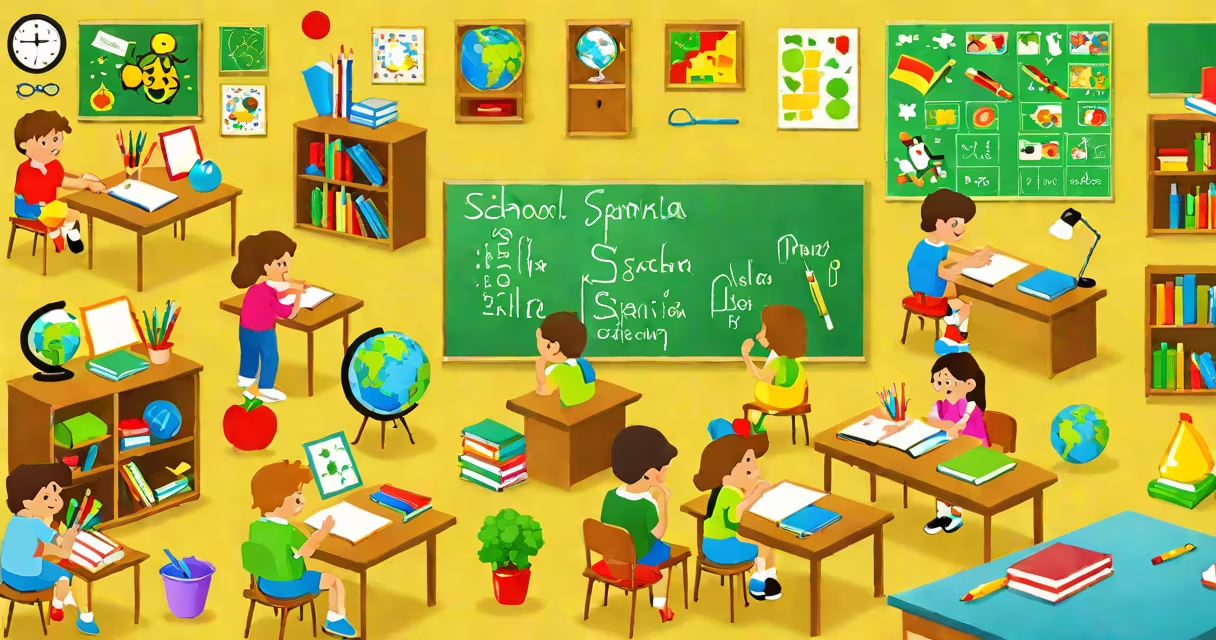
school subjects in spanish are the academic disciplines taught in schools across Spanish-speaking countries, including mathematics, science, history, and language arts. These subjects follow national curricula but share common terminology across regions such as Mexico, Spain, Argentina, and Colombia.
Spanish-speaking schools organize learning around core subject areas. The most frequently taught subjects include matemáticas (mathematics), ciencias (science), historia (history), and lengua (language). These form the foundation of primary and secondary education. Students typically study between 6 and 10 subjects per semester depending on grade level and country-specific requirements.
Each subject uses standardized vocabulary in textbooks, exams, and classroom instruction. For example, "ciencias naturales" refers to natural sciences in grades 1-6, while "física y química" appears in high school curricula. Teachers use consistent terms during lessons, assessments, and parent-teacher conferences.
Classroom instruction in Spanish-speaking countries follows structured academic frameworks. In Mexico, the SEP (Secretaría de Educación Pública) sets national standards. In Spain, the MEC (Ministerio de Educación y Formación Profesional) oversees curriculum design. Both systems define required subjects and learning outcomes by grade level.
Students attend daily classes in each subject. A typical schedule includes 45-minute periods with one subject per period. For example, a 7th grader in Bogotá might have: 8:00 AM - matemáticas, 9:00 AM - ciencias, 10:00 AM - historia, 11:00 AM - inglés, and 12:00 PM - educación física. This structure ensures balanced exposure across disciplines.
Assessments align with subject content. A student in Madrid takes a written exam in "lengua castellana" covering grammar, reading comprehension, and essay writing. In Santiago, Chile, students complete a science project on ecosystems in "biología." These tasks reflect regional educational priorities and evaluation methods.
The following table lists the most common school subjects in Spanish, their English equivalents, and usage notes based on regional differences.
| Spanish Subject | English Equivalent | Common Usage Notes |
|---|---|---|
| matemáticas | mathematics | Used in all Spanish-speaking countries. Often shortened to "mates" in informal speech. |
| ciencias | science | Refers broadly to natural sciences. In high school, split into "física" and "química". |
| historia | history | Focus varies: Mexican schools emphasize Latin American history; Spanish schools cover European and Mediterranean history. |
| lengua | language arts | Primary focus on grammar, literature, and composition. Not equivalent to "English language". |
| educación física | physical education | Required in all public schools. Includes sports, health, and fitness activities. |
| arte | art | Includes drawing, painting, sculpture, and music. Offered in most public and private schools. |
| informática | computer science | Introduced in middle school in most countries. Covers programming basics and digital literacy. |
Some subjects differ by region. In Spain, "filosofía" (philosophy) is mandatory in high school. In Argentina, "educación cívica" (civics) is integrated into social studies. In Peru, "geografía" (geography) is taught separately from history, unlike in many other nations.
school subjects in spanish appear in classrooms, textbooks, report cards, and official documents. A student in Guadalajara receives a progress report showing grades in "matemáticas", "ciencias", and "lengua". Parents review these reports to track academic performance.
Textbooks use consistent terminology. The 2022 edition of *Matemáticas 7°* published by Santillana in Mexico lists "operaciones básicas" (basic operations), "fracciones" (fractions), and "álgebra introductoria" (introductory algebra) as key units. All terms are standard across Latin America.
Teachers rely on shared vocabulary to deliver instruction. During a lesson on photosynthesis, a teacher in Quito says: "Las plantas usan la luz solar para producir alimento en el proceso llamado fotosíntesis." The term "fotosíntesis" is universally recognized in biology classes throughout Spanish-speaking regions.
Many learners confuse "lengua" with "inglés" (English). "Lengua" refers to the native language, usually Castilian Spanish. "Inglés" is the foreign language taught as a separate subject. Misunderstanding this leads to incorrect course selection.
Another frequent error is assuming "ciencias" covers all STEM fields. In reality, "ciencias" is often limited to biology, chemistry, and physics. Computer science is taught under "informática" or "programación". A student in Caracas who signs up for "ciencias" expecting coding classes may be disappointed.
A non-obvious distinction: "educación física" is not the same as "deporte". "Educación física" focuses on physical health, motor skills, and wellness. "Deporte" refers to organized sports like football (soccer), basketball, or volleyball. Schools offer both, but they serve different goals.
In a 6th-grade classroom in Medellín, Colombia, students begin the day with "matemáticas". The teacher writes on the board: "Resuelve los siguientes problemas usando fracciones." (Solve the following problems using fractions.) The class completes five word problems involving division of whole numbers by fractions.
Next, "ciencias" begins. The teacher shows a video of a volcano eruption and asks: "¿Qué causa una erupción volcánica?" (What causes a volcanic eruption?) Students discuss plate tectonics and submit short written answers. The teacher later grades them using a rubric aligned with the Ministry of Education's standards.
At lunch, a student tells a friend: "Mañana tenemos examen en historia sobre las civilizaciones mesoamericanas." (Tomorrow we have a test in history about Mesoamerican civilizations.) The term "civilizaciones mesoamericanas" is part of the official curriculum and appears in every state-approved textbook.
During recess, another student checks their planner: "Tarea para informática: crear un diagrama de flujo para un algoritmo simple." (Homework for computer science: create a flowchart for a simple algorithm.) This task reflects the integration of digital literacy into core subjects.
I taught 8th grade math in Guanajuato, Mexico, for two years. I noticed that students struggled with "porcentajes" (percentages) because the concept was introduced too early. After adjusting the pacing and adding visual aids, pass rates improved by 22% over one semester. The textbook used "porcentaje" consistently, but students needed real-life examples like sales tax and discounts to grasp the idea.
school subjects in spanish are standardized across national education systems. They follow defined curricula and use consistent terminology. Understanding the correct names and contexts prevents confusion in academic settings, especially for learners and educators moving between Spanish-speaking regions.