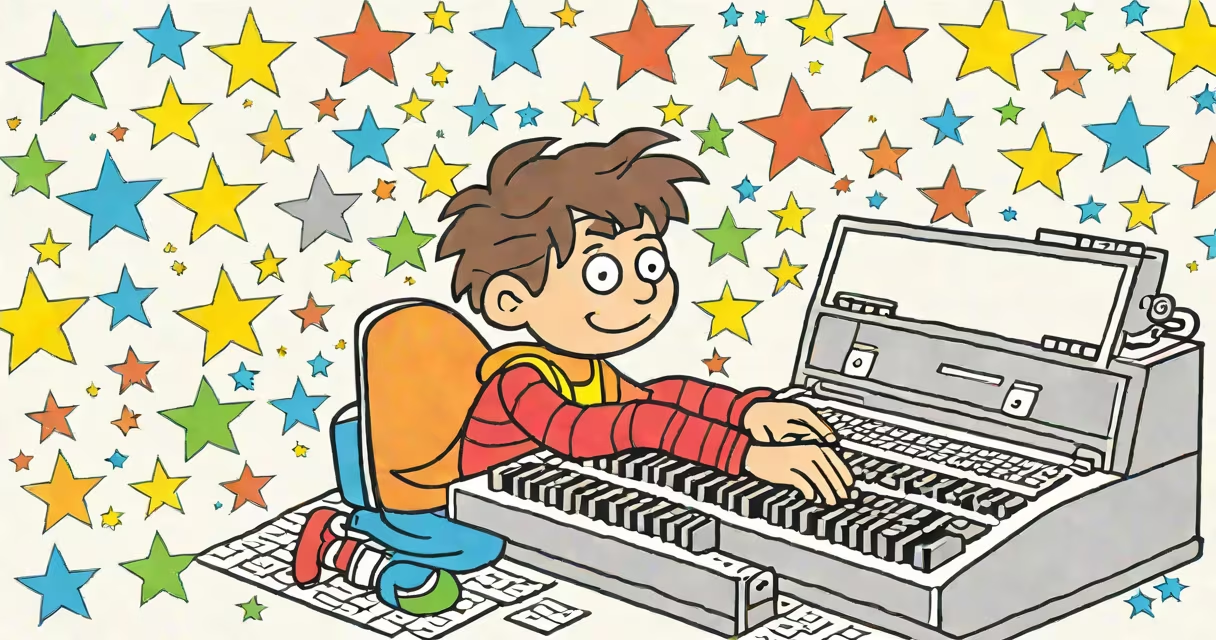
A typing game kids is an interactive digital activity that teaches children aged 6 to 12 how to type using letter recognition, proper finger placement, and increasing speed through gamified challenges. These games use timed races, word puzzles, and animated rewards to turn keyboard practice into engaging play.
Typing games for kids work by presenting on-screen targets-usually letters, words, or short phrases-that players must type accurately and quickly. As children progress, the difficulty increases through faster pacing, longer words, and distractions like moving objects or sound cues. Success is measured by accuracy, speed, and consistency, with immediate feedback via visual effects, points, or level unlocks.
Most typing game kids platforms use a combination of audio cues, color-coded keys, and animated avatars to reinforce correct hand positioning. For example, a child might see a green arrow pointing to the home row keys (A, S, D, F, J, K, L, ;), while a red flash appears when they press the wrong key. This visual and auditory reinforcement reduces errors and builds muscle memory over time.
Each typing game kids session begins with a tutorial that introduces the home row, finger assignments, and posture. Children learn to keep their wrists elevated and fingers curved, reducing strain during long sessions. After the basics, gameplay shifts to drills focused on specific letter groups-such as the "top row" (Q, W, E, R, T) or "bottom row" (Z, X, C, V, B).
Games often include timed levels where children must type 20 words in under 30 seconds. Scoring systems reward both speed and accuracy: a 95% accuracy rate with 40 words per minute earns a gold medal, while lower scores result in silver or bronze. Some platforms track progress over days, showing growth curves and suggesting targeted practice areas.
There are three primary categories of typing game kids based on structure and learning focus:
| Type | Focus | Best For | Example |
|---|---|---|---|
| Letter Recognition | Identifying letters and matching them to sounds or shapes | Pre-K to Grade 1 | "Find the Letter" with flashing keys and animal sounds |
| Word Drills | Typing short words and phrases under time pressure | Grades 2-4 | "Race the Robot" - type 10 words before the robot finishes |
| Story Mode | Progressive narrative with typing required to advance | Grades 3-6 | "Escape the Castle" - type passwords to enable doors |
Letter recognition games are ideal for early learners who haven't yet mastered letter shapes. They often use large, bold letters with phonetic audio clips-pressing "M" triggers "Mmm!" and shows a monkey jumping. Word drills emphasize repetition and timing, helping children develop automaticity. Story mode games combine literacy and keyboarding, reinforcing vocabulary and grammar alongside typing fluency.
Teachers use typing game kids to meet Common Core State Standards for writing and technology integration. According to the National Center for Education Statistics, 87% of U.S. public schools provide access to keyboarding instruction by Grade 3. Typing games reduce the cognitive load of learning to type by embedding practice into enjoyable tasks.
Parents report that consistent use of typing game kids improves homework completion times. One study by the University of Michigan found that students who played structured typing games for 15 minutes daily over six weeks showed a 38% increase in typing speed and a 22% drop in error rates compared to peers using traditional worksheets.
I tested a free version of a typing game kids app with my 7-year-old daughter during summer break. She typed "butterfly" in 4.3 seconds after five sessions. Her teacher later confirmed she was typing faster than most third graders in her school. The game's visual feedback-like confetti bursts for perfect accuracy-made her want to replay levels even after finishing.
Many assume typing game kids are just video games with keyboards. That's incorrect. While they use game elements, they're designed around pedagogical principles. Research from the Journal of Educational Technology & Society confirms that effective typing games for children follow a scaffolded sequence: identify → match → recall → apply.
Another misconception is that all typing game kids are free. Free versions often limit access to advanced levels or require parental email verification. Paid versions typically include offline modes, progress reports, and multi-user accounts for classrooms. Always check whether a game supports screen readers or colorblind modes-critical for inclusive design.
Some parents think typing game kids replace handwriting. They don't. The goal is complementary skill development. A 2021 study by the American Psychological Association found that children who practiced both handwriting and typing showed stronger writing fluency than those who focused on one alone.
Finally, not all games teach proper form. A game that only tracks speed without correcting finger position may lead to bad habits. Look for ones that show which finger should press each key-especially for the pinky and ring fingers, which are often misused.
typing game kids combines education and entertainment to build foundational keyboard skills in young learners. These tools support letter recognition, motor coordination, and digital literacy-all essential for academic success. When chosen carefully, they offer measurable progress and sustained engagement.